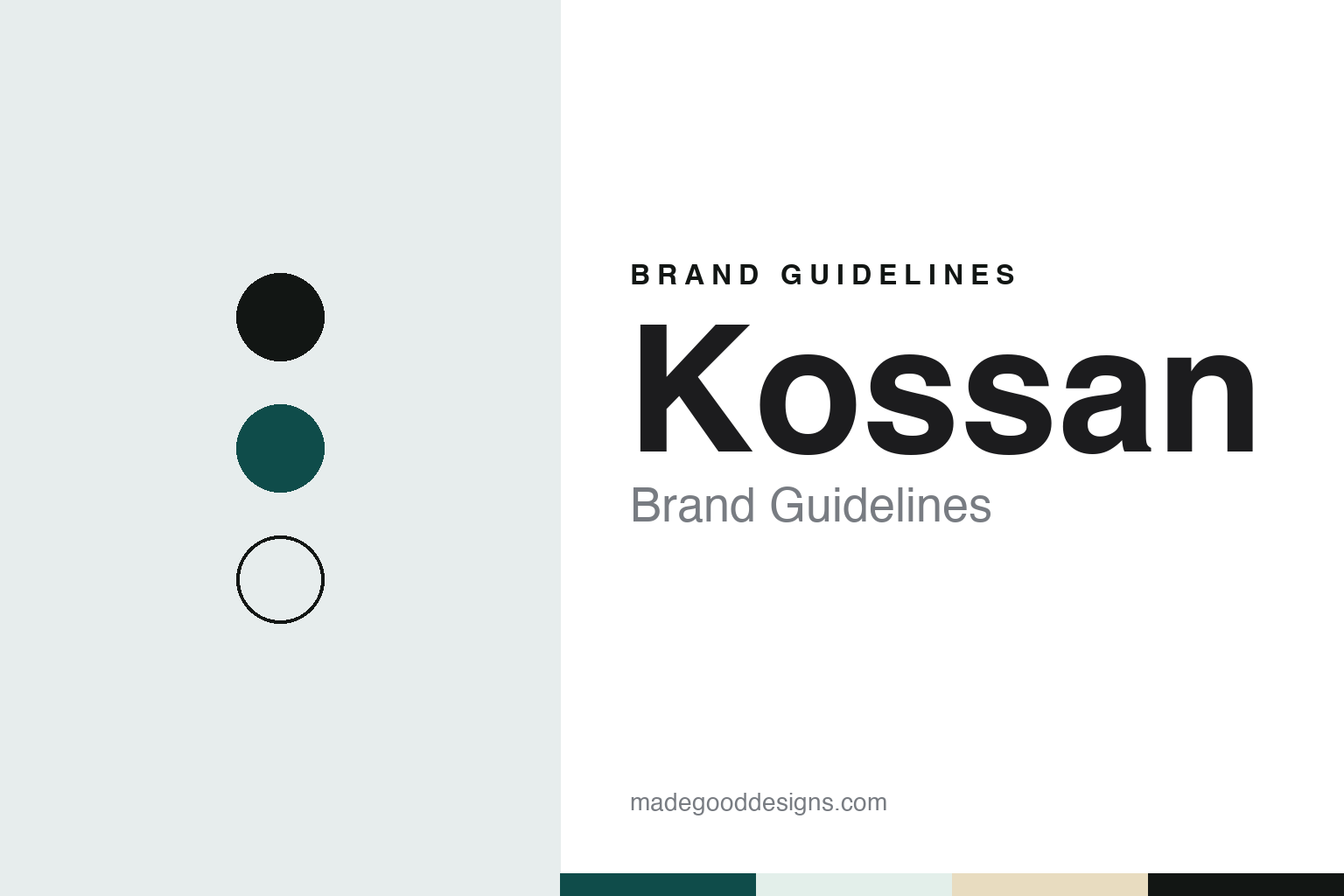
Kossan Brand Guidelines
The 1979 Klang rubber-bearing maker behind iNtouch gloves.
Aa
Two constants: a Kossan deep teal and pale mint palette and an Industrial sans register. Abstract homage — not a Kossan product or mark; no glove, box, logo or nameplate is reproduced.
Cutless bearings
A Klang rubber works, founded in 1979.
Kossan began in 1979 as a maker of rubber parts, not gloves. Malaysia’s trade-promotion agency MATRADE, in its directory of Malaysian brands, says Kossan Rubber Industries was founded that year to manufacture rubber cutlass bearings for fishing boats, and describes its founder, Lim Kuang Sia, as a chemist and an engineer. The Edge Malaysia reported in November 2016 that Lim had led the company since its inception in 1979, and that it had grown from a producer of marine rubber bearings into a maker of industrial rubber products and disposable latex gloves, exporting to more than 160 countries.
The company’s home was Klang, the port district west of Kuala Lumpur in Selangor. MATRADE lists Kossan at an address in Klang, and in August 2018, signing an agreement for a new factory in Perak, Lim told reporters that the site had been chosen partly because it was not far from the company’s headquarters in Klang, the Malay Mail reported. The company’s website now gives its head office as KOSSAN Tower in Setia Alam, in the neighbouring city of Shah Alam.
Gloves came a decade after the bearings. English Wikipedia says Kossan started making gloves in 1989, and lists among its subsidiaries Doshin Rubber Products, dated 1984, and Kossan Latex Industries, dated 1988. The Edge reported in 2016 that Kossan Rubber Industries Bhd had been listed on the then Main Board of Bursa Malaysia in 1996, and that Lim was an indirect substantial shareholder through his holding in Kossan Holdings, itself a substantial shareholder of the listed company. Kossan’s website carries the listed company’s investor information today.
Colour
Gloves, rubber parts and cleanrooms.
Kossan still presents itself as more than a glovemaker. Its website divides the business into three: technical rubber products, disposable rubber gloves and cleanroom disposable products. The technical side covers engineered, extruded and moulded rubber parts, and rollers for industry and printing. MATRADE lists printing, automotive, marine and construction among their uses, and says Kossan supplied rubber bearings for the Second Penang Bridge.
The glove business runs on two tracks. Under private label, or OEM, Kossan makes gloves that other companies sell under their own names. Under its own brands — what the company calls OBM — its website lists three names: iNtouch, for surgical and examination gloves; Confidenz, for halal examination and food-handling gloves; and Shirudo, for examination, industrial-safety and cleanroom use. MATRADE says the company makes latex and nitrile examination gloves for medical facilities and cleanrooms, and that more than 95% of its gloves are exported, to regions including the United States, Europe, South America and the Middle East.
The cleanroom line sits alongside, with the Shirudo cleanroom glove and a range of cleanroom disposables under the CleanEra name; English Wikipedia lists Cleanera among Kossan’s subsidiaries, with a Hong Kong arm. The company’s website lists the trade fairs where it appears in late 2026: MEDICA 2026 in Düsseldorf and the ISSA cleaning-industry show in Las Vegas, both in November, and a semiconductor and electronics exhibition in Manila in October — a spread that matches its mix of medical, industrial and cleanroom customers.
Kossan has leaned on patents. The Edge reported in 2016 that it had launched a patented “low derma” technology for synthetic gloves that September, and that it already held patents in Japan, China, Hong Kong and Taiwan. The same report said its first dedicated research and development centre was due to open in 2017, and that Lim saw automation as the way to reduce the company’s reliance on labour.
Typography
How glove makers present themselves.
Disposable gloves are among the most anonymous products in healthcare. They arrive in plain dispenser boxes, are worn for minutes and are thrown away, and most of the companies that make them sell to distributors, hospital buyers and other brands rather than to the public. Their visual identities are therefore built less around the product in use and more around the factory, the material and the scale of output.
The pictures repeat across the category. A gloved hand in blue or purple nitrile is held against a white ground; long dipping lines carry rows of ceramic hand-shaped formers through tanks of latex or nitrile; finished gloves are stripped, stacked and boxed; and dispenser boxes are piled into walls of colour, each size and material given its own shade. Cleanroom and hospital scenes supply the setting, with gowned staff, stainless steel and soft, even light.
Geography is part of the story. Malaysia and Thailand, both rubber-growing countries, are home to many of the makers in this series, and corporate material from the region often opens with aerial views of factory complexes, rows of long white sheds, alongside figures for lines, plants and annual capacity. Makers in China, Europe and elsewhere use the same vocabulary of automation, testing laboratories and certificates.
Trade fairs are where many of these brands meet their buyers. Stands at MEDICA in Düsseldorf and at the Dubai healthcare show long known as Arab Health tend to show stacked boxes, glove samples and product walls, with a company name in a clean sans and a colour that can carry from carton to booth. The guides in this series look at how individual makers handle that shared language.
Aa
An industrial sans for a rubber-products maker. (Specimen set in Archivo, a sans STAND-IN; NOT the Kossan logo.)
Kossan
A new Perak site and a recruitment-fee remediation.
Kossan’s growth has followed Malaysia’s glove trade. In August 2018 it signed an agreement with the Perak state’s economic development board to build an integrated glove factory at Bidor, in Perak, on land offered by the state, the Malay Mail reported; Lim said then that the company had almost four decades of history and sold its products in 190 countries. Its glove brands, its technical rubber and its cleanroom ranges have stayed under the one Kossan name since.
Kossan has also had to answer questions about how its migrant workers were recruited. In October 2020 it told the stock exchange it had finalised a remediation plan to repay recruitment fees paid by its migrant workers, after investigating the situation and consulting several stakeholders, and said it was committed to ensuring that they were “free from debt bondage” and forced labour, in line with a zero-cost recruitment policy it had already adopted, The Star reported. The plan was to run for 18 months. The same report noted that the US had imposed a detention order on gloves made by subsidiaries of Top Glove that July. In June 2021 Kossan said it had finalised the remediation and would pay the remaining balance in one lump sum by the end of that month, ahead of the original March 2022 schedule, The Star reported.
For a design guide, Kossan shows how a glovemaker can keep an industrial-rubber business, its own glove brands and a contract-manufacturing trade under one plain corporate name. Compare Top Glove, another Malaysian glovemaker, and Hartalega. For this guide we use a deep teal, a pale mint and a latex cream with a sans, an unofficial interpretation; no product or logo is reproduced.
Explore & save
Keep Kossan’s identity on hand — save it to a board in the Made Good inspiration library.
Kossan identity set
Pin the Kossan deep teal, pale mint and latex cream palette and the Industrial sans register to your own board.