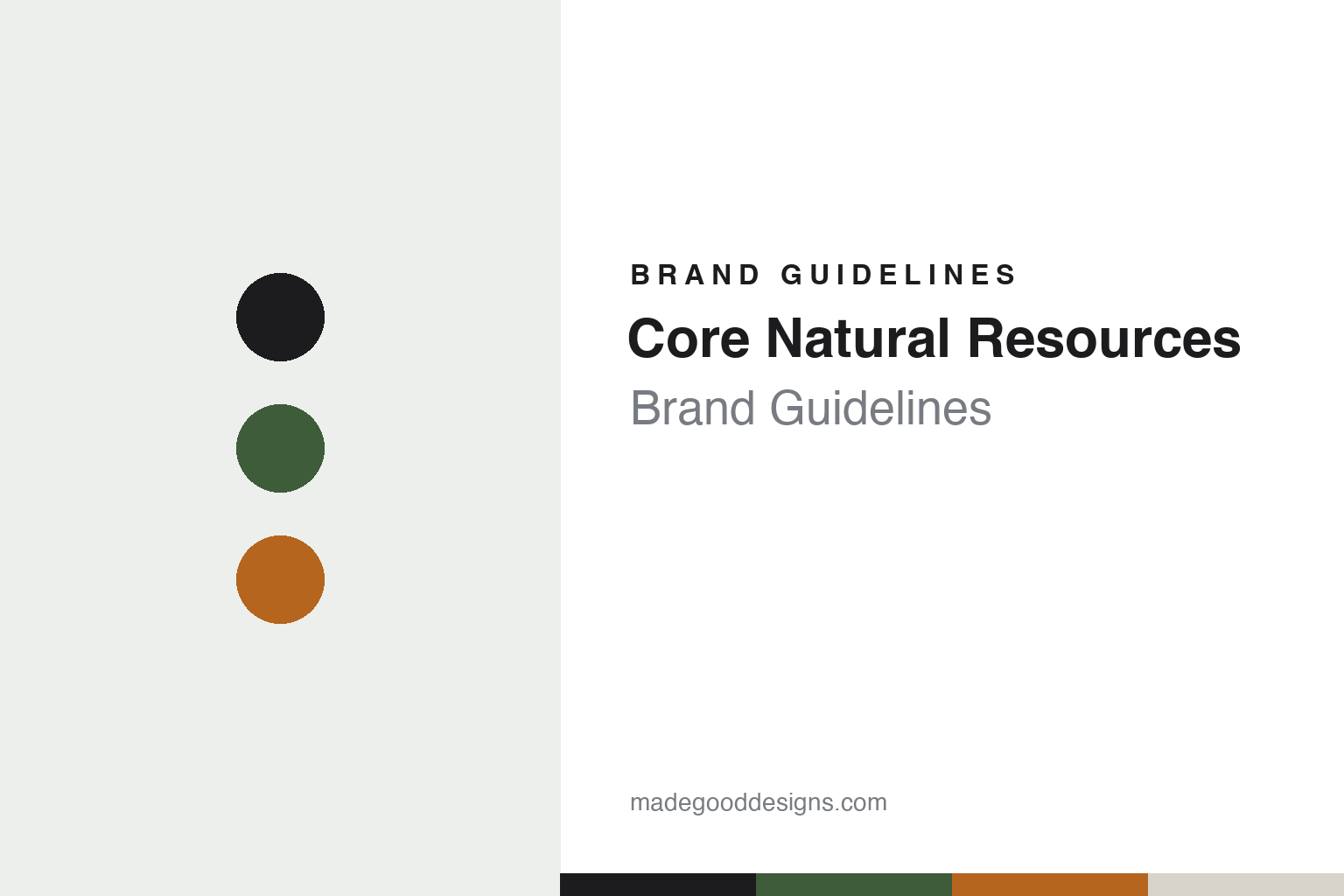
Core Natural Resources Brand Guidelines
Two old coal companies under one new name.
Aa
Two constants: a seam black, Appalachian green and furnace amber palette and a sturdy serif register. Abstract homage — not a Core Natural Resources product or mark; no logo, sign or wordmark is reproduced.
Consolidation
A western Maryland coal company and its successors.
Core Natural Resources is a United States coal producer formed in January 2025 by the merger of two older companies, CONSOL Energy and Arch Resources. Its own history page traces CONSOL and its predecessors to coal mining in 1864, and Arch to 1969.
CONSOL’s roots are in western Maryland. English Wikipedia says several small mining companies there combined in 1860 as the Consolidation Coal Company, which was formally established in 1864 and kept its headquarters in Cumberland, Maryland, until 1945. In 1909 it joined with the Fairmont Coal Company of West Virginia and the Somerset Coal Company of Pennsylvania, and in 1945 it merged with the Pittsburgh Coal Company and moved its headquarters to western Pennsylvania. The oil company Conoco bought Consolidation Coal in 1966, and DuPont acquired Conoco, coal business included, in 1981.
On 20 November 1968 an explosion struck the company’s Consol No. 9 mine north of Farmington, West Virginia. English Wikipedia says the cause was never determined and that the disaster became the catalyst for several new laws to protect miners.
CONSOL Energy itself was created in 1991 as a joint venture between DuPont and the German energy company Rheinbraun; DuPont sold most of its stake in 1998, and the company went public in 1999. It moved into natural gas in the 2000s, and in 2017 the two businesses separated: the gas company became CNX Resources, while the coal business became a separate listed company, CONSOL Energy Inc., announced on 29 November 2017. Its main operation was the Pennsylvania Mining Complex of three underground mines, alongside a coal export terminal in Baltimore.
Colour
Arch Mineral, Ashland Coal and Arch Resources.
Arch has a shorter but busier history. English Wikipedia says Arch Mineral was formed in 1969 as a partnership between Ashland Oil and the Hunt family of Dallas, and that Ashland Coal was set up in 1975 as a subsidiary of Ashland Oil. The two merged in July 1997 to form Arch Coal, a combination Core’s website also calls a merger of equals.
The company moved west in June 1998, buying the coal assets of Atlantic Richfield, among them the Black Thunder mine in Wyoming’s Powder River Basin and the West Elk longwall mine in Colorado. In 2009 it bought Rio Tinto’s Jacobs Ranch mine and joined it to Black Thunder, and in June 2011 it acquired International Coal Group. In January 2016 Arch Coal filed for Chapter 11 bankruptcy protection as part of a debt restructuring; it emerged on 5 October 2016 and returned to the New York Stock Exchange. On 15 May 2020 it changed its name to Arch Resources, a change Core says was meant to underline the growing weight of metallurgical coal in its sales.
In August 2024 the two companies announced an all-stock merger of equals. The Observer-Reporter of Washington, Pennsylvania, reported on 15 January 2025 that Core Natural Resources had announced the completion of the merger the day before, after more than 99% of each company’s voting shareholders had backed it. The newspaper reported that Core would be headquartered in Canonsburg, Pennsylvania, and would trade on the New York Stock Exchange as CNR; English Wikipedia says Arch shares stopped trading before the market opened on 14 January 2025.
Typography
Coal producers and their identities.
Coal companies rarely sell to the public, so their identity work is aimed at investors, governments, customers in power and steel, and the communities around their mines. The visual language that follows is one of scale: draglines working an open pit, haul trucks on benched slopes, trains on loading loops and ships at export terminals. Peabody’s own description of itself as a supplier of “essential products for the production of affordable, reliable energy and steel” names both of the markets those pictures serve.
Alongside the pit photography sits a second register: the land after mining. Producers publish reclamation and rehabilitation pages, biodiversity and water sections, and reports on safety and community relations. Peabody, for example, groups climate, land, water, safety, human rights and cultural heritage under one sustainability menu on its website, and says it plans progressive restoration of land disturbed by mining.
A third theme is the future of the product itself. Thermal coal for power and metallurgical coal for steelmaking are often reported as separate businesses; Peabody, for instance, lists its mines under “Seaborne Metallurgical,” “Seaborne Thermal,” “Powder River Basin” and “Other U.S.” headings. Some producers point to other energy projects; Coal India, for one, describes a solar project in Gujarat on its own website. How much weight a company gives each story varies, and the guides in this round report what each one says rather than judging it.
The most consistent document in the category is the annual report, with its maps of mines, its tables of operations and its photographs of crews and equipment. For a designer, that report is often the clearest record of how a coal company wants to be seen: the identity is less a logo than a set of repeated scenes, from the open cut to the rail line to the restored hillside.
Aa
A sturdy serif for a short, plain name. (Specimen set in IBM Plex Serif, a serif STAND-IN; NOT the Core Natural Resources logo.)
Core
Metallurgical and thermal coal, and two terminals.
Core describes itself as a producer and exporter of metallurgical and high calorific value thermal coals. At completion the Observer-Reporter reported that the combined company owned 11 mines, including the Bailey, Enlow Fork and Harvey mines in Washington and Greene counties, a complex CONSOL called the largest underground mine complex in North America. Core’s website lists operations in six states, a workforce of more than 5,000, the CONSOL Marine Terminal in Baltimore and an ownership interest in the DTA terminal in Norfolk, Virginia; it calls Black Thunder one of the largest coal mines in the world.
The first year brought an interruption. On 13 January 2025, the day before the merger closed, the company confirmed that longwall mining at the Leer South metallurgical mine in Barbour County, West Virginia, had stopped because of “combustion-related activity” in a previously mined area, North American Mining reported on 31 December 2025. The magazine reported that the longwall restarted in December 2025, after the main equipment was recovered and the affected area was permanently sealed.
The new name sits over two long histories. Core’s website introduces the company with the line “We are Proud Coal Miners” and names three first principles — safety, sustainability and continuous improvement — while the CONSOL name lives on in CONSOL Innovations, the part of the business its website presents for carbon-based products such as coal composite decking. The site also keeps Arch’s and CONSOL’s reports for 2023 as legacy sustainability documents.
For a design guide, Core Natural Resources shows a merged company choosing a short new name while keeping a predecessor’s name for a product line. Compare Peabody and Alliance Resource Partners, two more United States coal producers. For this guide we use a seam black, an Appalachian green and a furnace amber with a serif, an unofficial interpretation; no product or logo is reproduced.
Explore & save
Keep Core Natural Resources’s identity on hand — save it to a board in the Made Good inspiration library.
Core Natural Resources identity set
Pin the Core Natural Resources seam black, Appalachian green and furnace amber palette and the sturdy serif register to your own board.


