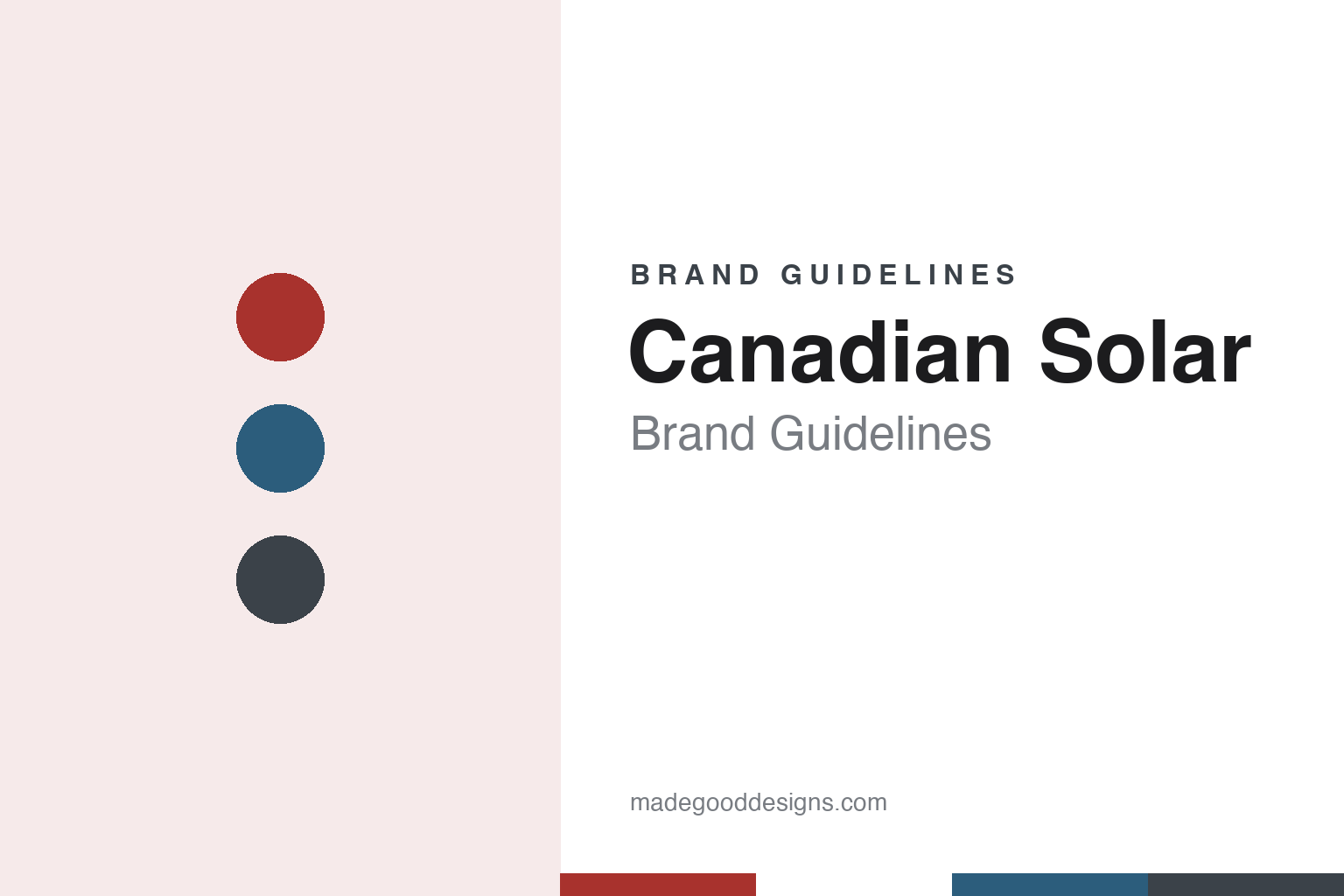
Canadian Solar Brand Guidelines
An Ontario start, a Nasdaq ticker and factories on several continents.
Aa
Two constants: a maple red, lake blue and slate palette and a plain public sans register. Abstract homage — not a Canadian Solar asset or mark; no logo, wordmark or lettering is reproduced.
From Guelph
A founder, an Ontario start and a Nasdaq listing, 2001 to 2021.
Canadian Solar dates from 2001. SolarQuarter, reporting on 15 January 2025, said the company was founded that year by Dr. Shawn Qu in Guelph, Ontario, and English Wikipedia gives the same founder, year and town. The company’s own about page says simply that Canadian Solar Inc. was founded in 2001 in Canada. In the 2025 report Qu, then described as chairman and chief executive, said the company’s roots remained deeply embedded in Ontario, “where our journey began 23 years ago.”
The company went public five years later. English Wikipedia says it listed on the Nasdaq in November 2006 under the ticker CSIQ, and the company says it has been publicly listed there since 2006. Its business grew in two directions: making modules and building the projects they go into. English Wikipedia says Canadian Solar entered project development in 2010 and in 2015 bought the solar developer Recurrent Energy from Sharp, a subsidiary it moved to Austin, Texas, in 2021.
Its supply record is tied to large solar parks. English Wikipedia lists modules for the Senftenberg/Schipkau solar park in Brandenburg, Germany, in 2011, and for the Grand Renewable Solar Project in Ontario in 2015, and says the company developed the Cafayate solar plant in Argentina’s Salta Province, which opened in 2019. In 2017, the same source says, Canadian Solar listed an infrastructure fund on the Tokyo Stock Exchange to hold solar plants built by its subsidiaries in Japan.
Colour
A Shanghai listing, storage units and a new head office, 2022 to 2025.
The group has split its businesses into named units. English Wikipedia says its manufacturing subsidiary, CSI Solar, completed an initial public offering and began trading on the Shanghai Stock Exchange in June 2023; pv magazine described CSI Solar in December 2025 as Canadian Solar’s majority-owned, China-listed subsidiary based in Suzhou. In July 2023, according to English Wikipedia, the utility-scale battery storage unit was renamed from CSI Energy Storage to e-STORAGE, and in September 2022 the company launched a home battery system, the EP Cube.
Factories followed in North America. English Wikipedia says Canadian Solar announced its first US manufacturing plant, a module factory in Mesquite, Texas, in June 2023, and a battery plant at Shelbyville, Kentucky, in November 2024. It lists production facilities in the United States, Canada, China, Indonesia, Vietnam and Brazil, making ingots, wafers, cells and modules among other products.
The head office moved within Ontario. SolarQuarter reported on 15 January 2025 that Canadian Solar had opened a new global headquarters in Kitchener, to serve as the corporate hub and to house e-STORAGE and the module sales and services units; the mayor of Kitchener and local members of parliament welcomed the move in the same report. The company’s contact page lists Kitchener as its global headquarters, with offices for its storage and project businesses in the United States, Europe, Latin America and the Asia-Pacific region.
Its supply chain has drawn scrutiny. In May 2022, pvBuzz reported that the company had promised an independent investigation into whether any workers in its supply chain were there against their will, after a subsidiary of a major supplier, GCL-Poly Energy Holdings, was sanctioned by the US government over allegations of forced labour. The same report said the company had earlier told a shareholder activist firm that such an assessment was impossible.
Typography
Modules on roofs and fields.
Solar panel makers sell a product that looks much the same from a distance: a dark rectangle of glass divided into a grid of cells. Their visual identities work around that sameness. Company websites and brochures return again and again to a few scenes — black or blue module grids on house roofs, long rows of panels across desert or farmland at utility-scale plants, and close-ups of individual cells, where the fine lines of the metal contacts, or their absence, become the detail that sets one technology apart from another.
The factory is the second stage set. Makers show clean production lines, robotic handling and testing laboratories, and they name their cell technologies — TOPCon, heterojunction, back contact — the way other industries name materials. Product families are given short, branded names, and colour is used sparingly: a corporate blue, green or orange against white, with the dark face of the module doing most of the visual work.
Because most panels reach homes and businesses through others, makers also speak to installers. Partner programmes, installer training, distributor networks and warranty pages appear prominently on their websites, addressed to the people who specify and fit the panels.
Trade fairs are where the industry shows itself in public. Intersolar Europe at the Messe München and SNEC in Shanghai draw module makers from China, Europe, North America and elsewhere, who use large booths to launch new module families, storage systems and inverters side by side. This guide sets out what can be checked about each maker — where it began, who owns it, and what it makes — and marks clearly what rests only on the company’s own word.
Aa
Plain public sans — after the straightforward lettering of a name that states its country. (Specimen set in Public Sans, a sans STAND-IN; NOT the Canadian Solar logo or any Canadian Solar lettering.)
Canadian Solar
A country in the name, module families and a US joint venture.
The name states a home country, though the work is spread far wider. The company’s about page describes it as a supplier covering modules, inverters and battery storage, and its product menu groups modules into families such as Bifacial, Dual Cell, HiDM and All Black. English Wikipedia says its standard modules use N-type TOPCon cells that take in light from both sides of the panel. The storage side carries separate names: e-STORAGE for utility-scale systems and EP Cube for homes.
The US business was restructured in December 2025. pv magazine reported on 3 December 2025 that Canadian Solar would form a joint venture, CS PowerTech, to run its US manufacturing and sales of solar modules, cells and e-STORAGE systems, holding a controlling 75.1 per cent stake and moving these assets out from under CSI Solar. In July 2026, according to a report by the German news service IWR republished by Renewable Energy Industry on 28 August 2026, the company started the first phase of a heterojunction cell plant in Jeffersonville, Indiana, which it called the first commercial-scale plant of its kind in the United States; the same report said the Mesquite module plant had been expanded.
The company lists industry recognition on its about page, including BloombergNEF Tier 1 status for its modules since 2016 and an Environmental Finance award for a green project bond in 2024. English Wikipedia adds that Environmental Finance gave the company a reporting award for its 2023 sustainability report.
For a design guide, Canadian Solar shows how a plain, place-based name can hold together manufacturing, storage and project-development units spread across several continents. Compare JinkoSolar, the module maker from Shangrao, China, and LONGi, the Xi’an solar company. For this guide we use a maple red, a lake blue and a slate with a sans, an unofficial interpretation; no product or logo is reproduced.
Explore & save
Keep Canadian Solar’s identity on hand — save it to a board in the Made Good inspiration library.
Canadian Solar identity set
Pin the Canadian Solar maple red, lake blue and slate palette and the plain public sans register to your own board.