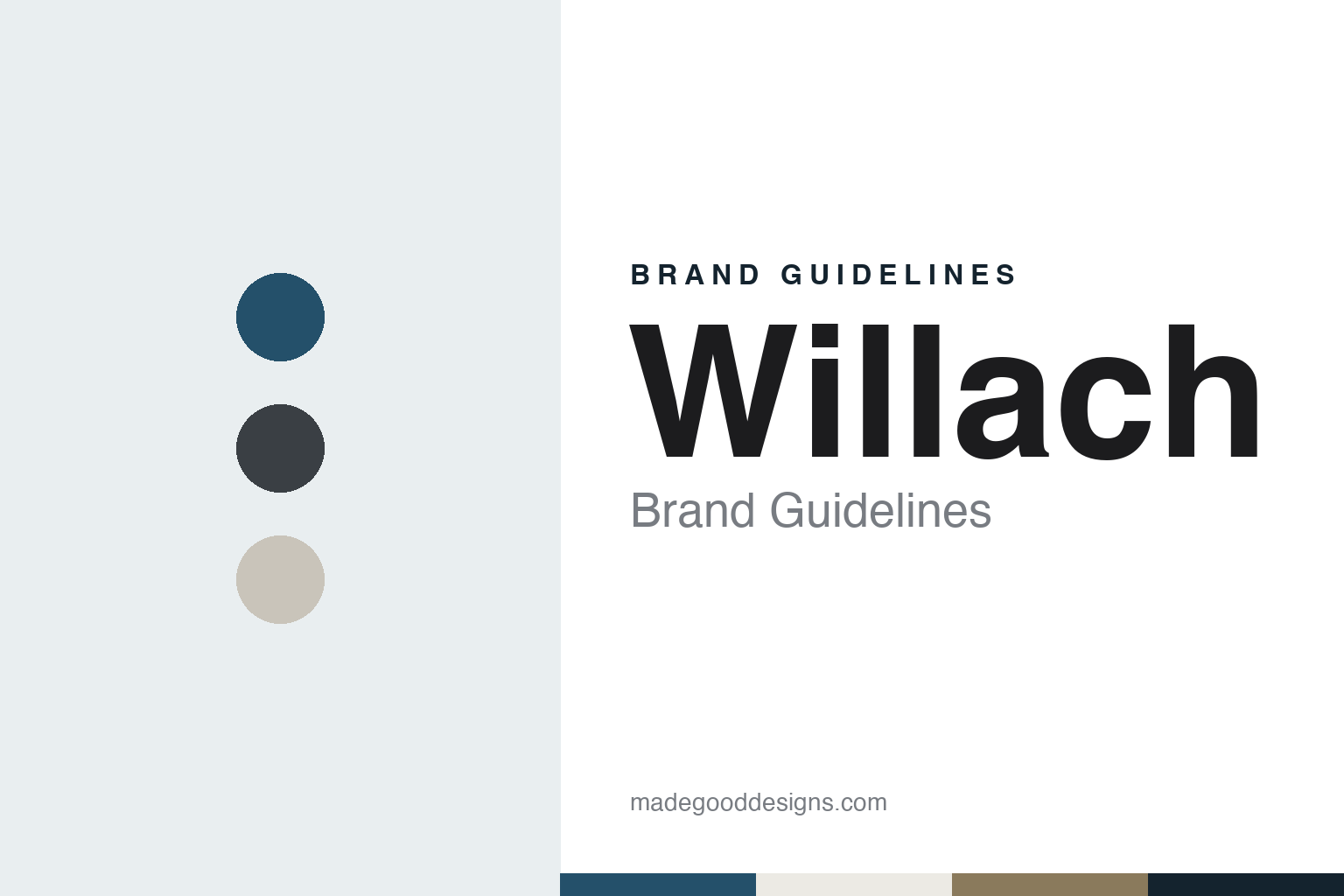
Willach Brand Guidelines
From locks and fittings in a Rhineland village to pharmacy drawers and robots.
Aa
Two constants: a Willach steel blue, graphite and warm grey palette and an engineered sans register. Abstract homage — not a Willach product or mark; no drawer, robot, logo or nameplate is reproduced.
Gebr. Willach
Two brothers, locks and fittings in a Rhineland village.
Willach began in 1889 in Ruppichteroth, a small municipality near Cologne in North Rhine-Westphalia. German Wikipedia and the company’s own anniversary history agree that the brothers Hugo and Otto Willach founded Gebr. Willach — “Willach Brothers” — that year as a trade in locks and fittings. Their family had married into the village in 1764, and their father, Wilhelm Willach, had built up a general store with branches in neighbouring towns.
The brothers soon moved from selling to making. The company history says that in the early twentieth century they hired skilled craftsmen from Velbert, a lock-making town, to train local workers, and built their first production hall in 1903. German Wikipedia adds that the factory generated its own electricity from 1904 and ran its own sawmill, turnery and paint works. Staff numbers reached 75 by 1914, the history says.
War interrupted the business twice. According to the company history, conscription in the First World War cut the workforce, and production stopped completely from 1915 to 1918; during the occupation of the Rhineland, German Wikipedia says, a branch in Cologne kept sales going. In 1926 the founders separated. Otto Willach and his son Friedrich Wilhelm kept the Gebr. Willach name and built a new works up the hill, while Hugo founded Hugo Willach & Söhne, renamed HUWIL in 1952 — a separate furniture-fittings maker that the British group Titus took over in 2006 and 2007, German Wikipedia says.
The Second World War is described in the company’s 125th-anniversary history, published in 2014, which draws on an earlier centenary history by Dagmar Hohn. It says the late 1930s were boom years, that a branch opened in Valencia had its goods confiscated during the Spanish Civil War, and that after 1939 the firm lost many staff and kept up low-level production with a handful of women. It says materials were scarce because Willach made nothing essential to the war effort, and that towards the end of the war a Bonn company making Nazi medals and insignia was billeted on its premises; after the war, Allied troops searching the site found the emblems and wrecked the offices. Production restarted under Allied permits, and the history dates a return to normal business to the 1948 currency reform.
Colour
From shop fittings to pharmacy drawers.
After the war Willach turned to shop fitting. Its history says that in the 1950s aluminium shop fittings — many of them for frameless glass sliding doors — made up most of its sales, and that in the early 1960s it developed the Gewiru Box, a steel-framed shelving system for shops. Also in the early 1960s, at an architect’s suggestion, it made pull-out cabinets for pharmacies; German Wikipedia dates the start of its pharmacy storage business to 1963.
The step that shaped the company came in 1969, when Willach launched its first FAMA pharmacy drawer system, then called System 3000. The history says drawers quickly displaced pull-out cabinets and that demand soon outran production. FAMA is still the name of its drawer and shelving ranges: the large-capacity FAMA 7007 GX drawer reached the market in 1994, and FAMA shelving followed from 2005, the company says.
Glass fittings became the second business. In 1986 Willach launched the VITRIS Supra showcase fitting, and in 2009 the Portavant sliding-door fitting; the company says an automatic version, the Portavant 80, won a Red Dot design award in 2013. The history says VITRIS was given its own brand presence in 2006 so that it would not be overshadowed by the pharmacy business.
After German reunification Willach opened a second production site at Burgstädt in Saxony, renting a building in 1992 and building its own from 1997, according to the company history; German Wikipedia also records the eastern plant.
Typography
Design and documentation.
Pharmacy automation is a business of quiet machines in busy rooms, and the companies that make them tend to present themselves through the places their equipment stands. The most familiar image is the automated dispensing cabinet: a tall, mostly white unit of locked drawers and a touchscreen, photographed on a hospital ward or beside a nurses’ station, often with a clinician mid-task rather than posed for the camera.
Behind the counter the imagery changes. Central-pharmacy and retail robots are usually shown as robotic arms behind glass, picking boxes from dense shelving or filling vials in long rows, while pouch packagers are pictured in close-up: a strip of clear pouches, each printed with a name and a time, unspooling from the machine. IV compounding robots appear inside clean enclosures, with syringes and vials arranged with laboratory precision.
People appear at the edges of these pictures. The standard scene is a pharmacist or technician at a touchscreen, scanning a barcode or checking a screen of data, and the wording around it leans on workflow, inventory and time returned to patient care. Colour palettes in the category are usually restrained, with whites, light greys and a single corporate blue, green or teal, and typography tends toward a plain sans that reads well on screens and spec sheets.
Much of the category’s presentation happens in person. Makers show their cabinets, carts and robots on stands at trade events such as the ASHP Midyear Clinical Meeting in the United States, the NACDS events for American chain pharmacy and Expopharm in Germany, where visitors can watch the machines run. The guides that follow look at how individual companies in this field set out their names, colours and type.
Aa
An engineered sans for a maker of drawers, robots and fittings. (Specimen set in Archivo, a sans STAND-IN; NOT the Willach logo.)
CONSIS
Robots, a sales company and the fourth generation.
Automation began as a joint project. The company history says that from 1992 Willach worked with partners on a storage robot for pharmacies, the Pharma Shuttle, shown at trade fairs from 1994; when that partnership broke up, Willach took full ownership of the development in 1998. Its CONSIS robots followed: channel robots for fast-moving packs from 2001, a C module for slow-moving packs first installed in 2003, and later B, D and E modules — the D module developed for high-volume hospital dispensing in China, where a joint venture was founded in 2009. The company now also sells CONSIS Dose systems, including the CONSIS.ATP pouch packager.
In 2007 Jens Willach and a fellow manager founded Willach + Heise GmbH as a sales and service company for pharmacies; it was renamed Willach Pharmacy Solutions GmbH at the end of 2009, and “Willach Group” was adopted as the umbrella brand, the history says. Subsidiaries followed in Australia and, in 2010, in Birmingham as Willach UK Ltd. German Wikipedia says that since 2009 the siblings Sonja Früh (née Willach) and Jens Willach have run the companies as managing partners — the fourth generation of the family.
The group’s head office and production remain in Ruppichteroth. The company says Gebr. Willach develops and makes its pharmacy storage systems and VITRIS glass fittings there, describes its products as “made in Germany”, and says it sells to more than 50 countries and employs more than 200 people across the group.
For a design guide, Willach shows how one family name can carry separate product brands — FAMA, CONSIS and VITRIS — across very different markets. Compare BD and Omnicell. For this guide we use a steel blue, graphite and a warm grey with a sans, an unofficial interpretation; no product or logo is reproduced.
Explore & save
Keep Willach’s identity on hand — save it to a board in the Made Good inspiration library.
Willach identity set
Pin the Willach steel blue, graphite and warm grey palette and the engineered sans register to your own board.