Tosho Brand Guidelines
Tokyo’s 1971 dispensing-machine maker behind Xana.
Aa
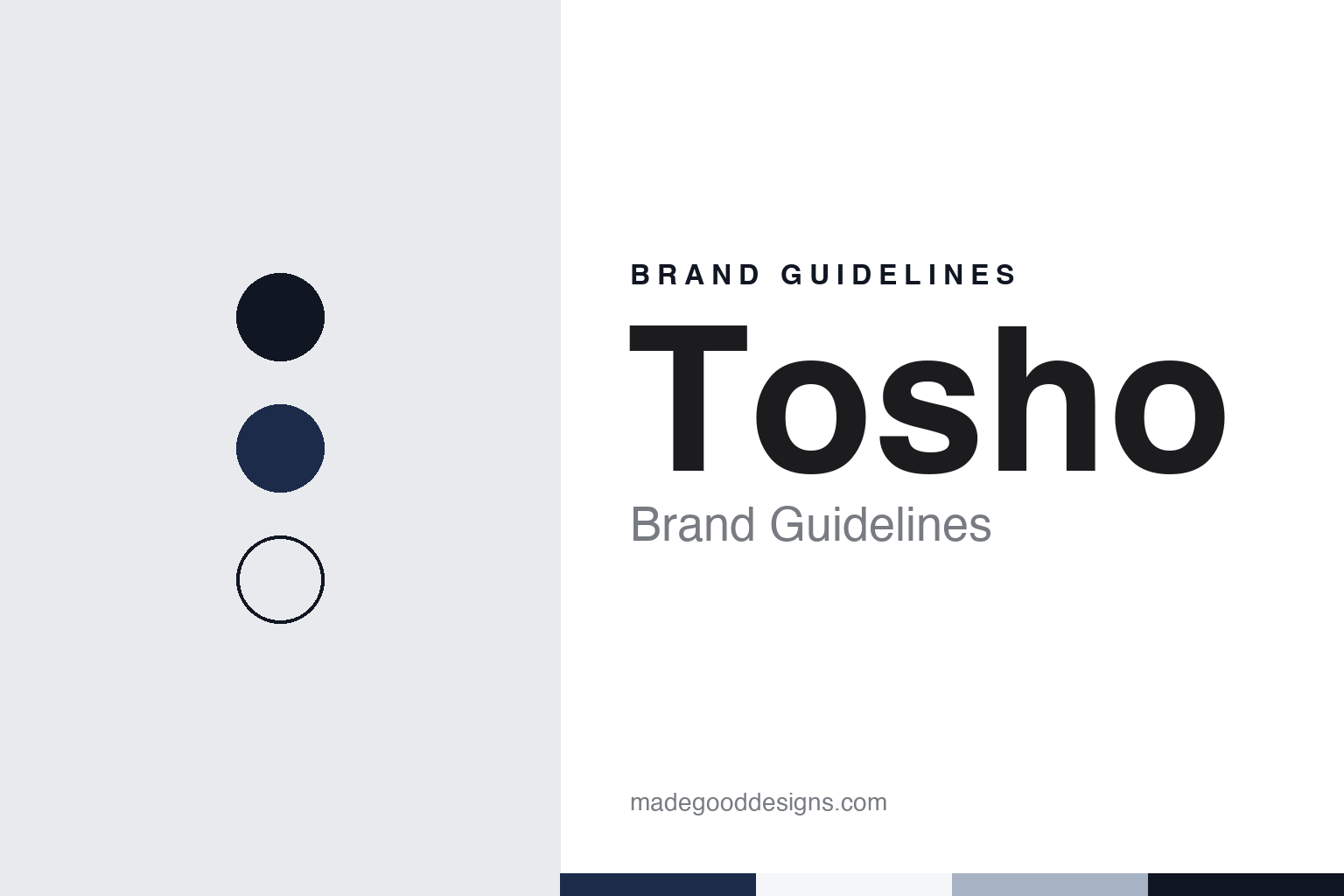
Two constants: a Tosho navy, white and blue-grey palette and a clean sans register. Abstract homage — not a Tosho product or mark; no machine, logo or pouch is reproduced.
Tokyo Shokai
A 1971 merger in Tokyo’s pharmacy trade.
Tosho began on 1 April 1971 in Tokyo. Its company history says three businesses — Tokyo Bunpoki, a packaging-machine firm, Tokyo Shokai and a firm called Winning — were merged to form Tokyo Shokai Co., Ltd., which made and sold automatic medicine-packaging machines from the start. In the president’s greeting on its website the company puts the beginning more simply: it started in 1971 as a wholesaler of the paper used to wrap powdered medicines, moved into making packaging machines and later into developing dispensing systems. The Worldfolio, in an April 2023 article on the company, also dated its foundation to 1971.
The 1970s and 1980s brought a widening range of pharmacy equipment. The history lists clean hoods and dust collectors in 1974, the MERIX series of dispensing counters and fittings in 1976 and the OMP fully automatic powder packagers in 1978. In April 1979 the company bought land at Higashi-Kojiya in Tokyo’s Ota ward and moved its head office and main factory there; a factory at Isesaki in Gunma followed in 1983 and a paper-converting plant in Niigata in 1984. The Main-TOPRA fully automatic tablet packagers, built around sliding cabinets, arrived in 1985, and the history records that it began online links between hospital host computers and pharmacy departments in 1987.
The company took its present name, Tosho Inc., in April 1992, according to its history. A new head-office building at Higashi-Kojiya was completed in 1994, and another in 2014, with the move in January 2015.
Colour
Xana, the pouch machine for export.
The product most associated with Tosho abroad is Xana, a family of fully automatic tablet packagers. The Worldfolio described Xana in 2023 as the company’s core business: a dose-dispensing machine that prints the patient’s name, a QR code and the medicine on each pouch. The company history dates the Xana series to April 2004. The compact Xana-1360 followed in 2005, and in April 2006 Tosho presented the higher-capacity Xana-4001U2 for the European market, with a domestic version in 2008. The Xana-UF series was announced in March 2020, and the English website, updated in 2025, features the Xana-4001U2 Advance and the Xana-100.
Export came before Xana. Tosho’s overseas page says its first tablet packager abroad went to a hospital in Taiwan in the 1980s, after which the business spread to Thailand, Singapore and China. In the 1990s, it says, machines supplied to Sweden’s largest state pharmacy led to dedicated dose-dispensing centres, a model that spread to the Nordic countries, the Netherlands, Australia and the United States. The history records CE marking for an export model, the YNS, in February 1997, and for the Leader 4001 in December 2002. In Japan the practice is called ippoka, packing medicines taken at the same time into one pouch; Tosho uses the English term “dose dispensing” abroad.
At home the range is wider. The history lists the UNIPUL automatic injection-drug dispensers from 1995, with the UNIPUL-5000 in 2015, and the mille automated dispensing shelf of 2009. The Ai series of combined tablet-and-powder packagers followed in 2016, and in 2017 a fully automatic tablet packager with the long name Ci-2680 Entrance MoonPhase60. Recent launches are powder machines: the Elen-01 weighing powder packager in 2023 and the Mi series in 2024. The Worldfolio reported that in Japan and elsewhere in Asia Tosho served mainly hospitals, and that abroad it then offered only its pouch machines, with injection-drug dispensers a hoped-for later step.
Typography
Machines behind the counter.
Pharmacy automation is a business of quiet machines in busy rooms, and the companies that make them tend to present themselves through the places their equipment stands. The most familiar image is the automated dispensing cabinet: a tall, mostly white unit of locked drawers and a touchscreen, photographed on a hospital ward or beside a nurses’ station, often with a clinician mid-task rather than posed for the camera.
Behind the counter the imagery changes. Central-pharmacy and retail robots are usually shown as robotic arms behind glass, picking boxes from dense shelving or filling vials in long rows, while pouch packagers are pictured in close-up: a strip of clear pouches, each printed with a name and a time, unspooling from the machine. IV compounding robots appear inside clean enclosures, with syringes and vials arranged with laboratory precision.
People appear at the edges of these pictures. The standard scene is a pharmacist or technician at a touchscreen, scanning a barcode or checking a screen of data, and the wording around it leans on workflow, inventory and time returned to patient care. Colour palettes in the category are usually restrained, with whites, light greys and a single corporate blue, green or teal, and typography tends toward a plain sans that reads well on screens and spec sheets.
Much of the category’s presentation happens in person. Makers show their cabinets, carts and robots on stands at trade events such as the ASHP Midyear Clinical Meeting in the United States, the NACDS events for American chain pharmacy and Expopharm in Germany, where visitors can watch the machines run. The guides that follow look at how individual companies in this field set out their names, colours and type.
Aa
A clean sans for a Tokyo maker of pharmacy machines. (Specimen set in Manrope, a sans STAND-IN; NOT the Tosho logo.)
Tosho
A family company in Ota ward.
Tosho is privately held. In the April 2023 Worldfolio article its president, Yoshihito Omura, described it as a family business able to plan for the long term without worrying about immediate profits, unlike a listed company. The company history records that he became president in September 2020. The same history notes that the company obtained ISO 27001 information-security certification in December 2020. The head office and showroom remain at Higashi-Kojiya in Ota, and the company lists branches across Japan from Sapporo to Kyushu; it says it employs about 700 people.
Tosho’s mission line, used in Japanese and English on its website, is “Your best pharmacy solution.” Its overseas page closes on another English phrase, “It works, TOSHO works,” and its English site opens with “Shaping the Future with You.” The company says its machines now reach 28 countries and regions, and names the Middle East, India and Africa as newer markets. The Worldfolio reported in 2023 that Tosho had begun selling in the United States about five years earlier, through distributors and OEM partner companies, and that it treated the American market as its next target.
One domain trap: the company’s website is at tosho.cc, while the similar tosho.co.jp address points to an unrelated company.
For a design guide, Tosho shows how a long-established equipment maker carries a family company’s plain name, alongside product names such as Xana and UNIPUL. Compare YUYAMA, another Japanese maker of dispensing machines, and JVM, the Korean maker of pouch packagers. For this guide we use a deep navy, a soft blue-grey and a cool white with a sans, an unofficial interpretation; no product or logo is reproduced.
Explore & save
Keep Tosho’s identity on hand — save it to a board in the Made Good inspiration library.
Tosho identity set
Pin the Tosho navy, white and blue-grey palette and the clean sans register to your own board.