FuelCell Energy Brand Guidelines
The Danbury research firm that became a carbonate fuel cell power-plant brand.
Aa
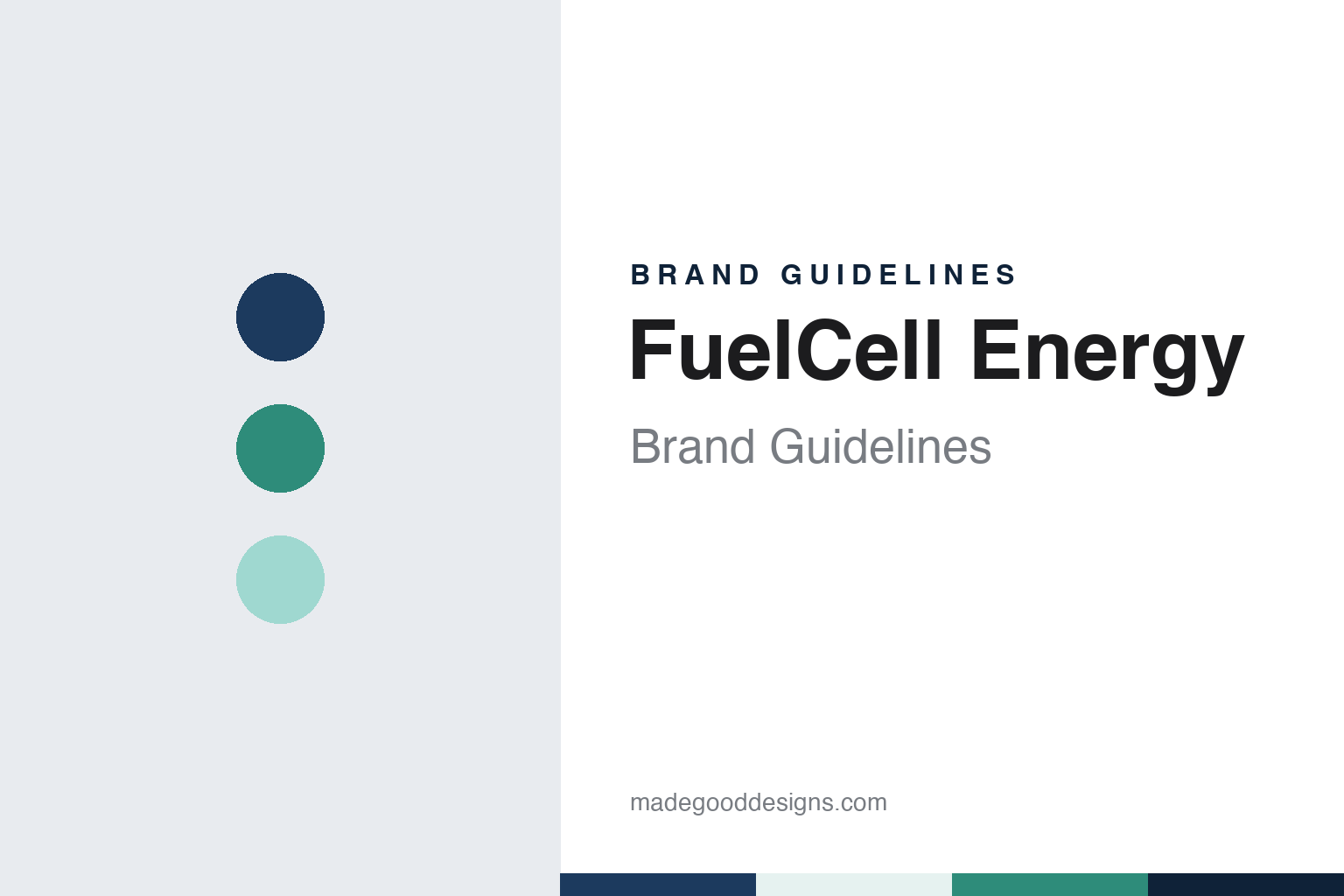
Two constants: a FuelCell Energy navy, teal and aqua palette and an Industrial sans register. Abstract homage — not a FuelCell Energy product or mark; no power plant, logo or nameplate is reproduced.
Energy Research Corporation
A small laboratory in Danbury.
FuelCell Energy began as Energy Research Corporation. English Wikipedia says it was founded in 1969 by the chemical engineers Bernard Baker and Martin Klein. The company’s own timeline calls Baker a “fuel cell pioneer” and Klein a “battery expert,” and says they set up the business to work on fuel cells and rechargeable batteries. In 1970, the company says, the two rented a small laboratory in Danbury, Connecticut, with a starting team of four. Danbury is still its headquarters.
Its early work was paid for by others. Through the 1970s, the company says, funding from the U.S. military and utility companies supported research into low-temperature fuel cells and silver-zinc batteries; in the 1980s it switched its focus to high-temperature carbonate fuel cells, which led to its Direct Fuel Cell product. In 1990 it won a Department of Energy contract to design, build and test fuel cells that could run on natural gas, the company says.
The company listed on the Nasdaq exchange in 1992 under the ticker FCEL, its timeline says, and in 1999 renamed itself FuelCell Energy and spun off its battery work as a separate company developing batteries for the U.S. military. Wikipedia names that spin-off as Evercel and places the rename alongside the 1992 listing, so the two accounts differ on the year. The name is written as one word, “FuelCell,” with a capital C in the middle, followed by “Energy.”
Colour
Carbonate power plants.
FuelCell Energy’s core technology is the molten carbonate fuel cell, which Wikipedia describes as the basis of the power plants it designs, manufactures, operates and services. The company says a 2-megawatt plant went online in Santa Clara, California, in 1996, that its first commercial plant of under a megawatt shipped in 2003, and that its first megawatt-scale plant shipped in 2006. Its website now offers three standard FuelCell Energy Block Systems, of 1.25, 2.5 and 12.5 megawatts, for uses it lists as power generation, combined heat and power, microgrids, biogas, carbon capture and distributed hydrogen. It also offers solid oxide electrolysis, and names Versa Power Systems, which Wikipedia says it acquired in 2012, as a subsidiary.
Its large projects include parks in Connecticut and South Korea. Wikipedia describes a fuel cell park in Bridgeport, Connecticut, made up of five 2.8-megawatt plants with a turbine that turns heat from the fuel cells into extra electricity, and the Gyeonggi Green Energy fuel cell park in South Korea, which it says supplies 59 megawatts of electricity plus district heating; the company dates both to 2013. In November 2018 it acquired the Bridgeport project from Dominion Energy, having developed, built and operated the plant since 2013, Wikipedia says; in 2021 it completed a plant for the water department of San Bernardino, California, that turns gas from anaerobic digesters into electricity and heat. Its push into Asia ran through a partnership with POSCO Energy that began in 2007; FuelCell Energy announced the end of that partnership in 2020, Wikipedia says. Its website is offered in English and Korean.
Partnerships with large companies run through its history. Wikipedia records work with ExxonMobil from 2012 on using carbonate fuel cells to capture carbon dioxide from power-plant exhaust, renewed in 2019 — the company dates its joint development agreement to 2016 — and a 2017 agreement with Toyota for a facility at Long Beach, California, which the company says was designed to produce hydrogen, electricity and water. In 2009, the company says, the Electrochemical Society gave it its New Electrochemical Technology Award.
Typography
Design and documentation.
Hydrogen and fuel cell companies sell equipment that most people never see in use. An electrolyser splits water into hydrogen and oxygen using electricity; a fuel cell runs the reaction the other way, turning hydrogen into electricity. In the PEM designs made by several firms in this guide, the work happens in stacks of thin membranes and plates, assembled into larger systems that are often delivered in standard shipping containers, painted white or pale grey and lined up in rows at an industrial site.
That makes the sector’s public image a matter of pictures and words more than products. Company websites lean on photographs of factory floors, stacks being assembled, container rows beside wind turbines or refineries, and the vehicles that use the gas: hydrogen buses, delivery vans and, in the warehouse market, fuel-cell forklifts. Products tend to carry short, technical names, and greens and blues, suggesting water, air and renewable power, are a common choice.
The firms differ in what they actually make. Some build electrolysers to produce hydrogen; others build fuel cells to use it; and Plug Power says it covers production, storage, transport and use in one business. Several are listed companies, so their history is told as much in stock-exchange announcements, fundraisings and restructurings as in product launches, and a company’s own claims about capacity or cost should be read as claims.
The industry meets at trade fairs such as Hannover Messe in Germany and the Hydrogen Technology Expo, where stand design, demonstration stacks and project announcements do much of the brand work. This guide sets out what can be checked about each company — who founded it, who owns it, where it makes its equipment — and marks clearly what rests only on the company’s own word.
Aa
An industrial sans — FuelCell as one word. (Specimen set in Manrope, a sans STAND-IN; NOT the FuelCell Energy logo.)
FuelCell Energy
Made in Torrington.
Manufacturing is in Connecticut. The company says it opened its factory in Torrington in 2001. On 29 October 2014 Governor Dannel Malloy announced a two-phase expansion of the Torrington plant, which his office said could add up to 325 jobs to the company’s Connecticut workforce of 538. In June 2026 the Connecticut Business & Industry Association reported that the Danbury company was expanding Torrington again, toward an annualised output of up to 500 megawatts, to meet demand for power at data centres, and that it had introduced a standardised 12.5-megawatt energy block during its second quarter. CBIA added that Time had named FuelCell Energy among the world’s top greentech companies of 2026.
The brand was redrawn in 2022. The company’s timeline says it revealed a new identity that year, and that “the use of gradients in the logo signals the journey that our customers are taking to carbon zero.” That is the company’s own reading of its mark. Its website pairs the logo with the line “Reliable power. Responsibly deployed.” and gives its mission as “Enable a world empowered by clean energy.” Its home page now speaks first to data centres, offering utility-scale power systems for them.
For a design guide, FuelCell Energy shows how a 1960s research firm became an industrial power-plant brand without leaving its home town, and how a gradient can carry a company’s story in a logo. Compare Bloom Energy, another American maker of stationary fuel cells, and Plug Power, a fellow American hydrogen company. For this guide we use a deep navy, a teal green and a soft aqua with a sans, an unofficial interpretation; no product or logo is reproduced.
Explore & save
Keep FuelCell Energy’s identity on hand — save it to a board in the Made Good inspiration library.
FuelCell Energy identity set
Pin the FuelCell Energy navy, teal and aqua palette and the Industrial sans register to your own board.