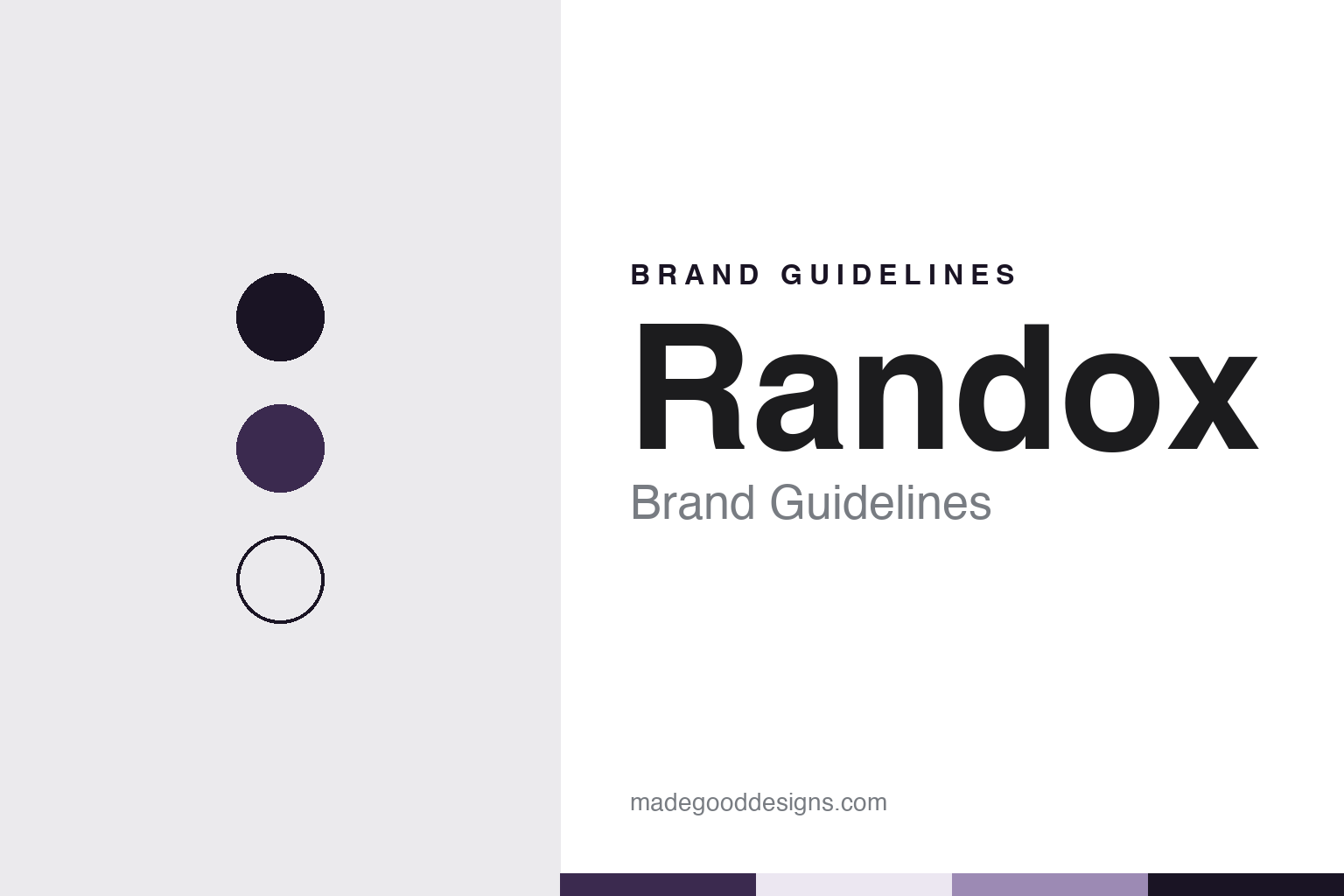
Randox Brand Guidelines
Crumlin’s 1982 diagnostics maker and its science park.
Aa
Two constants: a Randox plum and heather palette and a Sober serif register. Abstract homage — not a Randox product or mark; no analyser, logo or nameplate is reproduced.
Crumlin, 1982
A Northern Irish reagent maker.
Randox is a Northern Irish company in the in vitro diagnostics industry, headquartered in Crumlin, County Antrim. English Wikipedia says it was established in 1982 by its owner, Peter FitzGerald, and that it develops, manufactures and markets reagents and equipment for laboratory medicine, serving hospital, clinical, research and molecular laboratories as well as food testing, forensic toxicology and veterinary work.
Its reach into the American market is documented in the US Food and Drug Administration’s public 510(k) database, which lists Randox Laboratories, Ltd. as the applicant for clearances going back to October 1992, starting with an activated CK-NAC reagent kit; the database now holds well over a hundred Randox clearances.
The company grew around its Northern Irish base. According to English Wikipedia, it developed a site at Dungloe, in County Donegal in the Republic of Ireland, from 2014, and in 2019 moved into the Randox Science Park, a research and manufacturing site on the former Massereene Barracks in Antrim.
English Wikipedia names FitzGerald as the owner, and reports that in March 2020 the group was restructured to be ultimately held by Randox (IOM) Ltd, based in the Isle of Man, a step the company said was “to support any future transfer of company ownership to future generations.”
The name also reached a wider public through sport: Randox Health has sponsored the Grand National at Aintree since 2017, English Wikipedia says.
Colour
Lobbying, contracts and a recall.
Randox has featured in several official reports in the United Kingdom.
The first concerned lobbying. On 26 October 2021 the House of Commons Committee on Standards published its report on the conduct of the Conservative MP Owen Paterson, who had been a paid consultant to Randox since August 2015. The Parliamentary Commissioner for Standards found that he had breached the rule against paid advocacy in, among others, three approaches to the Food Standards Agency relating to Randox and the testing of antibiotics in milk, in November 2016 and November 2017, and in four approaches to ministers at the Department for International Development relating to Randox and blood-testing technology, in October 2016 and January 2017.
The second concerned Covid-19 testing. In August 2020 the Department of Health and Social Care announced that the Medicines and Healthcare products Regulatory Agency had instructed Randox to recall its Randox COVID-19 Home Testing Kit from NHS Test and Trace testing settings, “as a precautionary measure to prevent any further use of these Randox tests”; the notice was published on 7 August 2020.
The government’s testing contracts with the company were then examined by the National Audit Office. Its report of 24 March 2022, which reviewed the contracts let to Randox between January 2020 and December 2021, said the first contract had been let in March 2020 using emergency procurement without competitive tendering, which it said the speed needed at the start of the pandemic required. It found that the department “did not document key decisions adequately,” did not fully disclose ministerial meetings with Randox, and did not keep full records of ministerial discussions involving the company. It concluded that the gaps meant it could not give positive assurance “in the normal way,” but that it had “not seen any evidence that the government’s contracts with Randox were awarded improperly.”
Typography
Design and documentation.
In vitro diagnostics is a business most people meet only at second hand, through a blood sample sent away or a result read back by a doctor. The companies behind those results make analysers, the reagents that run on them and the software that ties them together, and they sell mainly to hospital laboratories, independent labs and clinics rather than to the public.
That shapes how they look. The typical product photograph shows a white or pale grey bench analyser in a clean laboratory, sometimes linked to others in a line of automation, with sample tubes standing in racks and a touchscreen at the front. Smaller formats appear too: single-use cartridges for point-of-care machines, test strips and cassettes for rapid tests, pipettes and reagent packs. Blue and white palettes are common across the sector, along with plain sans serif type and diagrams of the laboratory workflow, and some makers have had their instruments judged on design: Sysmex’s clinical laboratory system was among the Good Design Gold Award winners in Japan in 2011.
The trade meets at a few large events. MEDICA in Düsseldorf gathers medical technology makers, and the annual meeting of ADLM, the Association for Diagnostics & Laboratory Medicine, formerly the American Association for Clinical Chemistry, brings laboratory companies together in the United States. Some of these groups grew by acquisition, so a single corporate name often sits above product names that began with other companies.
This guide sets out what can be checked about each brand: who founded it, who owns it, where its products are made and what it says about its own identity, and it marks clearly what rests only on the company’s own word. No diagnostic or clinical claims are made for any product.
Aa
A sober serif — the register of a reagent maker. (Specimen set in Source Serif 4, a serif STAND-IN; NOT the Randox logo.)
Randox
A forensic case and a product range.
The most serious finding involved the group’s forensic arm. On 9 May 2017 the National Police Chiefs’ Council announced a coordinated operation to retest forensic samples after a police inquiry into data manipulation by two individuals working at Randox Testing Services. The council said data supporting more than 6,000 toxicology samples could have been affected, and that the Forensic Science Regulator and police had first been notified of the issue in January 2017. Working with the regulator, the Crown Prosecution Service and the Home Office, it set up a team of forensic experts to help police forces prioritise samples for retesting, to identify live cases that needed new tests and past cases where convictions could be unsafe.
In December 2018 Chemistry World reported that the scale had been revealed in November 2017 as more than 10,500 criminal cases across 42 police forces potentially compromised by the manipulation at the company’s Manchester laboratory, and that more than 40 drug-driving convictions had by then been overturned after samples were retested.
The diagnostics business itself is organised around named product families. Its website groups immunoassay products under Evidence, a line of biochip analysers including the Evidence Investigator and Evidence MultiSTAT; quality-control materials under Acusera; and clinical chemistry analysers under the RX name, including the RX Imola and RX Modena listed in FDA records. Its website also offers genomics and pharmaceutical services and contract manufacturing.
The Randox name covers several businesses: Randox Laboratories, the reagent and analyser maker; Randox Health, the name on the Grand National sponsorship; and Randox Testing Services, the forensic toxicology laboratory.
For a design guide, Randox shows how one founder-owned name can stretch across reagents, analysers, sport sponsorship and public testing contracts. Compare Bio-Rad, another maker of laboratory quality controls, and Qiagen, a European diagnostics and molecular-testing company. For this guide we use a deep plum, a heather and a pale lilac with a serif, an unofficial interpretation; no product or logo is reproduced.
Explore & save
Keep Randox’s identity on hand — save it to a board in the Made Good inspiration library.
Randox identity set
Pin the Randox plum and heather palette and the Sober serif register to your own board.