Frank Mayer and Associates Brand Guidelines
Grafton’s display printer turned kiosk maker.
Aa
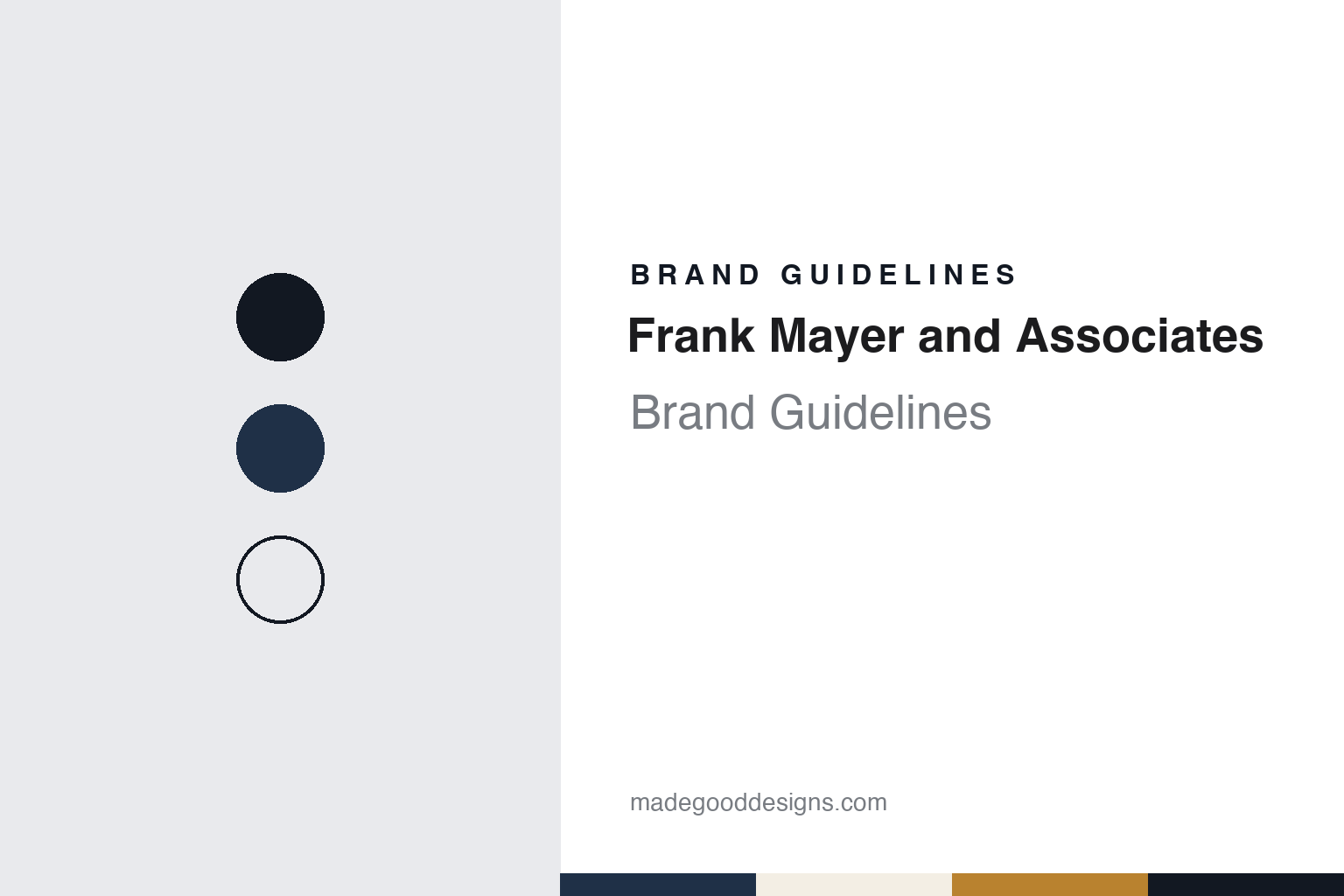
Two constants: a Frank Mayer navy, cream and amber palette and a Print-shop serif register. Abstract homage — not a Frank Mayer and Associates product or mark; no kiosk, logo or nameplate is reproduced.
A Milwaukee print shop
Silk-screen graphics for the city’s brewers.
Frank Mayer and Associates traces its start to 1931. The company says it was founded that year by Frank G. Mayer and “began as a modest printing press,” and in 2026 its website marks 95 years in business. The local weekly Ozaukee Press, in a profile published in August 2018, filled in the early picture: the founder started the business in Milwaukee, using silk-screen presses to make graphic items for the city’s beer producers, among them Miller Brewing, Schlitz and Pabst.
From printed graphics the firm moved into point-of-purchase work, the displays that sit in shops and carry a brand’s products and messages. The company describes how that printing business “quickly evolved into a respected name in manufacturing retail displays for well-known brands.” In 1964, the Ozaukee Press reported, it broke ground at its present site on Wisconsin Avenue in Grafton, in Ozaukee County. It has stayed there since; the company’s president told the paper that passers-by often take the building for a law or accounting office.
The family has run it for three generations. The Ozaukee Press reported that the founder’s son, Frank, took over in 1980 and moved the firm from a local to a national market; the company’s own history says that in the 1980s Frank W. Mayer “took the reins” and added a full-service assembly, warehouse and distribution operation for large production runs. The third generation is represented by Mike Mayer, named as president on the company’s website and as president and chief operating officer in the 2018 profile.
The company name carries a family idea too. In the same profile Mayer explained that the firm calls every employee an associate, because, he said, an associate “is part of the family.” The paper put the workforce at more than 90 people at the time, and reported that most of the business came from customers elsewhere in the country rather than from Wisconsin.
Colour
From Atari displays to self-order screens.
Kiosks came out of the display trade. The company says its first interactive kiosk project was built in the late 1970s for Atari’s game consoles and home computers, and that a kiosk division grew from that work, later serving brands such as BMW and John Deere. On its kiosk pages today it speaks of “more than four decades” as a custom kiosk supplier.
In 2018 the Ozaukee Press reported the launch of Approach, a self-service ordering kiosk aimed at national retail chains, quick-service restaurants and hotels, developed with hardware and software partners so that customers could build their own orders. The paper listed Nintendo, Lego, Garmin, General Electric and Macy’s among the companies the firm had worked with; its president was photographed beside a display of life-size Lego pieces from a separate project.
The current range, as the company presents it, has two halves. One is custom kiosks: a pre-engineered collection of freestanding, countertop, wall-mounted and large-display designs that clients can adapt, alongside fully bespoke units and outdoor kiosks built for weather. The other is retail displays, the point-of-purchase programmes for national brands that the company calls “in our DNA.” Its case studies include outdoor car-wash kiosks for the software company AMP, vehicle-registration kiosks for Intellectual Technology Inc., photo-concession kiosks for Showtime Pictures and modular product displays for Eaton.
The firm presents itself as a builder of hardware rather than a software house. It says it works with independent software vendors to house their platforms, and that it is “not tied to a single manufacturer or ecosystem,” so clients can choose their own computers, printers and screens. The markets it lists include quick-service ordering, healthcare, hospitality, gaming and entertainment, warehousing and cannabis dispensaries.
Typography
Design and documentation.
Self-service kiosk makers sell machines that most people meet without ever learning who built them. The tall touchscreen totem in a fast-food restaurant, the check-in unit in a hotel lobby or an airport hall, the ticket machine at a station and the self-checkout lane in a shop usually carry the name of the restaurant, hotel or retailer, not the maker. Acrelec’s own range, for example, is named by screen size and use, from a 22-inch counter-top unit to 27-inch floor-standing and outdoor kiosks.
So the makers present themselves to buyers rather than to the public. Their websites lead with markets — restaurants, retail, hospitality, healthcare, transport, government — and with the parts of a job they can take on: enclosure design, payment terminals and receipt printers, cash handling, software, installation, remote monitoring and field service. Counts of installed machines and the quality and environmental standards they say they are certified to are common, and are given here only as each company states them.
Trade fairs are where the products are shown. Retail-technology shows such as the National Retail Federation’s Big Show in New York and EuroShop in Düsseldorf draw kiosk and self-checkout makers alongside point-of-sale suppliers, and the trade title Kiosk Marketplace promotes an automated-retail and kiosk show of its own in Miami Beach. Trade titles such as Kiosk Marketplace and QSR Web also report the makers’ acquisitions and moves.
The companies in this group range from founder-built firms in France, Portugal, Germany and the United States to subsidiaries of larger Asian technology groups. This guide sets out what can be checked about each — who founded it, who owns it now and what it says about where its kiosks are made — and marks clearly what rests only on the company’s own word.
Aa
A print-shop serif — a nod to a firm that began with silk-screen presses. (Specimen set in Fraunces, a serif STAND-IN; NOT the Frank Mayer and Associates logo.)
Frank Mayer and Associates
Built, stored and shipped from Wisconsin.
The company’s pitch is scale. It describes itself as built for high-volume programmes, with 500,000 square feet of warehousing and assembly space, a core assembly team that can be enlarged with temporary staff for big deployments, and logistics staff who ship units to stores across the country. Kiosks and displays, it says, can be “built, stored, and shipped” to client sites or distribution centres by one partner. It calls itself “a trusted U.S. manufacturer”; the Grafton site on Wisconsin Avenue has been its base since the 1960s, according to the Ozaukee Press.
Design is part of the offer rather than an extra. The company says it runs an in-house design agency of designers and engineers, and its process runs from design and engineering through prototyping to manufacturing. Each client, it says, is given an account executive as a single point of contact, backed by a project team. Its home page sums up the offer as “Custom Digital Kiosks and Retail Displays at Scale.”
What carries through its own story is continuity: a family name on the door since 1931, a founder who printed brewery graphics, a second generation that took the firm national, and a third that sells touchscreens. The Ozaukee Press reported in 2018 that the family expected the business to stay in its hands.
For a design guide, Frank Mayer and Associates shows how a print and display maker can carry its craft into self-service hardware without changing its name or its town. Compare KIOSK Information Systems, another American kiosk builder, and Olea Kiosks, a self-service kiosk maker in California. For this guide we use a navy, a cream and an amber with a serif, an unofficial interpretation; no product or logo is reproduced.
Explore & save
Keep Frank Mayer and Associates’s identity on hand — save it to a board in the Made Good inspiration library.
Frank Mayer and Associates identity set
Pin the Frank Mayer navy, cream and amber palette and the Print-shop serif register to your own board.