Nitto Denko Brand Guidelines
A 1918 Tokyo insulation maker that built a business on tape.
Aa
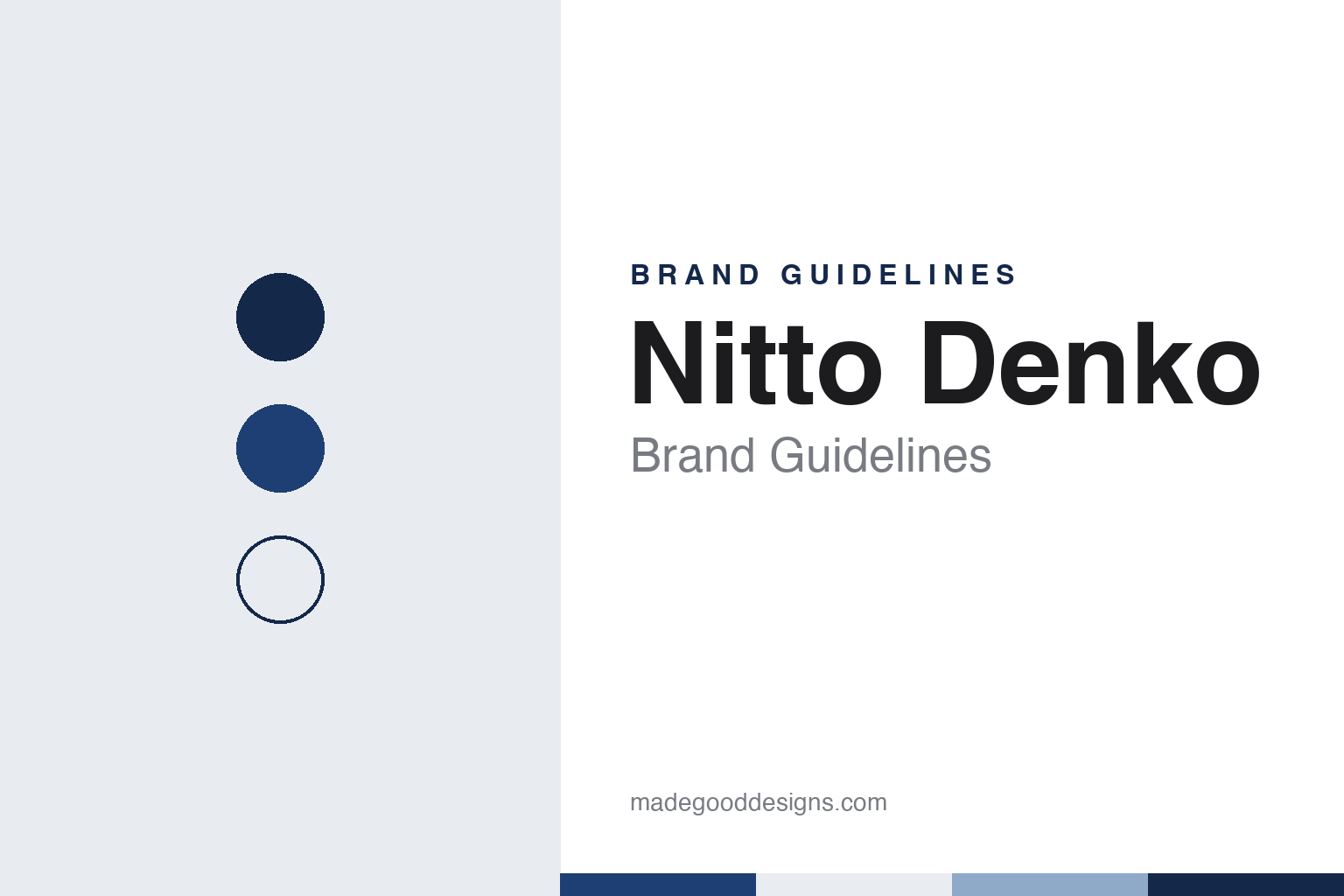
Two constants: a Nitto Denko blue, navy and grey palette and a clean Japanese sans register. Abstract homage — not a Nitto Denko product or mark; no tape, logo or packaging is reproduced.
Nitto Electric Industrial
Insulation for an import gap.
Nitto Denko began in October 1918 as Nitto Electric Industrial (Nitto Denki Kogyo), a small company in Osaki, in what is now Shinagawa in Tokyo. A company history published in July 2026 by the Japanese corporate-history site The Shashi, drawing on a 1968 company-history volume, a 1993 securities analysts’ journal and the company’s own securities report, names its founder as Totaro Inamura and says it was set up with 14 employees to make at home the electrical insulating materials whose imports had been cut off by the First World War. Japanese Wikipedia gives the same aim — making insulating materials in Japan — and dates the first insulating varnishes to 1924.
Its main customers were makers of heavy electrical equipment, Hitachi among them. In the 1930s the company lost its main customer, and in May 1937, The Shashi says, Hitachi took all of its shares in a business and capital tie-up that kept it going. In December 1941 it bought the Ibaraki works of a varnish and paint company in Osaka Prefecture, its first step into western Japan. In May 1945 an air raid destroyed the head office and works at Osaki; Japanese and English Wikipedia both record the loss, and in July 1946 the head office moved to Ibaraki. When the Hitachi tie was dissolved in July 1948, as Hitachi sold its shares during the post-war break-up of the large business groups, The Shashi says the company’s know-how lay in insulating cloth, tubing and paper and in insulating paint.
Sources describe the Hitachi link differently. Japanese Wikipedia says the company came into the Hitachi orbit after the war, that a Hitachi-group trading company later became its largest shareholder, and that it became independent of Hitachi capital only in 2003. Both accounts agree that Nitto sold its dry-battery and magnetic-tape business to Maxell Electric Industrial, the forerunner of today’s Maxell, in 1961.
Colour
From black tape to polarizing film.
Tape came after the war. Japanese and English Wikipedia date the start of mass production of black tape to 1946 and anti-corrosion tapes to 1949. In April 1951 the company made what The Shashi calls Japan’s first vinyl tape; English Wikipedia describes the same step as the first plastic tapes in Japan. Paper adhesive tape and the Nitomatic tape machines followed in 1962, double-coated tape in 1964 and, under the Nitoflon name, fluoroplastic products from 1961, according to Japanese Wikipedia.
The range then spread well beyond tape. Japanese Wikipedia lists semiconductor encapsulating materials from 1966, medical adhesive sheets from 1968, flexible printed circuits from 1973 and adhesive polarizing film for liquid-crystal displays from 1975. In 1976 it moved into polymer separation membranes, the reverse-osmosis and ultrafiltration membranes used in water treatment, and in 1987 it bought the American membrane maker Hydranautics. In 1975 it also set up Nitoms, a company for household products. Sports taping tape followed in 1981 and nappy fastening tape in 1982.
The company calls its strategy “global niche,” aiming for leading shares in narrow markets, Japanese Wikipedia says; that is the company’s own framing. It lists shares on the Tokyo and Osaka exchanges from 1962, moving to their first sections in 1967. Its first overseas office opened in New York in 1961, and its first overseas factory opened in Taiwan in 1969, according to Japanese Wikipedia. Production sites in Japan include Toyohashi, Kameyama, Onomichi, Shiga and Ibaraki.
Awards are recorded for its films and membranes. English Wikipedia says its seawater reverse-osmosis element SWC5 received a 2007 Nikkei Superior Products and Services Award, and Japanese Wikipedia says a method for making ultra-thin polarizing film received a Prime Minister’s Prize in 2017.
Typography
Tape, strapping and the trade.
The makers in this guide sell much of their range to people who use tape and strapping at work: warehouse teams sealing cartons, packers securing pallets, contractors masking a wall or sealing a duct. Their catalogues tend to be organised around jobs and materials. Shurtape’s industrial website, for example, sorts its range by trade — construction, HVAC, packaging, marine — while IPG lists pressure-sensitive and water-activated tapes, stretch and shrink films and packaging machinery side by side.
That gives the category a recognisable set of pictures for a designer to study: rolls of tape on their cardboard cores, often stacked by colour or width; cartons running through a case sealer at the end of a packing line; steel or plastic strapping drawn tight around a loaded pallet with a hand tool or a machine; and close-ups of an adhesive face or a cut edge. Some makers, Shurtape among them, give their trade tapes short codes of letters and numbers rather than names.
The trade also meets in person. PMMI’s Pack Expo shows in the United States, interpack in Düsseldorf and FachPack in Nuremberg, which held its 2025 edition in September, gather makers of packaging materials, tapes, strapping and the machines that apply them together, and a maker’s stand there is one of the places its identity is seen at full size.
This guide sets out what can be checked about each brand — who founded it, who owns it now, and what it says about where its products are made — and marks clearly what rests only on the company’s own word. The colours and typefaces shown are our own unofficial interpretation, not any maker’s official palette.
Aa
A clean Japanese sans — the register of a short “Nitto” mark. (Specimen set in Zen Kaku Gothic New, a sans STAND-IN; NOT the Nitto Denko logo.)
Nitto
A short name for a long one.
The present name arrived with the company’s 70th anniversary. In 1988 Nitto Electric Industrial became Nitto Denko Corporation, according to Japanese and English Wikipedia. Its visible brand has since shortened further. Japanese Wikipedia says the company changed its logo in July 2004 and changed it again in October 2013, at its 95th anniversary, to a mark reading simply “Nitto”, which it still uses.
That short name became widely visible through sport. In May 2017 The Guardian reported that the season-ending men’s tennis championship, rebranded the Nitto ATP Finals, would stay at the O2 in London until 2020. English Wikipedia’s ATP Finals article records that Nitto Denko extended its title partnership in September 2020 to 2025, and again in November 2025, to 2030.
The head office moved from Ibaraki to the city of Osaka in 2006. Japanese Wikipedia today gives two head offices, in Umeda in Osaka and by Shinagawa station in Tokyo, with the registered head office still at Ibaraki, and says more than 70 per cent of sales are made outside Japan. It is listed in Tokyo and is a member of the Sanwa group of companies linked to the former Sanwa Bank, now part of MUFG.
For a design guide, Nitto Denko shows how an industrial maker can shorten a long company name into a compact consumer-facing mark while keeping the full name for the business. Compare 3M, another tape maker known by a short name, and Avery Dennison, a maker of pressure-sensitive materials. For this guide we use a deep blue, a night navy and a soft grey with a sans, an unofficial interpretation; no product or logo is reproduced.
Explore & save
Keep Nitto Denko’s identity on hand — save it to a board in the Made Good inspiration library.
Nitto Denko identity set
Pin the Nitto Denko blue, navy and grey palette and the clean Japanese sans register to your own board.