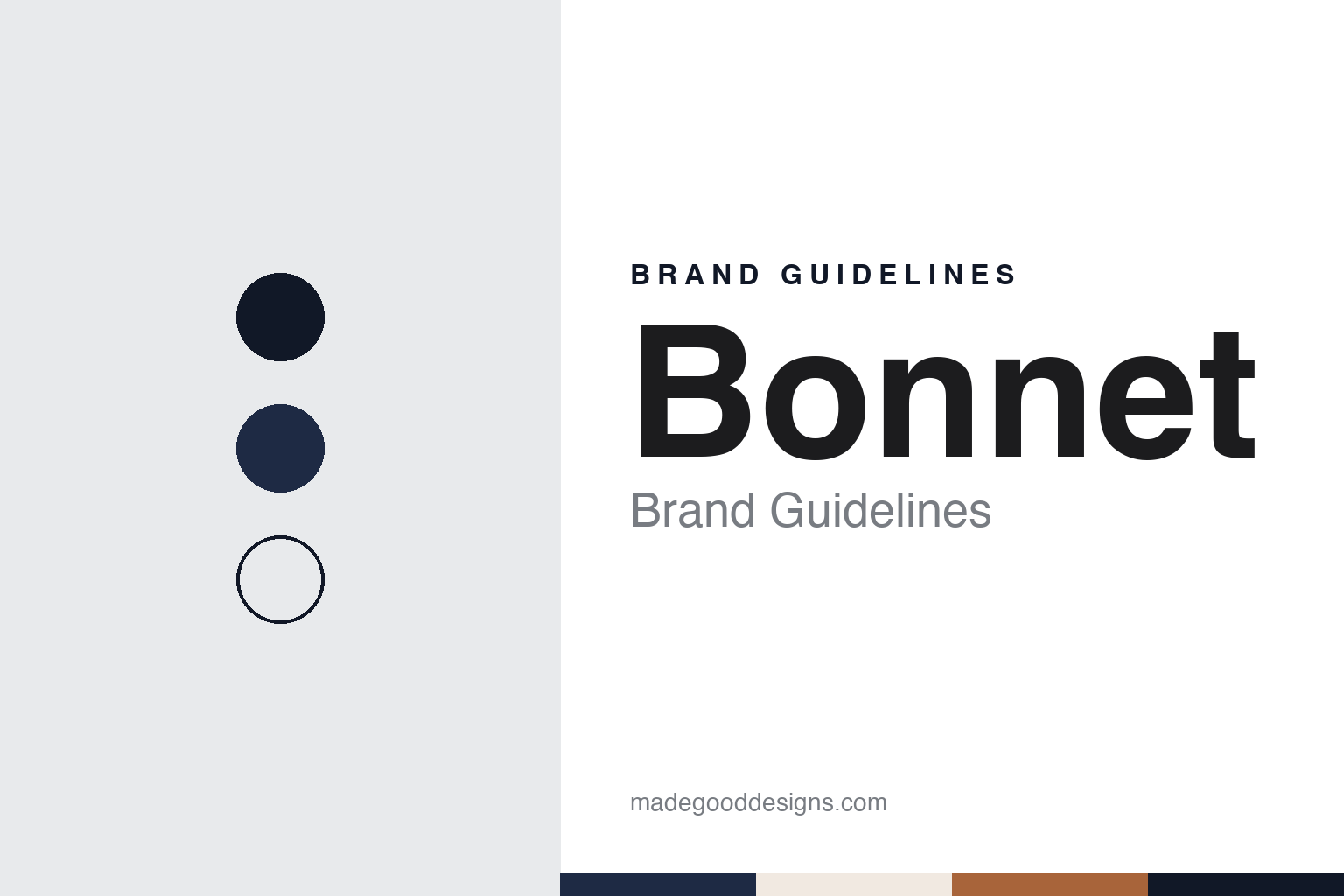
Bonnet Brand Guidelines
The Jura combi-oven maker that dates itself to an 1830 workshop.
Aa
Two constants: a Bonnet navy and copper palette and a French serif register. Abstract homage — not a Bonnet product or mark; no appliance, logo or nameplate is reproduced.
Since 1830
A mechanics workshop, by the company’s account.
Bonnet is a French maker of professional cooking equipment based in Poligny, a small town in the Jura, in eastern France. It dates itself to 1830. “Depuis 1830, Bonnet écrit l’histoire de la cuisson professionnelle,” its website says — since 1830, Bonnet has been writing the history of professional cooking — and it traces its start to “un petit atelier de mécanique fondé par Nicolas Bonnet,” a small mechanics workshop founded by Nicolas Bonnet. The sources read for this guide do not describe the firm between then and the post-war years, including the German occupation of France in 1940–44.
The company’s history then moves quickly. It describes “decades of transformations, mergers and industrial challenges,” and says that through them it kept one rule: to design equipment that is reliable and made “for cooks, not for shop windows.” Almost two centuries on, it says, the brand has become a reference in professional cooking.
The modern company is Bonnet SAS, and its owner is American. Bonnet says it has been part of ITW — Illinois Tool Works — since 2006, and calls the arrival “a new industrial and human era,” bringing more resources, more capacity to innovate and a faster opening to international markets. ITW runs its kitchen businesses through its Food Equipment Group; in October 2013 Foodservice Consultant, the magazine of the Foodservice Consultants Society International, listed Bonnet among that group’s brands alongside Hobart, Vulcan and Thirode, and described ITW’s decentralised model, under which its businesses operate largely independently.
Bonnet says ITW has also shaped its method. It calls its approach “Customer Back Innovation,” which it says is inspired by the ITW group’s methodology: working from what users need in a real service, testing and adjusting with them, rather than starting from the drawing board. “Our ovens and braising pans are not born in offices,” it says.
Colour
Poligny and Thirode.
Poligny’s cooking-equipment industry has a documented history of its own. French Wikipedia, citing a 2018 book of Franche-Comté business biographies by Annie Gay, says the engineer Roger Thirode, a native of Poligny, founded Les fours électriques Roger Thirode at Drancy, near Paris, in 1947. In 1952 he patented a “four-étuve,” an oven designed for butchers for both dry and moist cooking; French Wikipedia says about 15,000 were made between 1952 and 1957, and that the design then moved into professional kitchens.
In 1961, the same source says, Thirode built a second factory in his home town, Poligny. The firm bought competitors in France and the Tyson Metal Product company in Pennsylvania, was renamed SFEC Thirode SA, and, with 1,200 employees, became France’s leading producer of professional kitchen equipment, according to French Wikipedia. Thirode sold the business in 1990.
The Bonnet and Thirode names then appear side by side. French Wikipedia’s article on Poligny names Bonnet Thirode Grande Cuisine as the town’s largest business, with 115 employees making equipment for professional kitchens, and Foodservice Consultant listed Bonnet and Thirode as separate ITW brands in 2013. Bonnet’s current website presents a single brand and says Poligny is where its equipment is “imagined, tested and made.”
Bonnet organises its catalogue in three families. The first is combi ovens, which it says it first designed in its own factories in 1984. The second is multifunction braising pans, which include a line called ChefsPan. The third is modular horizontal cooking, with lines called 700 Flex and Maestroflex. The company calls the combi ovens and the braising pans the two emblematic products of the brand, with the modular units built around them.
Its newest oven is the Chef’sCombi. Bonnet’s news page says the oven was launched with two days of demonstrations at the Poligny factory on 18 and 19 June 2024, and that the chef Jean-Paul Jeunet, whom it describes as a starred chef, acts as the oven’s ambassador, cooking a lièvre à la royale and other dishes in it for the company’s recipe pages.
Typography
Design and documentation.
Commercial fryer and range makers sell to people who rarely see their products in a showroom. Their buyers are chain operators, dealers and kitchen consultants, and the brands present themselves in the language of the cooking line: the fry station of a quick-service restaurant, a bank of vats with baskets hung above them, and the oil filtration tucked into the cabinet below.
Range and modular-suite makers work at a different scale. Their pictures show hotel and restaurant kitchens laid out as one continuous run of cooking blocks, with burners, solid tops, griddles and fryers set into a single stainless line, and close-ups of the working parts: a flame ring under a pan, the plate of a griddle, a row of control knobs. Much of the trade’s visual record is technical rather than glamorous: specification sheets, catalogue line drawings, cut-away diagrams of heating tubes, and drawing files that kitchen designers drop into their plans.
The industry also meets at its own fairs. HostMilano in Italy and, in the United States, the NAFEM Show and the National Restaurant Association Show are among the events that trade titles such as Foodservice Equipment Reports cover each year in their show reports. Many of the brands in this guide now belong to a few large groups, among them Middleby and Ali Group, which completed its purchase of Welbilt in 2022.
This guide sets out what can be checked about each brand — who founded it, who owns it, and what it says about where its products are made — and marks clearly what rests only on the company’s own word.
Aa
A French serif — “cuisiner pour aujourd’hui, penser pour demain.” (Specimen set in Libre Caslon Text, a serif STAND-IN; NOT the Bonnet logo.)
Bonnet
Made in Poligny, by its own account.
Bonnet’s strongest brand claim is French manufacture. It says its ovens carry the Origine France Garantie label, which it explains as meaning that the product takes its essential characteristics in France and that at least half of its unit cost price is incurred in France. For the Chef’sCombi, it says every stage of the product’s creation takes place at Poligny, and it says it keeps control of each module through dedicated production units.
The rest of its pitch is about chefs and installers. Bonnet says it is a partner of the Académie culinaire de France, that it runs an in-house culinary service in which chefs and engineers test equipment in its laboratories and application kitchens, and that each piece is tested individually at the end of the line. It calls installers “our ambassadors,” holds product demonstrations for customers and installers at the factory, and says standard combi ovens and braising pans are available within 24 hours.
Its voice is short and declarative, in French. Its history page ends on a series of one-line statements — “Bonnet, c’est une signature qui dure,” a signature that lasts — and closes with a motto: “cuisiner pour aujourd’hui, penser pour demain,” cook for today, think for tomorrow. Its website is published in French only, with a note that an English version is coming soon.
For a design guide, Bonnet shows how an old name inside a large American group can still be presented through one French town and one factory. Compare RATIONAL, the German maker built on the combi oven, and Ambach, an Italian maker of modular cooking suites. For this guide we use a deep navy and a copper with a serif, an unofficial interpretation; no product or logo is reproduced.
Explore & save
Keep Bonnet’s identity on hand — save it to a board in the Made Good inspiration library.
Bonnet identity set
Pin the Bonnet navy and copper palette and the French serif register to your own board.