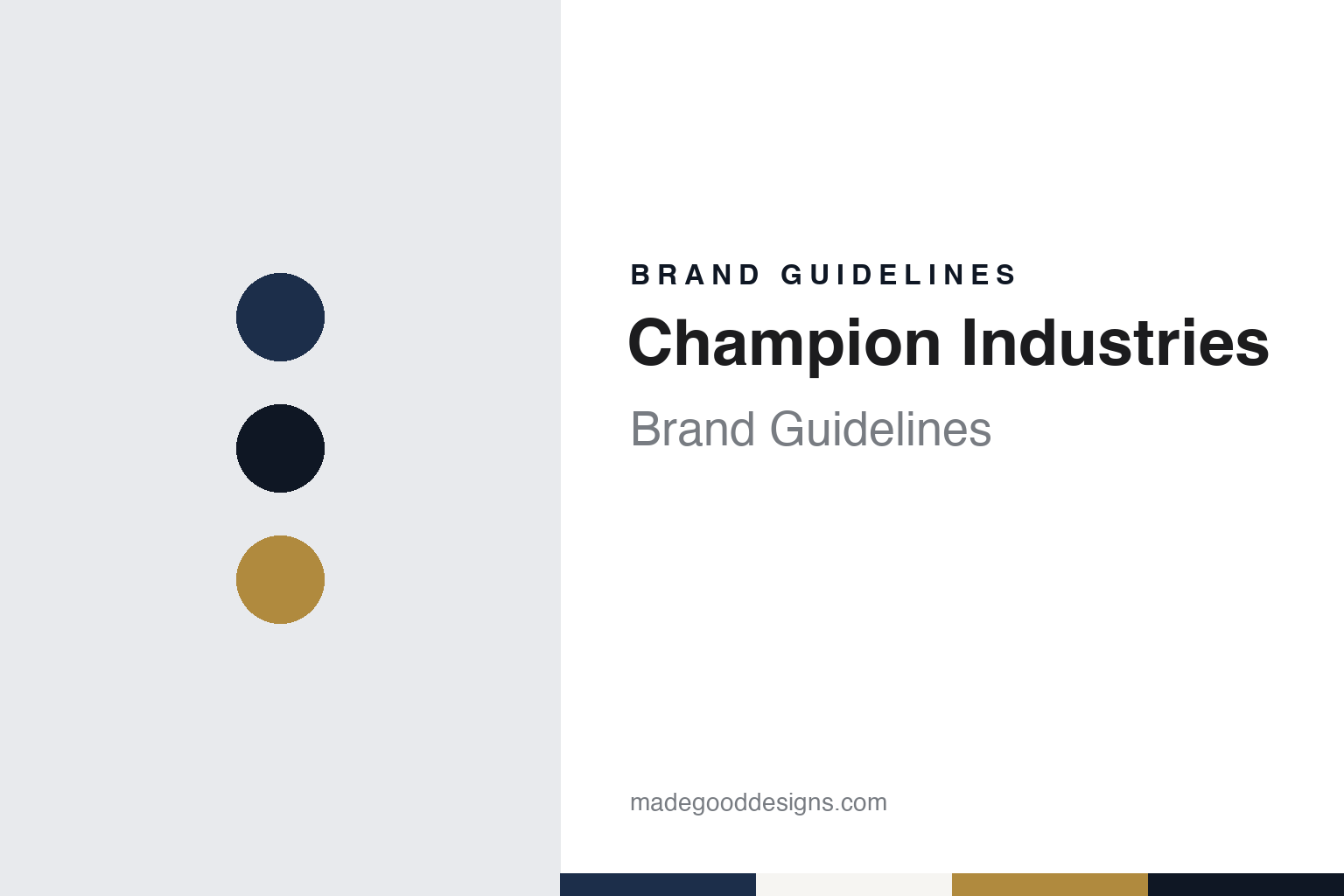
Champion Industries Brand Guidelines
The 1890 dishwasher maker whose machines were “built like a battleship.”
Aa
Two constants: a navy, steel and brass palette and a slab serif register. Abstract homage — not a Champion product or mark; no machine, logo or nameplate is reproduced.
Thompson and Low
From Hoboken to Erie to Winston-Salem.
Champion Industries traces its roots to 1890 in Hoboken, New Jersey, where the business was founded as Thompson & Low, according to both the company and a July 2021 profile by the Foodservice Consultants Society International (FCSI). In 1916 a new part-owner, Pat Davis Sr., renamed it Hamilton-Low. The company says that in this era it invented the vortex downwash dish machine, and FCSI’s profile names that machine as the invention that made the business nationally famous.
The Champion name has a nautical story. Hamilton-Low installed its first Champion-branded dishwasher on an ocean liner sailing between Europe and North America, FCSI reports, and that is how the machines earned the tagline “Built Like a Battleship.” The company says its first factory stood in New York City on the site later occupied by the Chrysler Building, and that its machines were supplied to hospitals, restaurants and hotels, among them the Waldorf Astoria.
The firm moved more than once. The company’s own history says it relocated to Erie, Pennsylvania, in 1931, and that in 1962 one of its salesmen, Gordon Apgar, bought a quarter of the business on the condition that it move to Winston-Salem, North Carolina, where he lived; FCSI also dates the Winston-Salem headquarters to 1962. In 1967, the company says, its owners sold Champion to American Sterilizer, known as AMSCO, an Erie company that used Champion’s expertise to develop utensil sanitizers for hospitals. Champion stayed under AMSCO’s ownership for the next thirteen years.
Colour
The dishwashing machine specialist.
Ali Group introduces the brand as “the dishwashing machine specialists for over 130 years.” Champion itself uses the singular, “The Dishwashing Machine Specialist,” and its range covers most of commercial warewashing. Ali Group, its owner, describes a line that runs from undercounter machines to single-rack door-type machines, rack conveyor machines and upright conveyor or flight machines, along with powered soak sinks and pot-and-pan washing systems. Current models on Champion’s own website include the UH130B MAX undercounter machine, the DH6000T VHR door machine with an extended hood, the PP-11 PRO VHR pot, pan and utensil washer and the Vortex sink.
Around the machines sit two further lines. Bi-Line makes stainless steel foodservice conveyors that carry trays and other items, and TRISYS covers waste equipment, including pulper systems, according to Ali Group. When Foodservice Equipment Reports covered a change of leadership in January 2016, it described the Champion Group as including the Champion, Moyer Diebel and Bi-Line brands.
Ali Group says the brand’s customers range from coffeehouses and restaurants to hospitals, schools and other institutions. In the 2021 FCSI profile, the company’s president, Will Means, said Champion had rebranded itself as “the dishroom solution specialists,” equipped its plant to build customised machines quickly, and turned requests from operators and foodservice consultants into new products. He described that approach to listening to customers as the company’s “DNA” for the previous ten years, and said the group let the brand make its own decisions without a lengthy corporate approval process. Means, who joined Champion in 2007, told FCSI that the company’s then executive vice president, Rob August, had told him on arrival that he had to become “a warewash expert,” advice he said he now passes on to every new hire.
Typography
Design and documentation.
Commercial dishwasher makers sell to professional kitchens rather than households. Their catalogues are sorted by how the ware moves: undercounter machines and glasswashers that sit beneath a bar or counter, hood-type or door-type machines that wash one rack at a time, rack conveyors for bigger runs of baskets, and flight-type machines that carry plates on a continuous belt. Hobart and Comenda both organise their ranges in this way on their websites.
The customer lists read like a map of institutional eating. Hobart names restaurants, hotels, hospitals, long-term care, schools and grocery retailers; Comenda adds pastry shops, ships, central kitchens and airline caterers, and says its flight-type machines are built for large canteens, hospitals and inflight catering. The baskets themselves come in standard sizes: Comenda quotes racks of 400 by 400 and 500 by 500 millimetres.
The trade meets at fairs rather than in shops. INTERNORGA, held every year in Hamburg, describes itself as a platform for hospitality and foodservice, with a hall area for kitchen technology and equipment, and plans its 100th edition for March 2027. In Milan, HostMilano is another fixed date; the American trade magazine Foodservice Equipment Reports keeps photo galleries from its 2023 and 2025 editions. Comenda’s own awards page lists an innovation prize from the Rest’Hotel fair in Caen.
Ownership in this sector often runs through large groups. Hobart is a brand of Illinois Tool Works’ food-equipment group; Comenda was the first company of Italy’s Ali Group, which has since gathered further warewashing names. This guide sets out what can be checked about each brand and marks what rests on the company’s own word.
Aa
A sturdy slab serif for a brand built on a shipboard slogan. (Specimen set in Zilla Slab, a slab serif STAND-IN; NOT the Champion logo.)
Champion Industries
An American brand in an Italian group since 1980.
Champion has belonged to the Ali Group since 1980, when Luciano Berti, the Italian group’s founder, bought it from AMSCO. FCSI’s 2021 profile calls the purchase Ali Group’s first international acquisition and says it brought heavy investment in Champion’s infrastructure and a marked expansion of its product line. The company credits the years that followed with developments such as built-in hot water boosters, fully integrated conveying and washing systems and single-source gas heating, and says it was under Berti’s ownership that it added the Bi-Line series of stainless steel conveyors to its offer.
The business has stayed inside the group. In January 2016 Foodservice Equipment Reports reported that Erik Nommsen had been appointed president of the Champion Group, his second term in the post after an earlier spell as president from 2008 to 2014, reporting to Filippo Berti, then chief executive of Ali Group North America; the magazine described Champion as a Winston-Salem warewasher manufacturer. In July 2022 Ali Group completed its purchase of Welbilt, the American owner of brands such as Merrychef and Convotherm, FCSI reported in August 2022, and Champion’s own website now says it operates as part of Welbilt. FCSI said the deal followed more than a year of negotiation and regulatory approval that began in May 2021, and that it left Ali Group with 95 global brands and about 14,000 employees in 34 countries. The company says it remains headquartered in Winston-Salem and supplies customers in the United States, Canada, Latin America, Europe, the Middle East and Asia.
For a design guide, Champion shows how a nineteenth-century name can travel on a single slogan, “Built Like a Battleship.” Compare Comenda, another warewashing brand in the Ali Group, and Hobart, another American maker of commercial dishwashers. For this guide we use navy, steel and a brass tone with a slab serif, an unofficial interpretation; no product or logo is reproduced.
Explore & save
Keep Champion Industries’s identity on hand — save it to a board in the Made Good inspiration library.
Champion Industries identity set
Pin the Champion navy, steel and brass palette and the slab serif register to your own board.