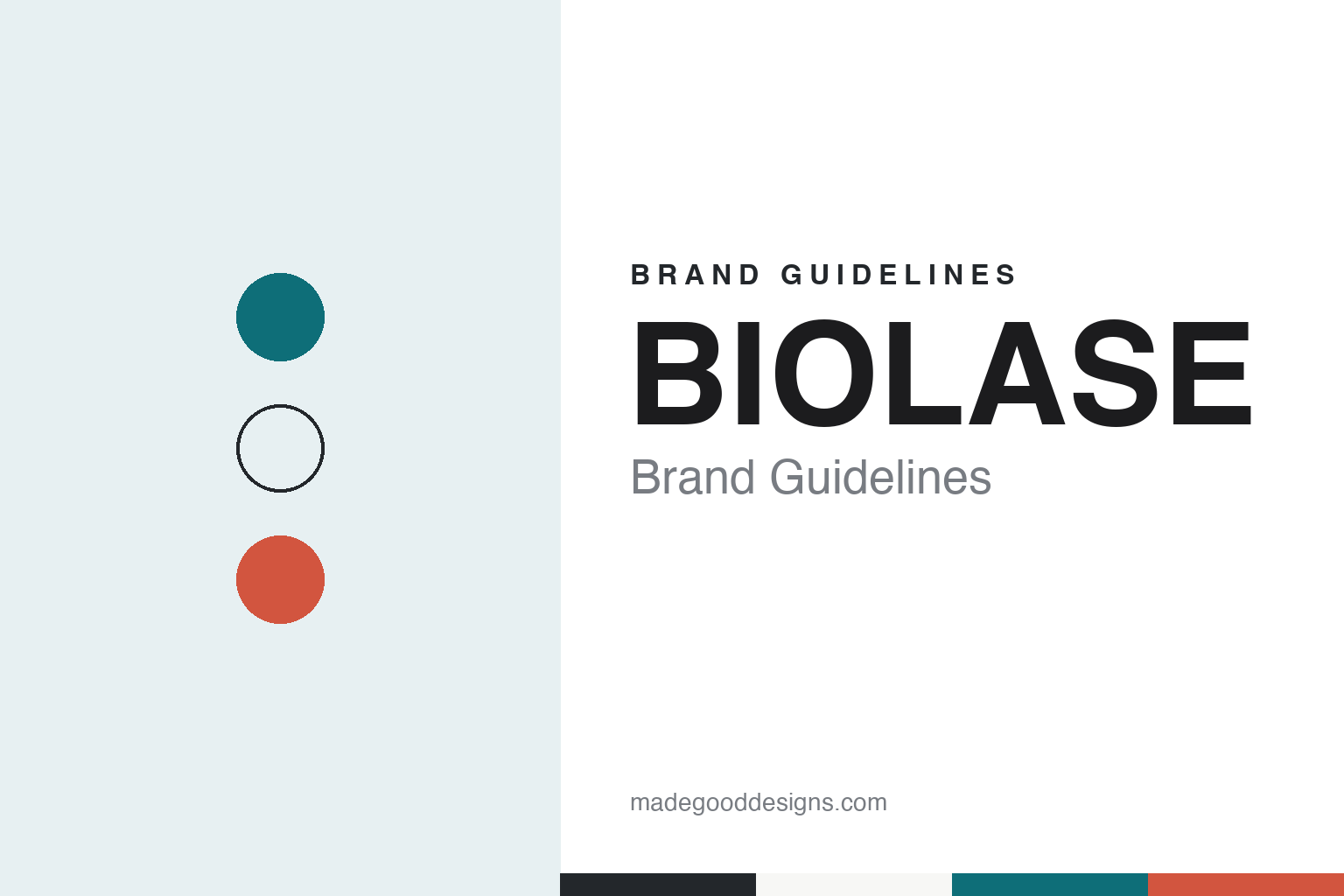
BIOLASE Brand Guidelines
The dental laser maker that began with a root-canal tool in Marseille.
Aa
Two constants: a teal, graphite and coral palette and a technical sans register. Abstract homage — not a BIOLASE product or mark; no laser, logo or packaging is reproduced.
Marseille, 1984
A root-canal tool, a move west and a new name.
BIOLASE did not begin as a laser company, nor in California. A Gale company profile, reproduced by Encyclopedia.com and giving figures up to 2006, traces it to Société Endo Technic, a small research-and-development firm founded in Marseille, France, in 1984. It worked on endodontic and laser products and developed a semi-automated root-canal handpiece called the Canal Finder System. ABL Advisor, reporting in December 2024, also gives 1984 as the founding year.
The company crossed the Atlantic in stages. In 1986, Gale says, it set up a Massachusetts sales subsidiary, Endo Technic Corporation; in 1987 the parent followed, moving its assets to a California subsidiary, and later that year Pamplona Capital Corp., a company formed to raise capital and make acquisitions, bought 77 percent of the business. Gale divides the following years into two phases of roughly seven years each: the first built around the Canal Finder System, the second around a run of new dental lasers. After several changes of name it settled on BIOLASE Technology, Inc. in 1994, by which time the root-canal handpiece had been set aside in favour of lasers.
The lasers arrived in the early 1990s. The FDA’s 510(k) database records clearance for the Laser-35, filed by Endo Technic Corporation of Tustin, California, in May 1991. Gale describes it as a 25-watt Nd:YAG dental laser, followed by the Nylad, which began shipping in 1993, and the Elmer, an erbium-chromium YSGG laser whose technology fed into the water-based cutting system that would carry the company.
Colour
Water and light.
That system was first called the Millennium. Gale says its design began in 1995 and was finished in late 1996; the FDA cleared the Millennium on 8 October 1998, according to the 510(k) database, which lists BIOLASE Technology at San Clemente, California. Sold as the Waterlase, it pairs laser energy with a water spray, a method the company called “hydrokinetic.” Jeffrey W. Jones became president and chief executive in November 1998, Gale says. The company at first relied on word of mouth among dentists, then on trade shows and sponsored seminars, to introduce the Waterlase, and had sold roughly 1,500 systems by the end of 2002.
Further FDA clearances for Waterlase followed between 2001 and 2004, and the second-generation Waterlase MD was introduced in October 2004, according to Gale. The company also sold a whitening laser, LaserSmile; formed the World Clinical Laser Institute in 2002 to train practitioners; and in mid-2003 bought the laser-related assets of American Medical Technologies. In 2006 it moved to Irvine, California, Gale says, and FDA records show its listed address changing from San Clemente to Irvine between 2006 and 2007. The company also took its lasers beyond dentistry: the FDA cleared the Oculase MD, which Gale describes as a laser for ophthalmic soft-tissue surgery, in July 2006.
Today’s range keeps two families: the Waterlase systems, which the company calls all-tissue lasers, such as the Waterlase iPlus and Waterlase MDX; and diode lasers for soft tissue under the Epic name, including the Epic X and Epic Hygiene. Education sits close to the product. The website offers Waterlase training, seminars, webinars and a podcast, and calls BIOLASE “the world leader in laser dentistry education and training,” which is its own claim.
Typography
Implants, scanners and software.
Dental implant and digital-dentistry companies sell to a narrow, expert audience, and their pictures show it. The typical product image is a small titanium screw shot on a white or pale grey ground, often beside its abutment and the driver that seats it, and lit to show the thread and the surface. Packaging tends to follow the same order: clean white boxes, colour codes for sizes, and the product line’s name set larger than the company’s.
Digital dentistry adds a second set of images. Intraoral scanners appear as slim wands next to a laptop or a cart, and the screen matters as much as the hardware: a coloured three-dimensional render of an arch, a planned implant position inside a CT slice, or a crown being shaped in design software. Milling machines and printers are shown with the blocks and discs they cut, and finished work is usually photographed as a single milled crown or bridge on a neutral surface.
The third subject is the clinician. Implant makers run training courses, symposia and hands-on sessions, and their brochures and press releases often show lecture halls and dentists at practice models rather than patients. Trade fairs carry much of that presentation: IDS, the International Dental Show in Cologne, and the congresses of the European Association for Osseointegration are where companies set up large stands, launch product lines and gather speakers.
The result is a category that looks clinical and orderly, with white space, steel greys and one or two accent colours carrying most of the identity. The companies in this guide include implant makers from South Korea, Europe, Brazil and the United States, alongside firms in intraoral scanners, lasers and CAD/CAM software. Each guide sets out who founded the company, who owns it now and what it says about where its products are made, separating documented facts from the company’s own claims.
Aa
A technical sans for a maker of laser systems. (Specimen set in IBM Plex Sans, a sans STAND-IN; NOT the BIOLASE logo.)
MegaGen
Chapter 11 and a Korean owner.
The public company did not survive in its old form. On 1 October 2024 BIOLASE filed for protection under Chapter 11 in the US Bankruptcy Court for the District of Delaware, with a sale under Section 363 of the Bankruptcy Code, ABL Advisor reported; the chief executive at the time was John Beaver, and the company said it would keep paying employees and handling orders during the proceedings, DentistryIQ reported. The court approved the dental-equipment company Sonendo as the initial “stalking horse” bidder, but MegaGen Implant of South Korea made a qualifying overbid, and the sale of substantially all of BIOLASE’s assets to MegaGen closed in November 2024, the same publication reported that December. DentistryIQ reported the completed acquisition in August 2025.
BIOLASE now presents itself as “a MegaGen Company.” Its chief executive is Kwang Bum Park, who also leads MegaGen and who wrote in a June 2025 letter on the company’s blog that the court had decided in favour of MegaGen’s bid, and that MegaGen itself had been set up in 2002 by more than 70 dentists; the company made its first public announcement under the new owner in September 2025. Its website gives its offices and education centre in Foothill Ranch, California, and its manufacturing and shipping site in Corona, California. In June 2026 the company announced investment to expand production at Corona, and in July 2026 it said it had combined its US commercial operations with MegaGen America while BIOLASE continues to lead manufacturing.
For a design guide, BIOLASE shows how a technical brand can keep its name and product families through a change of owner and country. Compare MegaGen, its Korean parent, and Dentsply Sirona, another maker of dental equipment. For this guide we use a teal, a graphite, a pale water blue and a coral with a sans, an unofficial interpretation; no product or logo is reproduced.
Explore & save
Keep BIOLASE’s identity on hand — save it to a board in the Made Good inspiration library.
BIOLASE identity set
Pin the BIOLASE teal, graphite and coral palette and the technical sans register to your own board.


