Grünbeck Brand Guidelines
The Höchstädt water firm owned by a foundation and its staff.
Aa
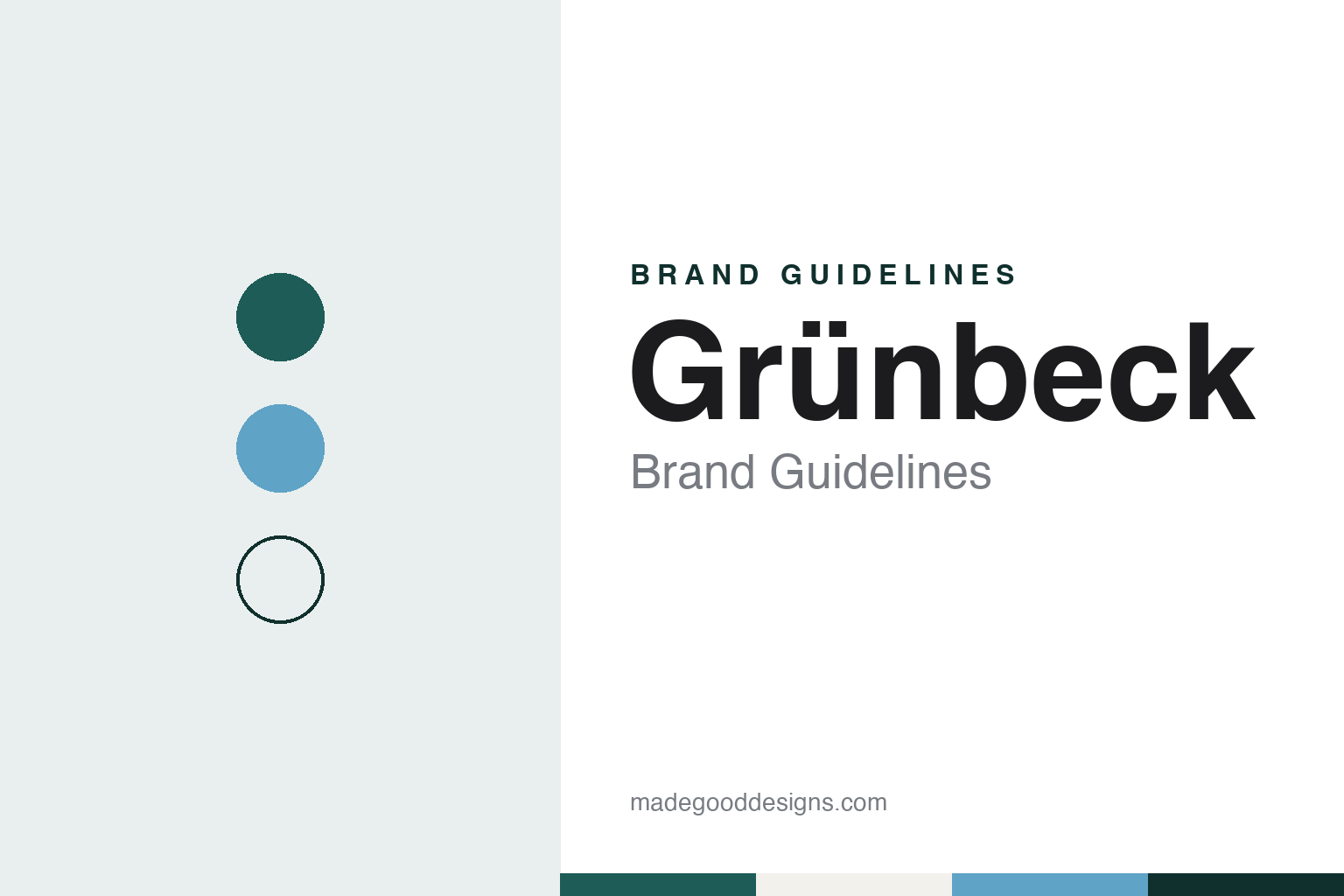
Two constants: a deep teal-green, water blue and stone palette and a clean technical sans register. Abstract homage — not a Grünbeck product or mark; no softener, filter, logo or nameplate is reproduced.
Höchstädt, 1949
A sales agency on the Danube.
Grünbeck began in 1949 in Höchstädt an der Donau, a small town on the Danube in the Bavarian district of Dillingen. The trade journal gwf Wasser, reporting the company’s 75th anniversary in September 2024, says that Josef Grünbeck set up a sales agency for technical water-treatment equipment that year. German Wikipedia adds that in its first years the business sold other makers’ products, and the company’s own history says it traded in water-treatment products without producing them.
Making came later. According to gwf Wasser, the business became the sole proprietorship “Josef Grünbeck Wasserchemie und Apparatebau” in 1967, was renamed “Josef Grünbeck Wasseraufbereitung” in 1975 and became Grünbeck Wasseraufbereitung GmbH in 1980. The company says it built a new administration and production building in Höchstädt in 1967, and that from 1980 it stepped up the development and manufacture of its own products while setting up sales companies in several European countries. German Wikipedia dates its first in-house developments to the late 1960s.
The founder also had a long public career. The Augsburger Allgemeine recorded in September 2025 that Josef Grünbeck sat on Höchstädt’s town council from 1966 to 1987, in the Bavarian Landtag from 1978 to 1982 and again in 1991 and 1992, and in the Bundestag for the liberal FDP from 1983 to 1994, and that he chaired the party in Bavaria from 1989 to 1991. In 1993 he received the Federal Cross of Merit, first class, and the Bavarian Order of Merit, the paper said.
Colour
Social partnership, a foundation and softliQ.
The company’s ownership is unusual in its trade. In 1968 Josef Grünbeck introduced what the company calls the Grünbeck model of “social partnership,” at first a share of profits for employees; German Wikipedia says that in 1988 it was widened so that staff could take a direct stake in the business. In 2010 the charitable Loni und Josef Grünbeck-Stiftung, named after him and his wife, was set up to keep the ownership stable, according to both German Wikipedia and the Augsburger Allgemeine. The foundation also awards an annual Josef Grünbeck prize to scientists, German Wikipedia says.
In 2024, the year of its 75th anniversary, the GmbH became Grünbeck AG. gwf Wasser reported that the change was meant to make shares simpler to transfer, since shares in an AG can pass without a notary, and to strengthen the brand abroad. The circle allowed to hold shares stayed the same — employees of Grünbeck, of its regional agencies and of its subsidiaries — and the foundation remained the majority shareholder. Günter Stoll heads both the AG’s management board and the foundation’s board, the journal said.
The work covers drinking water, heating and cooling water, swimming pools, and process water for drinks and food makers and power stations, German Wikipedia says, and since 2023 reverse-osmosis systems that supply ultrapure water for hydrogen electrolysis. For homes, the range covered in most detail in the sources read is the softliQ softener. Grünbeck says that a sharper brand profile and a new corporate design in March 2015 brought a new look to its building-services products, starting with softliQ, followed by the pureliQ filter series in 2017, which it says was styled to match, and the exaliQ dosing units in early 2019. Its website shows the current softliQ:SE softeners in three sizes, with a touchscreen and control through the company’s own app.
Typography
Design and documentation.
Water softener and filtration companies sell equipment that most customers rarely look at. A softener usually sits in a cellar, a garage or a utility room beside the boiler, and a filter cartridge hides under the sink or on the incoming pipe. So the brands in this guide put a lot of effort into the pictures around the product: a resin tank and a brine cabinet shown clean in a bright room, a cartridge photographed alone on a white background, and, again and again, a clear glass of water.
Much of the trade is sold through installers and dealers rather than over a shop counter. In North America many companies work through networks of local dealers, whose liveried vans carry the brand name from house to house; in Germany and its neighbours, plumbers and heating engineers specify and fit the equipment, and the makers run training centres and seminars for them. That makes the installer as much the audience for a brand as the household that pays for the system.
Trade fairs play a similar role. The Water Quality Association’s annual convention brings the North American residential and commercial water-treatment trade together, and ISH in Frankfurt, the trade fair for heating, sanitation and building services, is where many European makers show new softeners, filters and controls to installers and wholesalers.
The companies themselves range from family firms and foundation-owned businesses to units of large industrial groups, and several have changed hands more than once. This guide sets out what can be checked about each brand — who founded it, who owns it now and where its equipment is made — and marks clearly what rests only on the company’s own word.
Aa
A clean technical sans for a firm that understands water. (Specimen set in Figtree, a sans STAND-IN; NOT the Grünbeck logo.)
Grünbeck
“Wir verstehen Wasser.”
Grünbeck still makes its equipment in Höchstädt. The company says its open day for its 70th anniversary in 2019 drew about 8,000 visitors, who toured its production areas, and that in 2020 it began a long-term expansion of production, logistics and office buildings on the site that it calls “Werksplanung 2040.” The Augsburger Allgemeine reported in September 2025, citing a company press release, that more than 750 people work for Grünbeck AG in Höchstädt. German Wikipedia counts 25 regional agencies across Germany and activity in Austria, Switzerland, France, Italy and Spain; the company lists subsidiaries in Italy, Austria and Switzerland. In 2013 it opened the Grünbeck Forum, a four-storey training building where installers, planners and dealers learn about water treatment.
The brand speaks in a short line, “Wir verstehen Wasser” (“We understand water”), which runs across its website and appears in the newspaper’s 2025 report. The newspaper also quoted the company as saying that Josef Grünbeck saw water “not only as a technical medium but as a foodstuff,” an attitude it says still shapes the business. The company says that in 2022 it launched a campaign with the musician Jan Delay under the promise “Wir machen das klar,” built around his 2006 song “Klar,” and that the same year the ZEIT publishing house named it a “Marke des Jahrhunderts” in the water-treatment category. It also lists the Bavarian quality prize in 1997 and a place on a WirtschaftsWoche ranking of innovative mid-sized companies in 2014; these are the company’s own accounts.
For a design guide, Grünbeck shows how a foundation-owned, employee-held firm can give household plant a single family look, with matching names and housings across softeners, filters and dosing units. Compare Brita, another German water brand, and Culligan. For this guide we use a deep teal-green, a clear water blue and a pale stone with a sans, an unofficial interpretation; no product or logo is reproduced.
Explore & save
Keep Grünbeck’s identity on hand — save it to a board in the Made Good inspiration library.
Grünbeck identity set
Pin the Grünbeck deep teal-green, water blue and stone palette and the clean technical sans register to your own board.