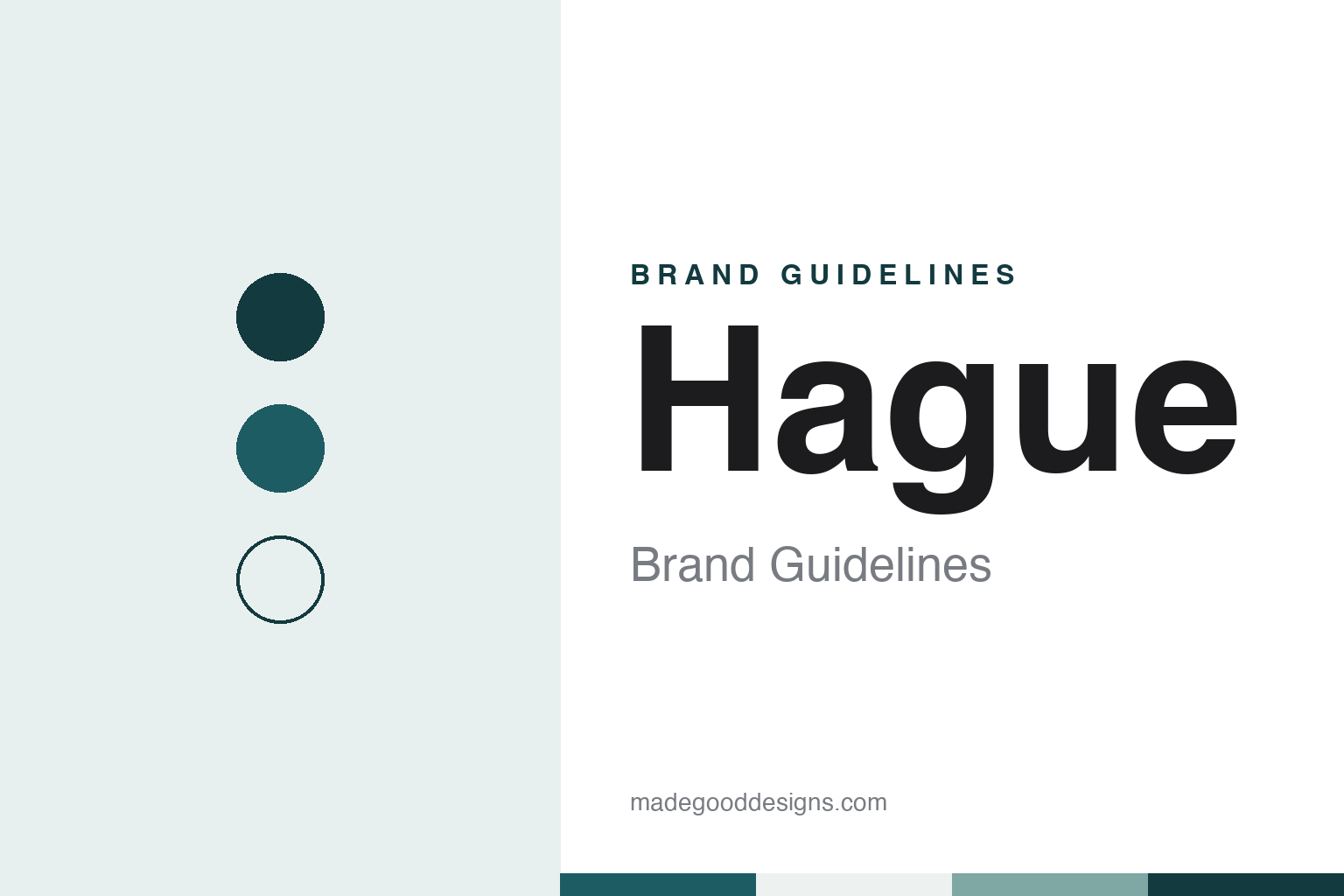
Hague Brand Guidelines
A family name from Ohio, a multi-chamber tank and a dealer network.
Aa
Two constants: a deep teal and rinse palette and a family-name serif register. Abstract homage — not a Hague product or mark; no softener, tank or logo is reproduced.
William R. Hague
A family firm and a staff of three.
Hague is an American water softener brand from central Ohio. Its full trading name is Hague Quality Water International, and the legal company behind it was William R. Hague Inc., as the trade magazine PHC Pros reported in September 2017. The company’s own account says that William R. Hague’s plan for the business began to take shape in 1960 with a staff of three, and that Hague has operated out of Ohio since that year.
Until 2017 Hague was a family-owned business: PHC Pros described it that way that year and placed it in Groveport, Ohio, a small town on the south-eastern edge of Columbus. At that point the president and chief executive was Bob Hague, who spoke of “our family-owned business” in the announcement of its sale. The company had about 100 employees, the magazine reported.
Hague’s own pitch is about engineering and about where things are made. The website says Hague products are designed, engineered and assembled in the United States, and quotes the view that “it’s important to make the product where you design it.” It also says the company exports to more than 50 countries. Those are the company’s statements; the 2017 report independently confirms the Ohio base, the family ownership and the existence of a dealer network both at home and abroad.
Colour
Chambers, patents and three names.
The product that defines Hague is a softener built around one tank divided into sections. PHC Pros described the Hague softener in 2017 as having a multi-compartment, compact tank design. The flagship is the WaterMax, now sold as the WaterMax Signature Series. Hague’s product page says buyers can choose a two- or three-compartment layout and fill each chamber with a different medium for a particular water problem, and that the unit has a built-in salt monitor, a touch-screen controller with Wi-Fi and a built-in bypass. The same page lists the unit as WQA Certified, and the company says the WaterMax holds nine United States patents.
The company sells through more than one door. According to the 2017 report, Hague products went to market through both retail stores and water quality dealers, under three names: Hague, WaterBoss and WaterMax. That split matters for design, because one maker had to look right on a store shelf and in a dealer’s showroom at the same time, with separate names doing different jobs.
Hague also describes how the units are built. On its “Hague Advantage” page the company says its softeners are made using injection moulding, laser welding and robotics, that each unit is made in-house and tested before it leaves the plant, and that it pairs the WaterMax with an H3500 reverse osmosis unit as a bundle it calls the MaxPack. Other current lines include the Maximizer and HomeGuard softeners, Hydroclean filters and the Interflo drinking-water filter.
The product pages follow the same pattern: the WaterMax page sets out the tank’s dimensions, its warranty and its certification, then explains the controller, the salt alert and the chamber options one by one. Hague also lists add-ons and a separate set of pages for dealers, including dealer education, technical support and a route for businesses that want to become Hague dealers.
Typography
Water treatment brands.
Water softener and filtration companies sell equipment that most customers rarely look at. A softener usually sits in a cellar, a garage or a utility room beside the boiler, and a filter cartridge hides under the sink or on the incoming pipe. So the brands in this guide put a lot of effort into the pictures around the product: a resin tank and a brine cabinet shown clean in a bright room, a cartridge photographed alone on a white background, and, again and again, a clear glass of water.
Much of the trade is sold through installers and dealers rather than over a shop counter. In North America many companies work through networks of local dealers, whose liveried vans carry the brand name from house to house; in Germany and its neighbours, plumbers and heating engineers specify and fit the equipment, and the makers run training centres and seminars for them. That makes the installer as much the audience for a brand as the household that pays for the system.
Trade fairs play a similar role. The Water Quality Association’s annual convention brings the North American residential and commercial water-treatment trade together, and ISH in Frankfurt, the trade fair for heating, sanitation and building services, is where many European makers show new softeners, filters and controls to installers and wholesalers.
The companies themselves range from family firms and foundation-owned businesses to units of large industrial groups, and several have changed hands more than once. This guide sets out what can be checked about each brand — who founded it, who owns it now and where its equipment is made — and marks clearly what rests only on the company’s own word.
Aa
A steady serif for a brand named after a family. (Specimen set in Source Serif 4, a serif STAND-IN; NOT the Hague logo.)
Hague
From family firm to A. O. Smith brand.
Hague’s independence ended in 2017. On 5 September 2017, PHC Pros reported, the Milwaukee-based water heater and water treatment group A. O. Smith completed its purchase of William R. Hague Inc. The magazine quoted A. O. Smith’s chairman and chief executive, Ajita G. Rajendra, as saying that the deal fitted the group’s strategy to grow its global water treatment business and that the Hague brand had “a very good, long-standing reputation for innovative and quality products.”
The same report set out why the buyer wanted it. Hague’s patented softeners filled out A. O. Smith’s home water treatment range; its compact, high-efficiency units suited the Chinese market, where A. O. Smith had begun selling Hague softeners that year; and its dealer network widened A. O. Smith’s distribution in the United States and abroad. Bob Hague said the family was happy to find a home for the business in a company with a long record of integrity and innovation.
Today the brand sits openly inside its parent. The Hague website has a page called “The A. O. Smith Connection,” which says the Hague line is now backed by A. O. Smith, and the site’s footer carries an A. O. Smith copyright and lists a contact address in Appleton, Wisconsin. Hague says its dealers are trained through A. O. Smith’s Water Quality University and in person at the A. O. Smith facility in Appleton. The family surname stays on the product even though the family no longer owns it.
For a designer, the result is an identity that has to work in two registers on the same website — a family name with a 1960 founding date on one side, and the parent group’s training, warranties and certifications on the other.
For a design guide, Hague shows how a family-named engineering brand keeps its own voice inside a much larger group. Compare Aquasana, another A. O. Smith water brand, and RainSoft, a dealer-sold softener maker from the Midwest. For this guide we use a deep teal, a pine ink and a pale rinse with a serif, an unofficial interpretation; no product or logo is reproduced.
Explore & save
Keep Hague’s identity on hand — save it to a board in the Made Good inspiration library.
Hague identity set
Pin the Hague deep teal and rinse palette and the family-name serif register to your own board.