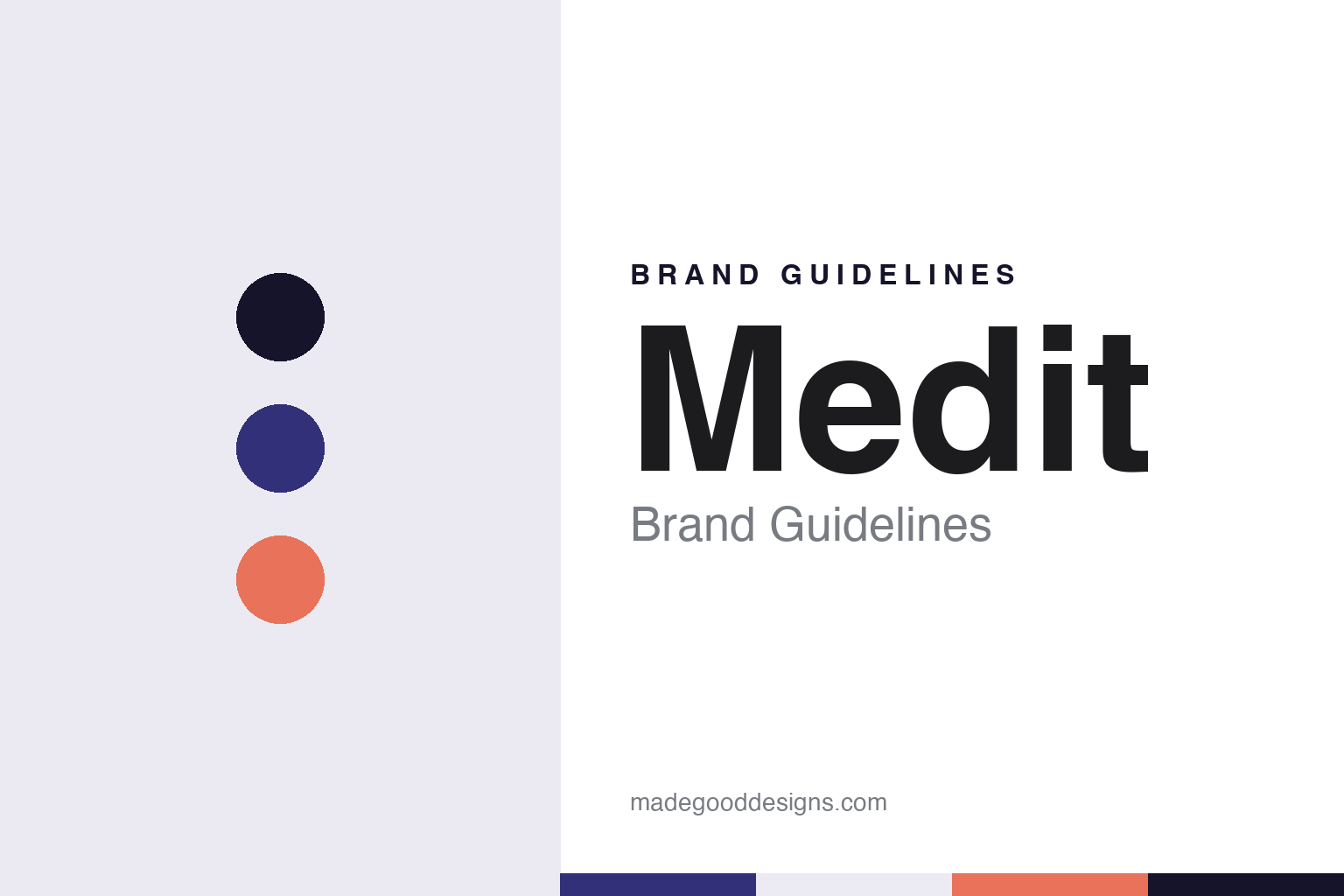
Medit Brand Guidelines
The Seoul dental-scanner maker behind the i900 and Medit Link.
Aa
Two constants: a Medit indigo, coral and porcelain palette and a Geometric sans register. Abstract homage — not a Medit product or mark; no scanner, logo or interface is reproduced.
A professor’s company
An engineering professor, a scanner maker and a push abroad.
Medit is a Seoul company that makes 3D scanners for dentistry and the software that runs them. It was founded in 2000 by Chang Min-ho, a professor of mechanical engineering at Korea University, Dental Tribune reported in December 2022. Korean names are romanised in more than one way, and the Korea Times and the Asian private-equity journal AVCJ write the founder’s name as Jang Min-ho; it is the same person.
The field Medit works in is digital dentistry. A dental 3D scanner records the shape of teeth as a digital file, which clinics and laboratories can then use to design and make crowns, bridges, aligners and other pieces without a physical impression. Intraoral scanners do this directly in the patient’s mouth with a handheld wand; laboratory scanners work from models. The Korea Times described Medit in December 2022 as a Seoul-based provider of 3D dental scanners and related solutions, and a photograph with the report showed the company’s wireless i700 intraoral scanner.
The Korea Times reported that it began expanding its global footing in 2018, setting up branches in major markets including the United States, Germany and China, and that it worked through about 230 dealerships in around 100 countries by the end of 2022. Dental Tribune dates the start of that overseas push to 2019. AVCJ described Medit as one of five companies that together held about 85 percent of the market.
Outside money arrived at the same time. In 2019 the Korean private-equity firm Unison Capital bought a 50 percent stake in the business, Dental Tribune reported, and by 2022 it was described as Medit’s largest shareholder.
Colour
The i-series scanners and an open platform.
Medit names its intraoral scanners with a lower-case “i” and a number. The wireless i700 was pictured in the Korea Times report on the company in December 2022. Its successor, the i900, was teased three weeks before its launch and officially unveiled at the end of April 2024, Dental Products Report wrote on 30 April 2024.
The i900 was presented as a piece of product design as much as a technical upgrade. According to the company’s launch release, quoted by Dental Products Report, it replaces physical buttons with a “Touch Band” that wraps around the body and a “Touch Pad,” so that the scanner can be controlled from any angle. Medit’s chief technology officer, Michael Lee, said in the release that “the brilliance of the Medit i900 lies in its sleek, unibody design,” and that there was “complex innovation within its simplicity.” Han Ryu, the company’s chief growth and strategy officer, said the 360-degree touch controls let users reach its optical engine “in just a few taps.” These are the company’s own descriptions.
The other half of the brand is software. The i900 runs on Medit Link, which the company calls its open software platform. According to the launch release, Medit Link gives access to a suite of free dental apps, connects with other platforms, services and hardware, and receives regular updates for features such as patient consultation and communication with laboratories. In the same release Medit described itself as a global provider of 3D intraoral scanners and an all-in-one digital dentistry platform that also develops software to support work shared between clinics and dental laboratories.
That pairing of hardware and an open platform is how the company presents itself, and it was also the theme of the investors who later bought it. When MBK Partners announced its purchase, it spoke of developing Medit into a digital dental platform operator with an ecosystem that reached beyond scanners to dental teams, dealers, solutions and devices, the Korea Times reported.
Typography
Design and documentation.
Dental implant and digital-dentistry companies sell to a narrow, expert audience, and their pictures show it. The typical product image is a small titanium screw shot on a white or pale grey ground, often beside its abutment and the driver that seats it, and lit to show the thread and the surface. Packaging tends to follow the same order: clean white boxes, colour codes for sizes, and the product line’s name set larger than the company’s.
Digital dentistry adds a second set of images. Intraoral scanners appear as slim wands next to a laptop or a cart, and the screen matters as much as the hardware: a coloured three-dimensional render of an arch, a planned implant position inside a CT slice, or a crown being shaped in design software. Milling machines and printers are shown with the blocks and discs they cut, and finished work is usually photographed as a single milled crown or bridge on a neutral surface.
The third subject is the clinician. Implant makers run training courses, symposia and hands-on sessions, and their brochures and press releases often show lecture halls and dentists at practice models rather than patients. Trade fairs carry much of that presentation: IDS, the International Dental Show in Cologne, and the congresses of the European Association for Osseointegration are where companies set up large stands, launch product lines and gather speakers.
The result is a category that looks clinical and orderly, with white space, steel greys and one or two accent colours carrying most of the identity. The companies in this guide include implant makers from South Korea, Europe, Brazil and the United States, alongside firms in intraoral scanners, lasers and CAD/CAM software. Each guide sets out who founded the company, who owns it now and what it says about where its products are made, separating documented facts from the company’s own claims.
Aa
A rounded geometric sans for a Seoul scanner maker. (Specimen set in Outfit, a sans STAND-IN; NOT the Medit logo.)
Medit
From Unison Capital to MBK Partners.
Unison Capital’s time as the largest shareholder ended with a sale. On 14 December 2022 Dental Tribune reported that Unison and its adviser, Citigroup Global Markets, had chosen MBK Partners, which the magazine called a prominent Asian private-equity firm, as preferred bidder. On 29 December the Korea Times reported that MBK had signed to acquire a 99.5 percent stake in Medit from Unison, about a month after being picked, in a process that had also drawn Carlyle, KKR and Blackstone.
The founder did not leave. Chang and parties related to him agreed to reinvest a considerable part of their proceeds and to remain joint investors alongside MBK, the Korea Times reported, and AVCJ added in January 2023 that Medit’s core management team was also taking part. The Korea Times said the deal was expected to close around the first quarter of 2023. In the same report the paper noted that investment bankers expected Medit and the Danish company 3Shape to grow their positions and to sharpen what it called a two-way rivalry in the industry.
The colours and type in this guide are our own choice. What the company does put forward in public is product design: the i900’s unibody form and its button-free touch controls were the centre of its 2024 launch, and its executives described the scanner’s simplicity as the point. The naming is equally plain, a letter and a number for each scanner and a single platform name for the software.
For a design guide, Medit shows how a younger hardware brand can build its identity around a clear naming system and an open software platform rather than a long heritage. Compare 3Shape, the Copenhagen scanner maker the Korea Times named as Medit’s rival, and Osstem, another Korean dental company. For this guide we use a deep indigo, a warm coral and a soft porcelain with a sans, an unofficial interpretation; no product or logo is reproduced.
Explore & save
Keep Medit’s identity on hand — save it to a board in the Made Good inspiration library.
Medit identity set
Pin the Medit indigo, coral and porcelain palette and the Geometric sans register to your own board.