Osstem Implant Brand Guidelines
The dental software firm that taught a country to place implants.
Aa
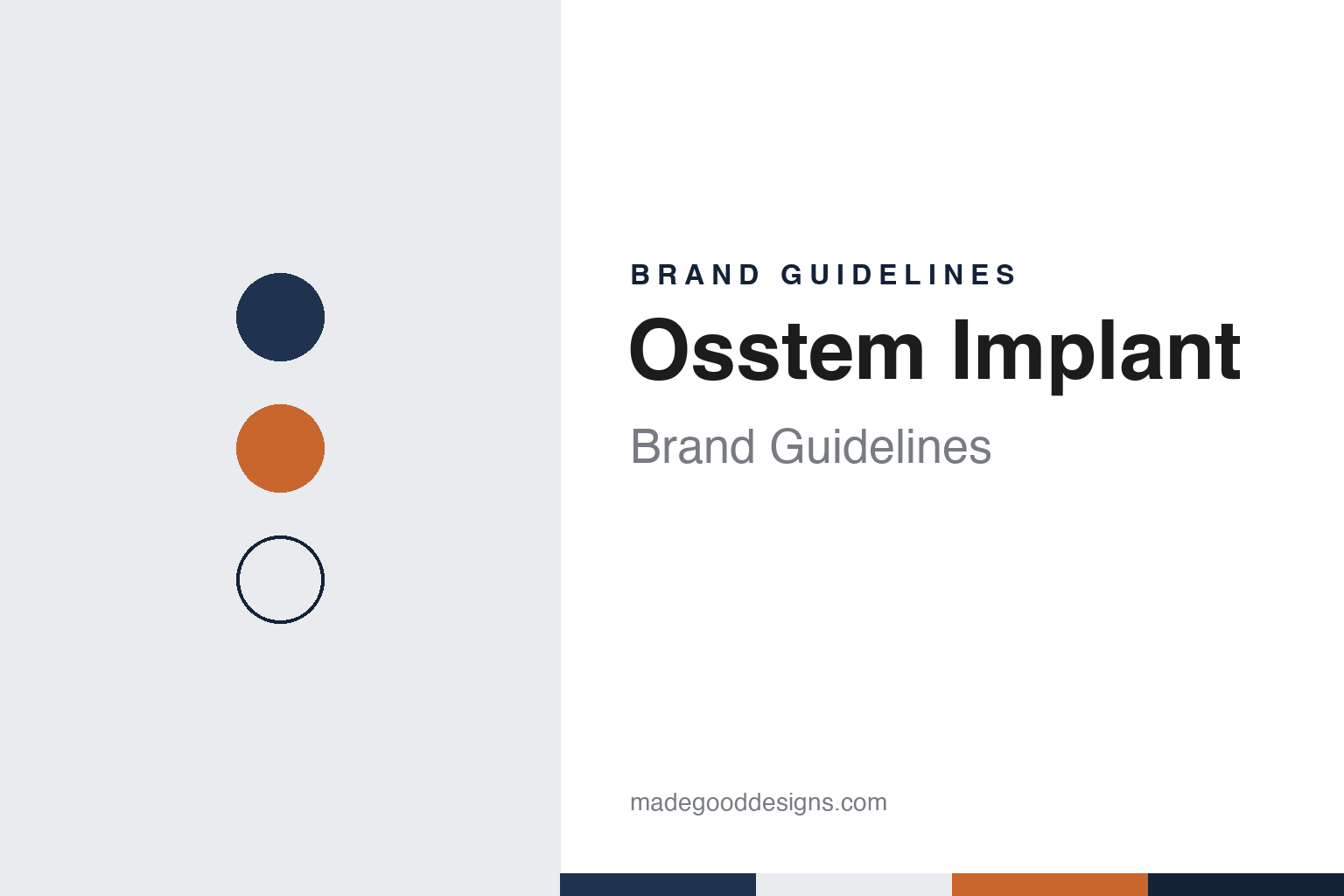
Two constants: a navy, white and orange palette and a clinical sans register. Abstract homage — not an Osstem Implant product or mark; no implant, logo or package is reproduced.
From software to implants
A dental software firm that turned to implants.
Osstem Implant did not start as an implant maker. According to a January 2007 report in the Korean business daily eToday, the company was set up in 1997 under the name D&D System. Money Today reported in August 2023 that its founder was Choi Kyoo-ok (also romanised Choi Gyu-ok), a dentist, and that its first product was software that helped dental clinics file claims under the national health-insurance scheme.
The move into implants came in 2000. Money Today reported that the company entered the business by buying Sumin, an implant manufacturer it described as Korea’s first. eToday gave the next steps: a merger with an implant company of the Osstem name in 2002 and the adoption of the present name, Osstem Implant, in 2006. By the time the company prepared its listing on the KOSDAQ market in January 2007, eToday reported, it had overseas subsidiaries in nine countries, including the United States, Japan and Germany.
The American business carries a different name. Hiossen, the company’s US arm, says it was set up by its parent Osstem in 2006 in Pennsylvania and became Hiossen Implant in 2007 in Englewood Cliffs, New Jersey. Hiossen says its implants are manufactured and packaged in Pennsylvania; that is the company’s own account.
The Korea Times, in February 2023, placed the company’s headquarters in western Seoul and described Choi as its founder and chairman, a title he still held in July 2025, when the news agency Newsis listed him among the guests at the opening of the group’s new building in Songdo.
Colour
Training as the sales pitch.
Much of Osstem’s public identity is built around teaching dentists. In an August 2022 interview with Dental Tribune International, Choi said that since the late 1990s he had performed implant surgery and developed a ten-day, 80-hour clinical training course that included a live surgical demonstration, with dentists recruited as lecturers and a dedicated education centre. He described the company’s understanding of dentists’ needs as what set it apart, and named training and keeping prices reasonable as the keys to wider use of implants.
The course later grew into a longer programme. In the same interview Choi said the Master Course, a 24-day programme in basic, surgical and prosthodontic parts, was launched officially in 2018 under the slogan “D.I.Y (do implant yourself)” and was offered by 30 overseas branches in 26 countries. He added that an online series, Osstem OnDemand, had run monthly since 2020, and that the company’s European symposium, the Osstem-Hiossen Meeting, would be held in Rome in October 2022 and in London the following year.
The product side is broad. Choi told Dental Tribune International that the company had diversified its line-up so that dentists could match products to individual cases, and named recent developments: the BA and SOI implant surface treatments, the KS (Key Solution) implant with a new connection, which Osstem Europe introduced in May 2022, and TissueMax, a product for guided bone regeneration. He also noted that the company’s dental unit chair was already sold in Europe.
He described the company’s ambitions beyond implants in the same interview: software for patient management, imaging and the design of surgical guides and prostheses; input equipment such as CBCT units and scanners; output equipment such as milling machines and 3D printers; and even design and floor-plan services for dental surgeries. “Ultimately, our aim is to become a total service provider,” he said.
Typography
How implant and digital-dentistry companies present themselves.
Dental implant and digital-dentistry companies sell to a narrow, expert audience, and their pictures show it. The typical product image is a small titanium screw shot on a white or pale grey ground, often beside its abutment and the driver that seats it, and lit to show the thread and the surface. Packaging tends to follow the same order: clean white boxes, colour codes for sizes, and the product line’s name set larger than the company’s.
Digital dentistry adds a second set of images. Intraoral scanners appear as slim wands next to a laptop or a cart, and the screen matters as much as the hardware: a coloured three-dimensional render of an arch, a planned implant position inside a CT slice, or a crown being shaped in design software. Milling machines and printers are shown with the blocks and discs they cut, and finished work is usually photographed as a single milled crown or bridge on a neutral surface.
The third subject is the clinician. Implant makers run training courses, symposia and hands-on sessions, and their brochures and press releases often show lecture halls and dentists at practice models rather than patients. Trade fairs carry much of that presentation: IDS, the International Dental Show in Cologne, and the congresses of the European Association for Osseointegration are where companies set up large stands, launch product lines and gather speakers.
The result is a category that looks clinical and orderly, with white space, steel greys and one or two accent colours carrying most of the identity. The companies in this guide include implant makers from South Korea, Europe, Brazil and the United States, alongside firms in intraoral scanners, lasers and CAD/CAM software. Each guide sets out who founded the company, who owns it now and what it says about where its products are made, separating documented facts from the company’s own claims.
Aa
A clinical sans for a training-led brand. (Specimen set in Archivo, a sans STAND-IN; NOT the Osstem Implant logo.)
Osstem Implant
A listing, a court case and a buyout.
The company’s recent history includes a serious criminal case. In 2022 a former head of its finance team was arrested and indicted for embezzling company funds over fifteen occasions between November 2020 and October 2021, the Korean daily Asia Economy reported. In January 2023 the Seoul Southern District Court sentenced him to 35 years in prison; the Seoul High Court upheld that term in January 2024, and the Supreme Court confirmed the ruling in March 2024, Asia Economy reported.
Ownership changed in the same period. In January 2023 the private-equity firms MBK Partners and UCK Partners (Unison Capital Korea) bought a stake from Choi and launched a tender offer, the Korea Times reported. After a second tender closed in April 2023, their purpose-built company, Dentistry Investment, together with Choi’s remaining shares and the company’s own shares, accounted for 96.1 percent of the stock, Asia Economy reported. Shareholders approved a voluntary delisting in June, and Osstem Implant left the KOSDAQ market on 14 August 2023, after sixteen years as a listed company.
Since then the group has kept building. In July 2025 its subsidiary Osstem Global opened the Triple Tower complex in Songdo, Incheon, Newsis reported: three linked buildings for manufacturing, research and offices, begun in December 2020 and planned as a centre for equipment manufacturing, clinical and education support, research and the development of a digital dentistry platform.
For a design guide, Osstem Implant shows a dental brand whose public face is the lecture hall and the training course as much as the product, from a company that started by writing software for dentists. Compare Dentium, another Korean implant maker founded by a dentist, and Straumann. For this guide we use a deep navy, clinic white and a warm orange with a sans, an unofficial interpretation; no product or logo is reproduced.
Explore & save
Keep Osstem Implant’s identity on hand — save it to a board in the Made Good inspiration library.
Osstem Implant identity set
Pin the Osstem Implant navy, white and orange palette and the clinical sans register to your own board.