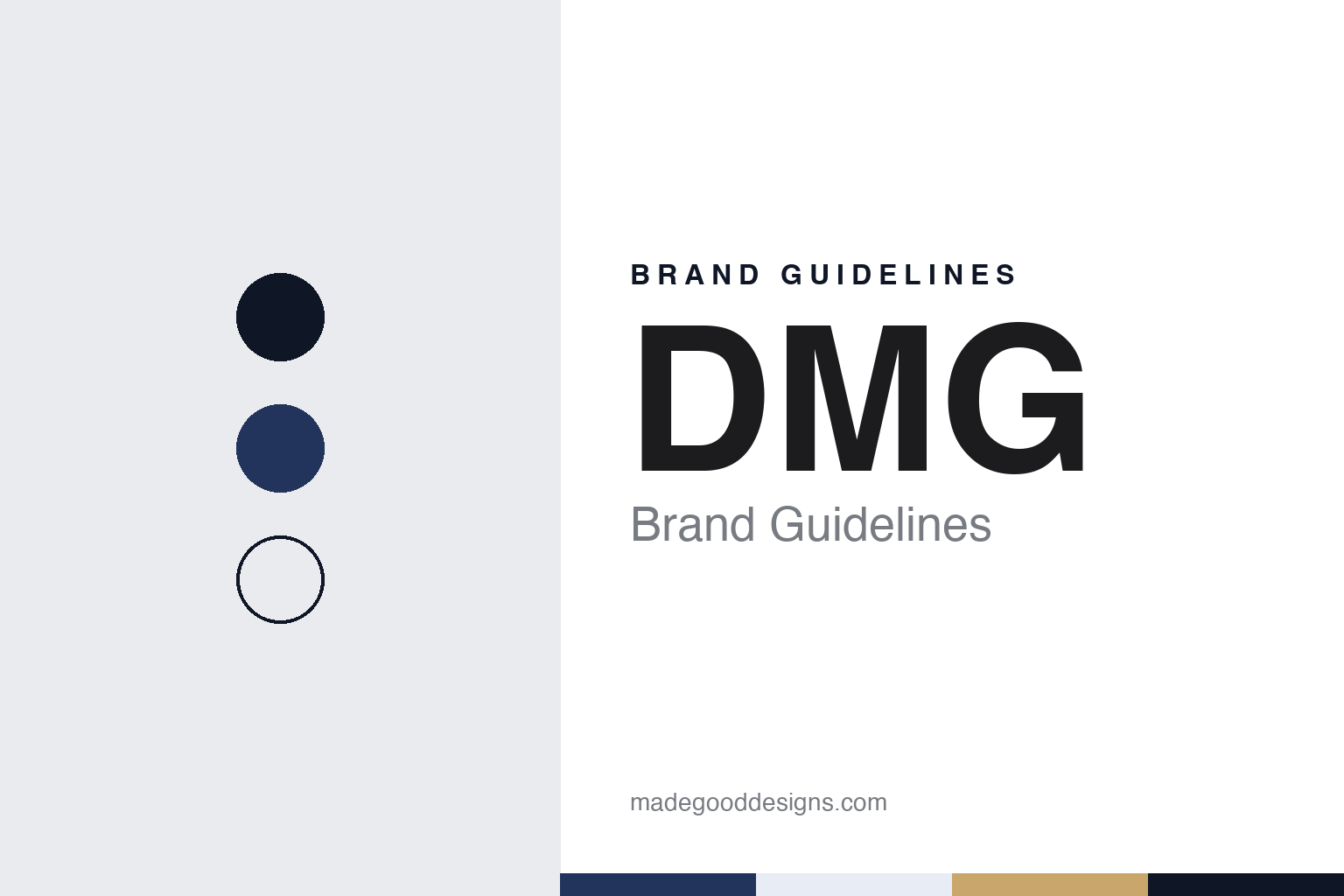
DMG Brand Guidelines
The Mühlbauer family’s dental materials maker in Hamburg-Lurup.
Aa
Two constants: a DMG harbour navy and sand palette and an Engineered sans register. Abstract homage — not a DMG product or mark; no package, logo or label is reproduced.
Dental-Material Gesellschaft
Silicate cement in Hamburg.
DMG stands for Dental-Material Gesellschaft, the “dental materials company,” and it was founded in Hamburg by Ernst Mühlbauer, a business graduate. The company and its family holding, Mühlbauer Technology, give the founding year as 1963, and the dental news site ZWP online used that year in July 2013. A DMG anniversary text carried by the same site in May 2014 gave 1964, and the company held its 50th-anniversary open day on 10 May 2014, so both dates appear in print.
It began small. Mühlbauer Technology describes DMG as Ernst Mühlbauer’s “one-man business,” started on modest capital with one aim: to make the best silicate cements on the market. The 2014 anniversary text adds that its first fields were silicate cements for the dental industry and dental impression materials, and that in 1978 it patented “Safecaps,” sealed, self-activating capsules for amalgam, which it calls a milestone.
The company has stayed in the same city. German Wikipedia’s article on Lurup, a district in Hamburg’s west, lists DMG among the businesses based there. zm, the German dentists’ journal, reported in May 2014 that DMG had marked its 50 years with an open day for staff, dentists, partners and the public, and that a new building of 6,000 square metres, recently topped out, would take over production of impression materials from that October. In his welcome speech, the journal reported, Wolfgang Mühlbauer said yes to Hamburg and yes to Germany as a location.
Colour
Luxatemp, Honigum, Icon.
DMG’s own brands came later than its manufacturing. According to the 2014 anniversary text, it began marketing products internationally under its own brand names in the 1990s with Luxatemp, a material for temporary crowns and bridges. DMG says Luxatemp was the first such material delivered from a cartridge, and that it also patented the material class known as compomers. Its milestones page then lists Honigum, an impression material, in the mid-1990s; the MixStar automatic mixing device; PermaCem, which it calls the world’s first cement from a cartridge; and Vitique, a luting composite.
The product that brought it wider attention, according to the 2014 text, was Icon, sold from 2009, which the company describes as a caries-infiltration treatment for early caries without drilling. DMG says Icon won it the German Innovation Prize, the Deutscher Innovationspreis. Other ranges include LuxaCore core build-up materials, LuxaPost root posts, the TempoCem temporary cements and the Flairesse prophylaxis line.
The newest work is digital. DMG’s milestones page dates its 3D-printing range, DMG 3Delux and the LuxaPrint resins, and its DentaMile connect printing software to 2017–2020, and says the software won a German Innovation Award. In 2021 it added DeltaFil, a glass ionomer filling material. The company says it sells in more than 80 countries, mostly through exclusive trading partners, and that about 20 percent of its staff work in research and development.
Typography
Design and documentation.
Dental materials companies sell to a narrow, expert audience, and their visual language reflects it. Catalogues and product pages tend to show the object itself: a syringe of composite, a capsule of cement or a cartridge of impression material photographed on a plain white ground, often beside the shade guide that tells a clinician which tone of tooth-coloured material to pick. Colour matters in this trade in a practical sense, because shades are part of the product.
The delivery system is part of the brand too. Makers present their materials in the form they reach the surgery — single-dose capsules, automix cartridges that fit a dispensing gun, paste-paste syringes and bottles of adhesive — and many give each range a short, memorable name that is printed large on the pack. Curing lights, mixers and dispensers add a second, equipment-led strand to many catalogues.
The other recurring image is the clinician at chairside. Companies show dentists and assistants at work, run continuing-education courses and publish clinical cases, so that the brand appears as a working tool rather than a consumer good.
Trade fairs remain central. The International Dental Show in Cologne and the Chicago Midwinter Meeting, run by the Chicago Dental Society, are where many makers launch products and build their stands, and those booths — product walls, demonstration chairs and hands-on tables — are among the most visible expressions of each company’s identity. This guide sets out what can be checked about each brand, and marks clearly what rests on the company’s own word.
Aa
An engineered sans — three capitals, DMG. (Specimen set in Manrope, a sans STAND-IN; NOT the DMG logo.)
DMG
A second-generation family business.
DMG remains a family company. In 1998 Wolfgang Mühlbauer, a chemist and the founder’s son, took over as managing director, according to the 2014 anniversary text, and zm described him the same way that year. The company’s careers site now names him and Susanne Stegen as its executive management, calls DMG “a second-generation family business,” and puts its workforce in Germany at close to 500. In 2005 the family set up Mühlbauer Technology as a holding company for DMG’s subsidiaries and later acquisitions, which it says include the American company Sterngold and the plastics firm KTR Kunststofftechnik; the holding says it does not depend on external investors and that the third generation has begun to take management roles. Other members it names are DMG Digital Enterprises and BURMS 3D Druck Jena, a 3D-printing business.
The Hamburg site is central to the brand. DMG says its products are “Made in Germany,” and a 2013 company text on ZWP online said it researches, develops and produces entirely in its own works in Hamburg. In December 2022, ZWP online carried DMG’s report of a topping-out ceremony for a new 9,000-square-metre production and storage building there, shortly after Wolfgang Mühlbauer had been named Hamburg’s family entrepreneur of the year for 2022. A December 2022 press release from the Hamburg family office Kontora, promoting a podcast interview with him, said he counted the combination of research, production and marketing at the Lurup site as an advantage. DMG also runs its own events, among them the Interdentale congress series, IconVention and courses at its Dental Training Center in Hamburg.
The name needs care. DMG is also the name of DMG Mori, the machine-tool group, which is unrelated; the dental company trades from dmg-dental.com and uses the slogan “Dental Milestones Guaranteed” for its milestones page. Its product families share prefixes: Luxa for temporaries, cores and posts, Perma for permanent cements and Tempo for temporary ones.
For a design guide, DMG shows how a family firm can carry a plain three-letter name across six decades and many product lines. Compare Kulzer, another German dental materials maker, and Kettenbach, a German maker of impression materials. For this guide we use a harbour navy and a sand with a sans, an unofficial interpretation; no product or logo is reproduced.
Explore & save
Keep DMG’s identity on hand — save it to a board in the Made Good inspiration library.
DMG identity set
Pin the DMG harbour navy and sand palette and the Engineered sans register to your own board.