Enza Zaden Brand Guidelines
From an Enkhuizen seed shop to a family-owned breeder in 26 countries.
Aa
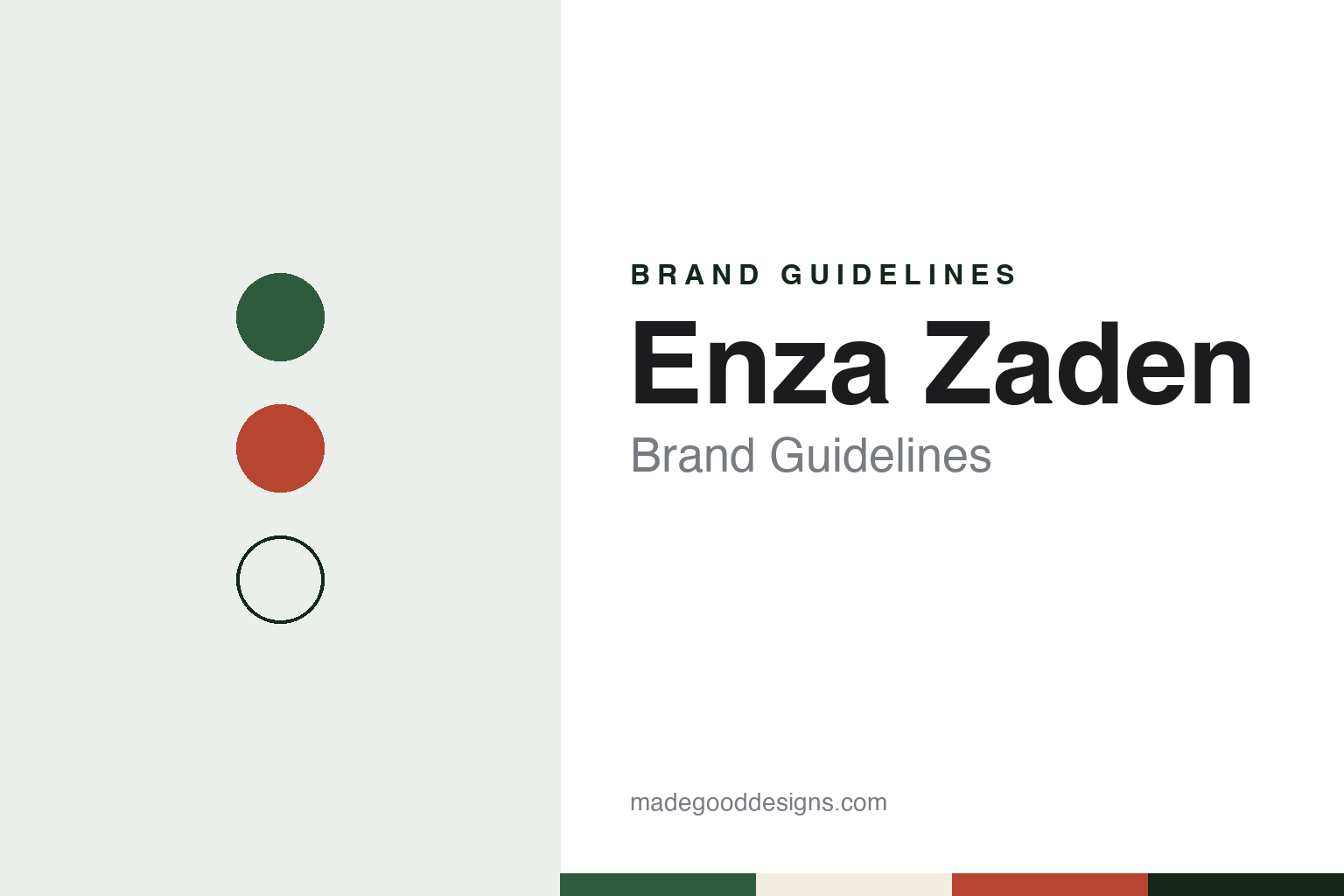
Two constants: an Enza Zaden green, cream and red palette and a plain grotesque register. Abstract homage — not an Enza Zaden product or mark; no pack, logo or variety name artwork is reproduced.
De Enkhuizer Zaadwinkel
A seed shop for allotment holders in Enkhuizen.
Enza Zaden began in 1938 in Enkhuizen, the old harbour town on the IJsselmeer in North Holland. The company says its founder, Jacob Mazereeuw, opened a shop called De Enkhuizer Zaadwinkel that sold vegetable seeds, seed potatoes and legumes to people growing food on allotments. NH Nieuws, the regional broadcaster, described the start in 2016 as a greenhouse in the centre of the town. English and Dutch Wikipedia both say the name changed in 1944 to De Enkhuizer Zaadhandel, and that “Enza” is an abbreviation of that name. The sources read for this guide do not describe the company during the German occupation of the Netherlands in 1940–45.
The turn came after the Second World War. The company says Mazereeuw then moved his attention entirely to professional growers of outdoor and greenhouse vegetables, and it quotes him crediting a broad bean variety, Ezetha’s Witkiem, with building growers’ trust in the young firm. Its own history also tells how, in the early 1950s, he found a Sicilian grower’s card in a seed packet and flew to Sicily, without speaking Italian, to buy seed directly.
Breeding followed in the next generation. According to Wikipedia, his son Piet Mazereeuw took up breeding in 1959, and his tomato Extase, introduced in 1962, was a breakthrough whose success paid for more staff, technology and breeding programmes. The company calls Extase the variety that “put us on the map.” It says the same money funded a cucumber programme shaped around British growers, which produced Monique, a hybrid with only female flowers introduced in the late 1960s.
Growth abroad came later. Wikipedia says the company expanded internationally from 1985, opening its first foreign office in the United Kingdom and then research and breeding sites in countries including Spain, Italy, Indonesia, the United States, France, Turkey and Germany, so that within fifteen years it had a worldwide presence. The company adds that in the early 1980s, to meet local rules, it shared its cucumber and tomato parent lines with a Turkish distributor so that seed could be produced in Turkey, a step it describes as a matter of mutual trust.
Colour
Tomatoes, peppers, lettuce and an organic arm.
Enza Zaden is a breeder for professional growers rather than a garden-centre brand. Wikipedia says it works on more than thirty vegetable crops, among them tomato, cucumber, pepper, lettuce, onion and melon, and that it breeds by conventional methods, without genetic modification, while using laboratory techniques to speed selection. The company says a new variety takes at least six years and often longer, and that it uses molecular marker analysis to judge young plants from their first leaves.
Its seed is grown under contract by growers around the world, the company says, and most of it comes back to Enkhuizen to be dried, sorted and cleaned before a laboratory checks germination, varietal purity and health. It says almost four million packs leave each year for its branches and distributors.
Several product lines carry their own names. In 1998 Enza Zaden became majority shareholder in Vitalis, an organic breeder, and the company says Vitalis is now wholly owned. Wikipedia says Vitalis sells under the name Vitalis Biologische Zaden and runs an expertise centre at Voorst in Gelderland. In 2009 the company began developing snack-sized sweet peppers for the United States, took them to Spain in 2012 and grouped them under the name Tribelli; it says Tribelli had become its largest segment by 2017. In 2022 it launched HREZ, a collection of tomato varieties that it describes as highly resistant to the tomato brown rugose fruit virus.
Typography
Trial fields, greenhouses and seed packs.
Vegetable seed companies sell something their customers rarely see in finished form. A breeder’s product is a variety: a tomato, a pepper, a carrot or a cabbage with traits that took years of crossing and selection to fix. The seed itself is small, dry and uniform, so most of these companies present themselves through what the seed becomes, and through the places where it is tested.
That is why the same images recur across the category. Trial fields in rows, greenhouses filled with trained tomato and cucumber plants, and close views of leaves and roots show the work of selection. Catalogues and websites favour cut tomatoes, peppers and cucumbers photographed on white, so that colour, shape and the inside of the fruit can be compared. Named varieties carry much of the message.
The audience is professional. Breeders such as these sell to commercial growers, propagators, processors and retailers rather than to home gardeners, and their packs and brochures carry practical information on sowing, growing conditions and the traits each company claims for its varieties. Several firms also show the stages that follow breeding: seed production by contract growers, then cleaning, sorting, germination testing and packing.
Open days are the most public face of the trade. In the north of North Holland, where companies including Enza Zaden and Bejo belong to the Seed Valley network, breeders invite customers to walk their trial fields and greenhouses each year; in September 2023 NH Nieuws reported that Bejo’s open days in Warmenhuizen drew visitors from about 70 countries. This guide sets out what can be checked about each company, and marks clearly what rests on its own word.
Aa
A plain grotesque for a grower’s catalogue. (Specimen set in Libre Franklin, a sans STAND-IN; NOT the Enza Zaden logo.)
Enza Zaden
Three generations of one family.
Enza Zaden has stayed in the hands of the Mazereeuw family. Wikipedia says Jaap Mazereeuw, Piet’s son and Jacob’s grandson, became chief executive in 2011, the third generation to run the business. The company now describes itself as an independent family company with more than 3,000 employees, over 45 subsidiaries and three joint ventures in 26 countries, with its headquarters in Enkhuizen, and it says it introduces around a hundred new vegetable varieties a year.
Outside recognition came in 2016. In March, NH Nieuws reported that Enza Zaden had been nominated for the Dutch family business of the year and described it as the sixth player on the world market for seed breeding. On 7 April 2016 it won: the company’s news page says the award, given each year by the Stichting Familie Onderneming, the Dutch family business foundation, was presented in The Hague, and that Jaap Mazereeuw accepted it with his father. The jury called the firm “one of the major world players in the sector.”
The company is also part of Seed Valley, which Dutch Wikipedia describes as a network of horticultural companies in the Kop van Noord-Holland, the northern tip of the province. In 2016 Jaap Mazereeuw told NH Nieuws that the area between Enkhuizen and Warmenhuizen is so surrounded by water that it never gets really cold or really warm.
For a design guide, Enza Zaden shows how a seed breeder builds a public face from the produce itself, with named varieties such as Extase and Tribelli doing the work a logo cannot. Compare Rijk Zwaan, another Dutch family vegetable breeder, and Bejo, its Seed Valley neighbour in Warmenhuizen. For this guide we use a polder green, a deep ink and a tomato red on cream with a sans, an unofficial interpretation; no product or logo is reproduced.
Explore & save
Keep Enza Zaden’s identity on hand — save it to a board in the Made Good inspiration library.
Enza Zaden identity set
Pin the Enza Zaden green, cream and red palette and the plain grotesque register to your own board.