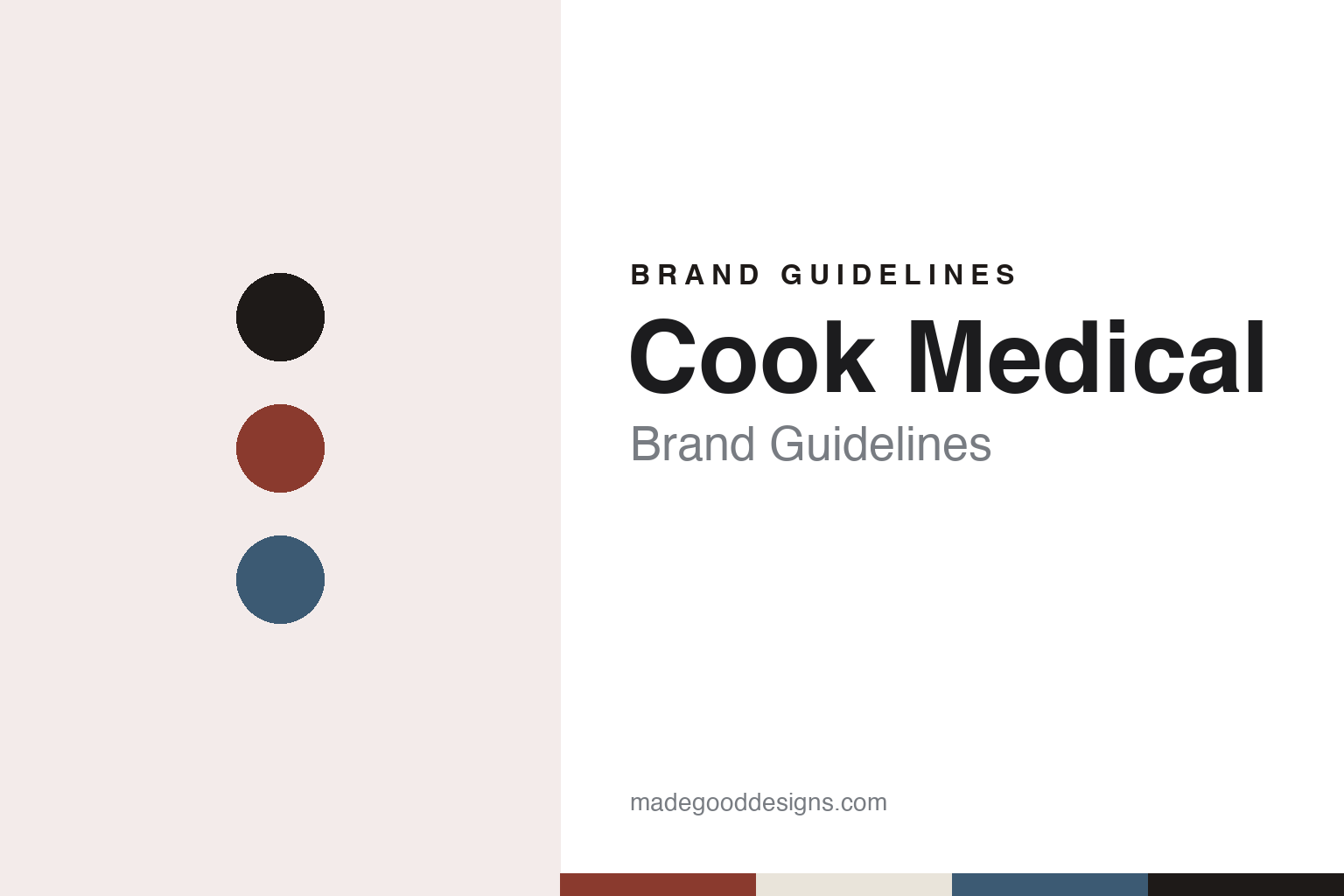
Cook Medical Brand Guidelines
Wire guides from a Bloomington spare room, and a company that stayed private.
Aa
Two constants: a Cook Medical brick, limestone and slate palette and a bookish serif register. Abstract homage — not a Cook Medical product or mark; no device, logo or label is reproduced.
A spare room
Wire guides, catheters and a technique that needed tools.
Cook Medical began in July 1963 in a spare room of an apartment in Bloomington, Indiana, where Bill and Gayle Cook made wire guides and catheters, the company says. English Wikipedia, in its article on Cook Group, dates the flagship company, Cook Incorporated, to 1963 and lists its first products as catheters, needles and wire guides. The company says these were the first percutaneous wire guides and catheters produced in the United States.
The business grew out of a technique. In the early 1950s Sven-Ivar Seldinger showed that a needle, a wire guide and a catheter could give access to the blood vessels, and, Cook says, physicians lacked properly designed tools for the method, improvising with hypodermic needles and even steel piano strings. In 1960 Bill Cook heard about that gap from a cousin who was a radiologist, according to the company’s history, and his early catalog grew from four pages to a hundred by 1969.
The range was built with doctors. Cook says Bill Cook met Charles Dotter at the Radiological Society of North America meeting in Chicago in November 1963, and that in January 1964 Dotter performed the first transluminal angioplasty on a human with a coaxial dilator system developed with Cook. Later collaborators named by the company include Cesare Gianturco, from the late 1960s, whose work led to the Bird’s Nest vena cava filter and the Gianturco-Roubin Flex-Stent; Constantine Cope, from the late 1970s, behind the Micropuncture introducer sets; and the urologist Alvin Rutner, whose work in the 1970s, the company says, laid the foundation for its urology business. From the Dotter collaboration came products such as the Dotter Transluminal Dilatation Set and the Curved Safe-T-J Wire Guide; Cook’s own timeline adds a stainless steel occluding embolus in 1975 and a coronary stent in 1993. English Wikipedia describes the Gianturco-Roubin stent as the first coronary stent approved for use in the United States.
Colour
Copenhagen, Australia and Limerick.
Cook went abroad early. In April 1969, the company says, it incorporated William Cook Europe in Copenhagen, its first operation outside the United States to make and distribute its devices. The Danish company moved to Søborg in 1972 and later to Bjæverskov, where Cook says it now employs more than 800 people. A sales subsidiary opened in Spain in 1979, followed in the early 1980s by offices in the United Kingdom, Germany, Italy, Sweden and France.
In 1979 Cook bought Hughes Medical, its distributor in Australia, and renamed it William Cook Australia; offices followed in Singapore in 1986, India in 1987, Hong Kong in 1988 and Japan in 2004, with an operations headquarters in Shanghai from 2008, according to the company. It says China had become its second-largest market by 2009, when it set up a distribution center in the Waigaoqiao Free Trade Zone outside Shanghai. In Limerick, Ireland, Cook Ireland opened in 1996; the company says it now provides about a tenth of Cook’s global manufacturing and opened an Innovation Center there in 2013.
Cook Medical is part of Cook Group, which English Wikipedia describes as a privately held company in Bloomington with medical, services and property divisions, and whose flagship Cook Incorporated, Wikipedia says, made more than 16,000 products across ten hospital service lines as of 2014. Beyond devices, Wikipedia says, the group restored and owns the French Lick Resort in Orange County, Indiana, which includes the historic West Baden Springs Hotel, and led a revitalization of downtown Bloomington around Fountain Square Mall, opened in 1988. Today the company says it serves 135 countries with about 12,000 employees across Cook Group companies, organized into Vascular and MedSurg divisions.
Typography
The category.
Hospital device makers sell to clinicians, purchasing teams and hospital engineers rather than to shoppers, and their brands are built for that audience. Their catalogues and websites tend to show the equipment where it is used: infusion pumps on poles beside a bed, dialysis machines lined up in a treatment room, monitors and consoles in intensive care.
Much of the product is small and disposable, so the pictures often come close. Gloved hands hold a catheter, a cannula or an infusion set; blood tubing is coiled for a dialysis session; a dialyzer or a single-use endoscope is photographed on plain white so that every connector and label can be read. Product names usually lean on model numbers and technical terms rather than on lifestyle words.
People appear too, usually in uniform: nurses and doctors at the bedside, technicians at a workbench, trainers at a company teaching centre. Several makers in this group run their own training facilities for clinicians, and they present them as part of what they sell alongside the devices.
The trade meets at congresses and fairs. Medica in Düsseldorf gathers hospital suppliers from around the world each autumn; ASN Kidney Week, the American Society of Nephrology’s annual meeting, draws dialysis makers; and Digestive Disease Week brings together gastroenterologists and endoscopy suppliers. Stands, booth graphics and congress brochures are where many of these brands are seen at their largest, and this guide sets out what can be checked about each company: who founded it, who owns it, and where it says its products are made.
Aa
A bookish serif for a company that tells its story through physician collaborators. (Specimen set in Source Serif 4, a serif STAND-IN; NOT the Cook Medical logo.)
Cook Medical
Narrowing the range, keeping the ownership.
In recent years Cook has narrowed its portfolio. A sale of its whole reproductive health business to CooperCompanies, announced in February 2022, was terminated in 2023, and the Federal Trade Commission welcomed the cancellation, Bloomington’s public broadcaster WFIU reported on 1 August 2023. In November 2023, Inside Indiana Business reported, Cook sold part of that business, together with some otolaryngology products, to CooperCompanies, agreeing to keep making them for at least two years while manufacturing moved to Cooper’s subsidiary CooperSurgical.
Other parts of the group have gone too. In January 2024, WFIU reported, Cook Group agreed to sell Cook Biotech, a West Lafayette company, to RTI Surgical; in September 2017 it had sold Cook Pharmica to Catalent, according to English Wikipedia. Pete Yonkman, president of Cook Medical and Cook Group, tied the 2023 sale to a five-year strategic plan: “Our vision is to get back to what we were founded on,” he said, “delivering a continuous stream of innovative new products and services.”
The ownership has not changed. When the biotech sale was announced, Yonkman said the rest of Cook Group would not change ownership and would remain privately held, WFIU reported, and the station had noted in 2023 that Cook Medical still belongs to the Cook family. The company’s own website says it is “still proudly privately held.”
For a design guide, Cook Medical shows a brand that presents itself through the physicians it worked with and the places it built, from a Bloomington apartment to plants in Denmark and Ireland. Compare Boston Scientific, another American maker of interventional devices, and Teleflex. For this guide we use a brick red, a pale limestone and a slate blue with a serif, an unofficial interpretation; no product or logo is reproduced.
Explore & save
Keep Cook Medical’s identity on hand — save it to a board in the Made Good inspiration library.
Cook Medical identity set
Pin the Cook Medical brick, limestone and slate palette and the bookish serif register to your own board.