RAGT Brand Guidelines
The 1919 Rodez farmers’ cooperative that became an international seed group.
Aa
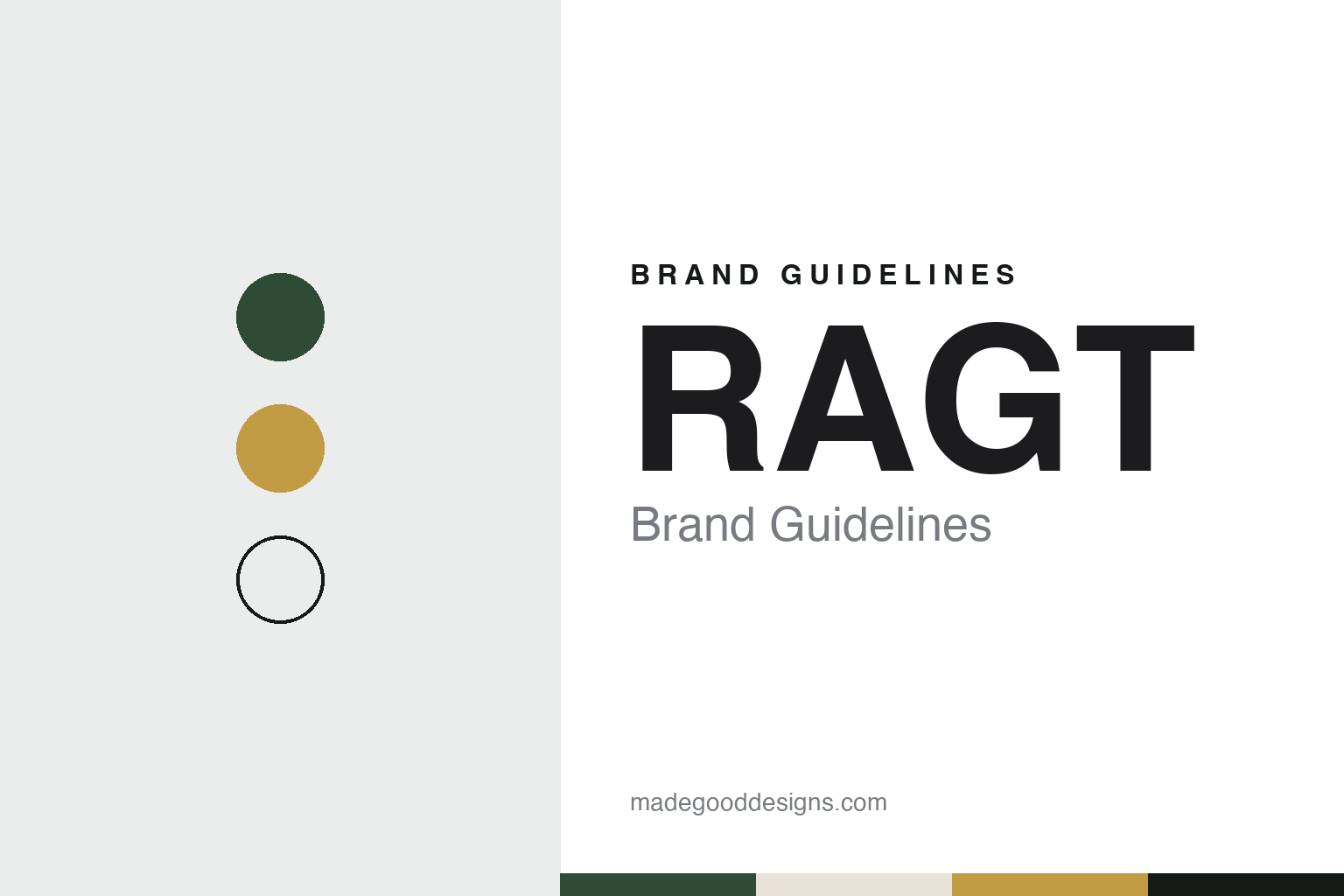
Two constants: an Aveyron green, limestone and wheat-gold palette and a regional serif register. Abstract homage — not a RAGT product or mark; no seed bag, logo or variety label is reproduced.
A cooperative in Rodez
Four old provinces in one acronym.
RAGT began in Rodez, in the Aveyron, in 1919. The name is an acronym of four historic territories of the south of France — Rouergue, Auvergne, Gévaudan and Tarnais — as both the company and French Wikipedia explain. It started as a farmers’ cooperative, founded, the company says, on the initiative of Maurice Anglade, to organise local agriculture after the First World War. Its first president, the company adds, was Charles de Rodat, himself a farmer at Druelle, just outside Rodez. The sources read for this guide do not describe the cooperative during the war years of 1939–45.
The group still quotes Anglade’s words from that year, taken from a course he gave on “the organisation of the farming profession,” in which he called for rural leaders chosen for their character, competence and know-how rather than their fortune. The company presents those words as the source of the values it claims today: rigour, professionalism and a certain boldness.
The date on which the cooperative became a company is reported in two ways. RAGT’s own timeline says the cooperative became a société anonyme in 1925; French Wikipedia and the farm magazine Réussir, in a May 2019 report on the group, give the year as 1944. RAGT’s governance page, separately, dates its present structure, with a management board and a supervisory board, to 2001.
Animal feed came early. In 1936, the company says, a partnership with the feed maker Sanders started a feed business that remains an important part of the group, and which it renewed in 2021. Plant breeding came later: RAGT dates its first variety programmes in field crops to 1954, while Réussir gives 1962 as the start of the seed activity, so the two accounts differ.
Colour
From Dekalb to a holding with three companies.
The step into Europe, the company says, came in 1972 with an agreement with the American seed company Dekalb, covering maize, sorghum and sunflower programmes. Réussir reported in 2019 that the partnership lasted almost thirty years and that, when Monsanto took over Dekalb in 1999, RAGT increased its own research spending. The company dates its first foreign subsidiary, RAGT Saaten in Germany and Austria, to 1986, and a new head office building in Rodez to 1997.
In 2004, RAGT says, its seed company bought Monsanto’s cereals business, known as PBI, which made it a major name in soft wheat and malting barley; Réussir described the purchase in 2019 as the British public programme for straw-cereal breeding. In 2010 it added Sérasem, a variety-breeding subsidiary of the cooperative group InVivo.
Since 2000 the group has been organised under a holding company, RAGT SA. Its organisation page lists three operating companies. RAGT Semences breeds, produces and sells seed, with research run through RAGT 2n. RAGT Plateau Central serves farmers in its home region of Occitanie with supplies, animal nutrition and a network of country stores, sold as RAGT Jardin & Maison and, since 2026, also as Gamm vert RAGT. RAGT Energie, created in 2008, makes CALYS agricultural pellets from biomass.
On scale, the company gives a portfolio of about 40 species, 25 research stations, 21 commercial subsidiaries and sales in more than 60 countries. Réussir, reporting in 2019, counted 32 species and noted that the historic laboratory is at Druelle, close to Rodez, and that RAGT Semences had registered 189 new varieties in 2018. The crops it names include maize for silage and grain, wheat, barley and other straw cereals, forage plants, and oil and protein crops.
Ownership has stayed close to home. RAGT says its shareholders are mostly descendants of the founding families, alongside financial partners and employee shareholders; its governance page lists the farm-sector investors Sofiprotéol and Unigrains on the supervisory board, which is chaired by Claude Tabel. The management board is chaired by Laurent Guerreiro.
Typography
Seed, field and fair.
Grass, forage and field seed companies sell something that looks almost the same in every bag, so much of their identity sits in where the seed ends up. Their pictures tend to come from three places: the finished turf of a football stadium or golf course, the cattle or sheep grazing a pasture, and the breeding plots where new varieties are tested in long rows before they reach a farmer. The Danish encyclopedia Lex, for example, illustrates its entry on DLF with a stadium pitch in Paris and a golf tournament in Arizona.
The seed bag itself often carries the brand. Bags stacked on pallets in a warehouse or a dealer’s yard are a common sight in the trade, and some companies make the bag the signature: Barenbrug says its grass seed is sold in yellow bags, and a 2020 release from its New Zealand business described the new name going onto those bags.
Many of these firms are owned by farmers or families rather than by listed groups, and they say so. DLF is held by a cooperative of Danish seed growers, according to Lex, while Barenbrug describes four generations of family ownership. Founding dates, anniversaries and long histories of mergers are therefore part of how such companies present themselves.
The trade also meets in person. Field days, demonstration plots and agricultural fairs such as Agritechnica in Germany and Farm Progress in the United States are where breeders show varieties to farmers, dealers and contractors. This guide sets out what can be checked about each company, who founded it, who owns it and what it sells, and marks clearly what rests only on the company’s own word.
Aa
A regional serif for a century-old cooperative name. (Specimen set in Source Serif 4, a serif STAND-IN; NOT the RAGT logo.)
RAGT
Sugar beet, malting barley and the Pacific.
The last few years have been busy. The company lists the integration of Seed-Force in New Zealand and Australia in 2020; a partnership with Bayer on hybrid wheat for European markets in 2021; the purchase of Tobin, an Argentine sorghum, maize and sunflower seed business, in 2022; and, in 2023, the renaming of its Australian business as RAGT Australia, together with the purchase of BASF’s wheat assets there.
The largest move came next. The trade weekly AgriTrade News reported on 12 May 2025 that RAGT had completed its purchase of the French Deleplanque Group, first announced in September 2024, bringing in the Strube sugar-beet and Van Waveren vegetable-seed businesses. RAGT’s seed-division head, Damien Robert, told the paper the deal put sugar beet among the group’s top three species. Group president Laurent Guerreiro called it consistent with the strategy shared with shareholders. In December 2025, the company says, it also completed the purchase of Syngenta’s two-row malting-barley seed business, including the Market Stainton breeding site.
Through all of this, the head office has stayed in Rodez, which the company presents as a sign of its attachment to its home region. Its 29 consumer stores, the company says, are in the Aveyron, Cantal, Lozère, Tarn, Tarn-et-Garonne and Haute-Garonne.
For a design guide, RAGT shows how a regional farmers’ cooperative can carry its origins in an acronym of old provinces while trading as an international breeder of field-crop seed. Compare Limagrain, another French seed group with cooperative roots, and KWS, the German breeder. For this guide we use a deep green, limestone and a wheat gold with a serif, an unofficial interpretation; no product or logo is reproduced.
Explore & save
Keep RAGT’s identity on hand — save it to a board in the Made Good inspiration library.
RAGT identity set
Pin the RAGT green, limestone and wheat-gold palette and the regional serif register to your own board.