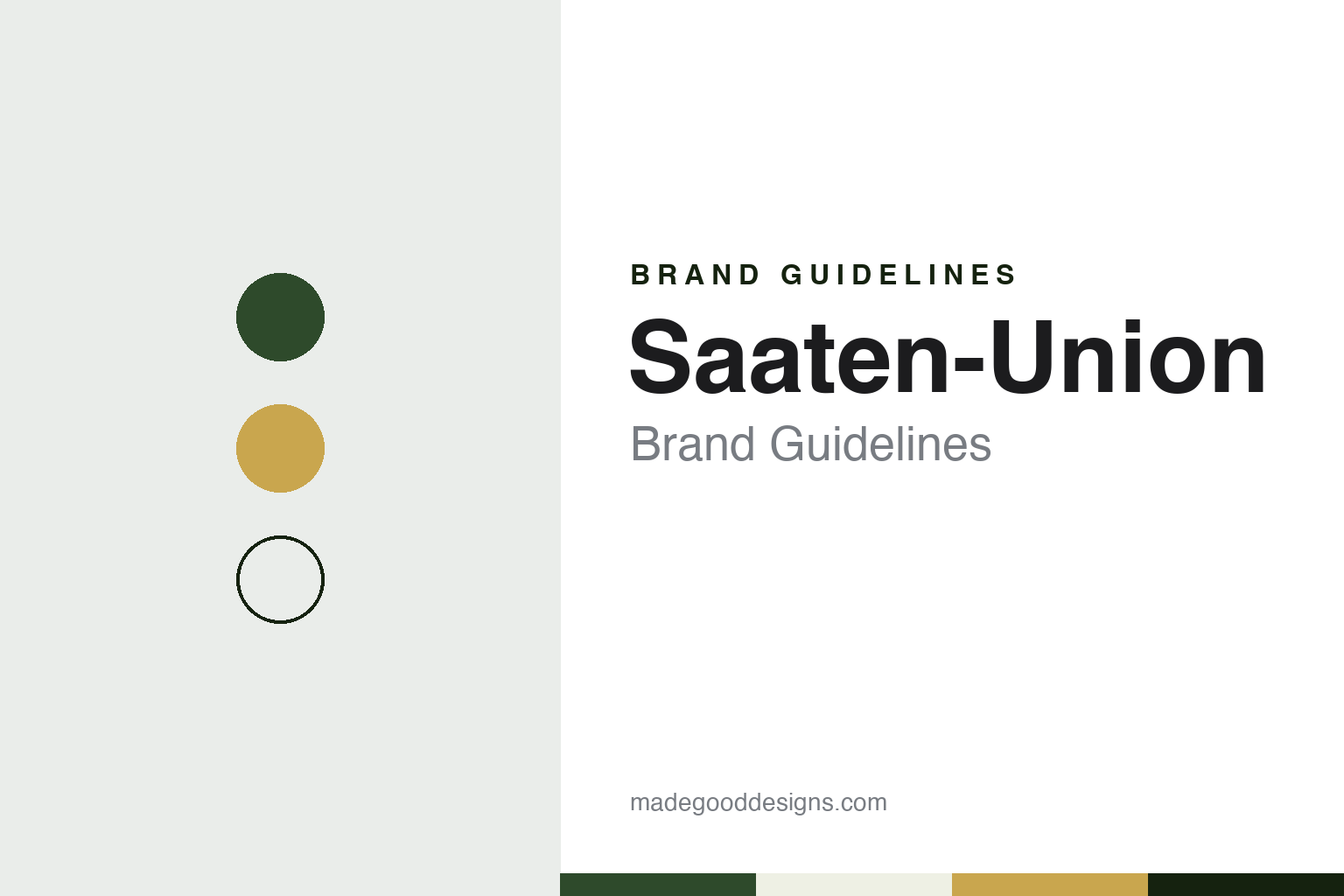
Saaten-Union Brand Guidelines
Isernhagen’s shared sales house for German plant breeders.
Aa
Two constants: a Saaten-Union field green and straw gold palette and a Plain sans register. Abstract homage — not a Saaten-Union product or mark; no seed bag, logo or label is reproduced.
A union of breeders
Five breeders, one sales house.
Saaten-Union is not a single breeding company but a sales house shared by several. German Wikipedia describes SAATEN-UNION GmbH as the marketing organisation for five medium-sized German plant breeders, selling maize, wheat, barley and rye alongside a wider choice of catch crops, grasses and peas. The company says it was founded in 1965 and is based in Isernhagen, just outside Hanover in Lower Saxony. It describes itself as the link between breeders and farming: because it understands what the market and farms will need, it says, it can breed, develop and advise with a clear aim.
The name means, roughly, “seed union,” and the structure follows it. German Wikipedia lists the shareholders as P. H. Petersen Saatzucht Lundsgaard, which it says joined in 1971; Norddeutsche Pflanzenzucht Hans-Georg Lembke, known as NPZ, which breeds oilseeds, grain legumes, grasses and clover; Dr. Hans Rolf Späth, a breeder of spelt, durum wheat and asparagus at Rastatt, founded in 1972; W. von Borries-Eckendorf, which breeds wheat, barley and fodder beet; and Nordsaat Saatzucht. The company puts it more simply: a union of five medium-sized breeders that have often grown as family businesses, and so, it says, think in generations.
The circle has changed over time. German Wikipedia records that Strube Research, of Söllingen, was a shareholder until early 2024, when it passed its stake to Saaten-Union itself, and that Ackermann Saatzucht also left during 2024.
Colour
Hybrids, legumes and catch crops.
The shareholders breed; Saaten-Union sells and advises. Its website groups the range into cereals, maize, catch crops, legumes and organic seed, with smaller lines of sunflowers, linseed, sorghum and fodder and energy beet. A few names recur across the catalogue: HySeed for its hybrid wheat and hybrid rye, viterra for catch-crop mixtures aimed at soil fertility, nature and organic farms, and V-Max for fodder and biomass mixtures. Its maize is sorted by ripening group, from early to late, under a newer programme it calls BOOST. In March 2026, the company says, Germany’s Federal Plant Variety Office registered six new cereal varieties for it: three winter wheats, a triticale, a hybrid rye and a feed barley.
Hybrid cereals run through the group’s history. German Wikipedia says Petersen became a member of the Hybro partnership in 1982 to breed hybrid rye, and that Nordsaat, which has worked on hybrid wheat since the 1950s, took over the hybrid wheat programme of the former East Germany as well as the hybrid wheat business of Hybritech, then part of Monsanto. Saaten-Union also holds the sales mandate for the varieties of HYBRO Saatzucht, the same article says.
Legumes reach it through partners. In a company news item of April 2022, NPZ wrote that its field bean and pea seed is distributed by Saaten-Union, while its oilseed rape goes through Rapool-Ring, a separate sales organisation in which NPZ is also a shareholder.
Research is shared too. In 1984 the then seven shareholders set up a joint laboratory, the Saaten-Union Resistenzlabor, according to a profile dated April 2025 and published by the German plant breeders’ association BDP. Renamed Saaten-Union Biotec in 2009, German Wikipedia says, it works from Leopoldshöhe and, since 2006, from a second site on the campus of the Leibniz Institute of Plant Genetics and Crop Plant Research. The profile says its first work was anther and microspore culture, producing doubled-haploid barley and rape — fully true-breeding plants in a single generation — along with resistance tests on young plants, and that a marker laboratory followed in 1993. The doubled-haploid method, it adds, is now used routinely in wheat, triticale and spelt as well. German Wikipedia records that the seed company Deutsche Saatveredelung joined the laboratory as its eighth shareholder in 1999, and that Solana Research, part of the Solana group, was admitted in July 2011. It now has eight shareholders, the profile says, and serves more than twenty breeding companies and research institutions.
Typography
Design and documentation.
Grass, forage and field seed companies sell something that looks almost the same in every bag, so much of their identity sits in where the seed ends up. Their pictures tend to come from three places: the finished turf of a football stadium or golf course, the cattle or sheep grazing a pasture, and the breeding plots where new varieties are tested in long rows before they reach a farmer. The Danish encyclopedia Lex, for example, illustrates its entry on DLF with a stadium pitch in Paris and a golf tournament in Arizona.
The seed bag itself often carries the brand. Bags stacked on pallets in a warehouse or a dealer’s yard are a common sight in the trade, and some companies make the bag the signature: Barenbrug says its grass seed is sold in yellow bags, and a 2020 release from its New Zealand business described the new name going onto those bags.
Many of these firms are owned by farmers or families rather than by listed groups, and they say so. DLF is held by a cooperative of Danish seed growers, according to Lex, while Barenbrug describes four generations of family ownership. Founding dates, anniversaries and long histories of mergers are therefore part of how such companies present themselves.
The trade also meets in person. Field days, demonstration plots and agricultural fairs such as Agritechnica in Germany and Farm Progress in the United States are where breeders show varieties to farmers, dealers and contractors. This guide sets out what can be checked about each company, who founded it, who owns it and what it sells, and marks clearly what rests only on the company’s own word.
Aa
A plain sans — SAATEN-UNION in capitals. (Specimen set in Inter Tight, a sans STAND-IN; NOT the Saaten-Union logo.)
Saaten-Union
SAATEN-UNION in capitals.
Saaten-Union also works beyond Germany under its own name. German Wikipedia says it uses the name as an umbrella brand through subsidiaries in France, the United Kingdom, the Czech Republic, Poland, Romania, Hungary, Russia and, since 2009, Ukraine, with sales partnerships in other countries. At home, its website points farmers to regional sales advisers and to practical tools — calculators for sowing rates, catch crops and legumes, and a planner for the silage maize harvest — as much as to any single product.
For an identity, that leaves the name to do much of the work. The company writes it in capitals, SAATEN-UNION, on its website and its own facts page, and the same name sits over hybrid cereals, catch-crop mixtures and legumes alike. The company presents the brand as a group of family-grown breeders and the advice that links them with farmers, rather than as the story of one founder.
For a design guide, Saaten-Union shows how a shared sales house can carry several breeders under one name. Compare KWS, another seed breeder from Lower Saxony, and Limagrain, a seed group built by a farmers’ cooperative. For this guide we use a deep field green and a straw gold with a sans, an unofficial interpretation; no product or logo is reproduced.
Explore & save
Keep Saaten-Union’s identity on hand — save it to a board in the Made Good inspiration library.
Saaten-Union identity set
Pin the Saaten-Union field green and straw gold palette and the Plain sans register to your own board.