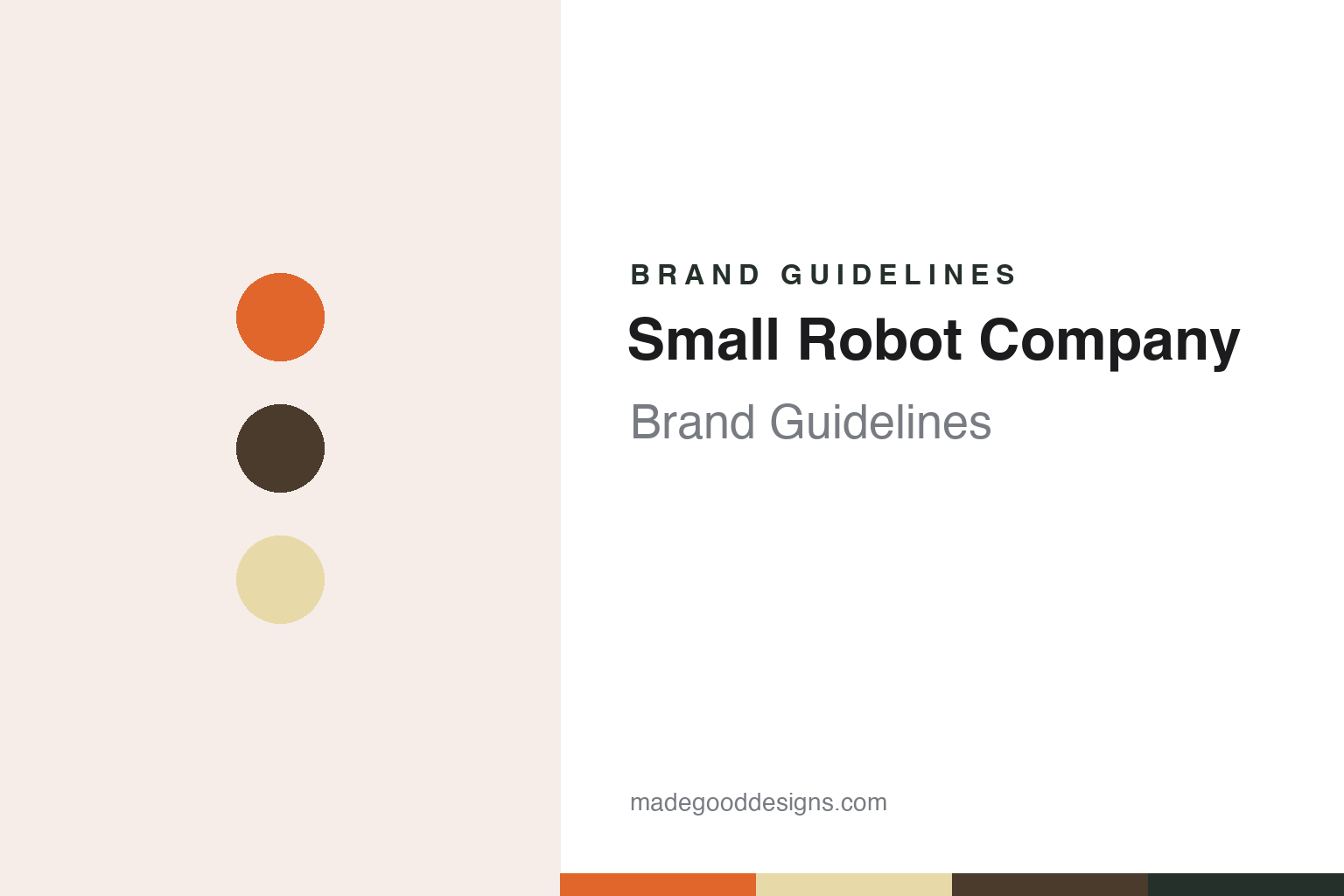
Small Robot Company Brand Guidelines
The Wiltshire start-up that named its farm robots Tom, Dick and Harry.
Aa
Two constants: a prototype orange, loam and wheat palette and a Friendly serif register. Abstract homage — not a Small Robot Company product or mark; no robot, logo or nameplate is reproduced.
Farming-as-a-Service
Three founders and a different kind of farm machine.
Small Robot Company was a British agricultural-robot start-up based near Salisbury, in Wiltshire. The Robot Report gives its founding year as 2017 and its founders as Ben Scott-Robinson, Sarra Mander and Sam Watson Jones. The technology site diginomica reported in 2018 that the company was officially launched in November 2017, and the company later said it had first been unveiled that year at REAP, the agri-tech conference run by Agri-TechE. Scott-Robinson was its chief executive; Watson Jones, described by Farmers Weekly in 2018 as a fourth-generation farmer, was later its president. Notices in The London Gazette give its line of business as the manufacture and development of agricultural machinery.
Its idea was to replace large tractors with small, light robots that worked plant by plant, and to sell the result as a service rather than a machine. Scott-Robinson told diginomica in 2018 that under “Farming-as-a-Service,” farmers would not buy a robot but would pay per hectare for the work, moving them away from paying upfront for costly machinery. He said the robots were smaller, lighter and more precise than typical farm machinery, and caused less damage to the soil; we give that as the company’s view.
The company built the service with farmers. diginomica reported a Farmer Advisory Group of 20 farmers who had signed up to trial the system in their own fields, take part in user testing and advise on how soils and crops behave. In the same report, Scott-Robinson said the robots that made occasional visits would be sent out from the company’s base, which it called Small Robot Central.
Colour
Robots with everyday names.
The company was known for naming its machines like people. Tom was a monitoring robot that drove across fields photographing crops; Dick was planned as a weeding and spraying robot; Harry was a planting, or drilling, robot; and Wilma was the artificial-intelligence system that tied them together, according to Farmers Weekly in 2018 and The Robot Report in 2024. The Robot Report added that Dick never got beyond early trials. An early Tom prototype working on trial farms had a name of its own, “Rachel,” diginomica reported.
The first Tom was a small, practical machine. Farmers Weekly described the 2018 prototype as bright orange and no bigger than a cocker spaniel, built partly from 3D-printed parts on a chassis bought from a company in Kansas. An Android phone on its back took around three photographs a second, a Trimble GPS dome gave it positioning, and a laser range finder at the front helped it detect objects. The plan, Farmers Weekly reported, was for many data-gathering Toms, each able to survey about 250 hectares in a fortnight. Wilma, which diginomica said was built in-house on Canonical’s Ubuntu and the open-source Robot Operating System, had by then learnt to tell wheat from grass weeds, Farmers Weekly reported.
The company called its approach “Per Plant Farming.” In November 2022, five years after its first showing at REAP, it launched Tom v4, its next-generation monitoring robot. In an announcement published by Farming Online, it said Tom v4 was rolling out to 20 farms that month for its first commercial services, with work planned in Suffolk and Shropshire, and that trials were pending with the James Hutton Institute in Scotland, the crop-nutrient company Mosaic and the produce grower G’s Growers.
Typography
Design and documentation.
Precision-farming and agricultural-robot companies sell technology that most people never see up close, so their imagery has to do a lot of explaining. The most familiar picture is a machine working a long crop row, shot low and often in the warm light of early morning or evening, with the rows running away toward the horizon. It speaks of scale and repetition: the field is large, and the machine passes over every metre of it.
The second recurring picture is the screen. Guidance and control makers show in-cab displays filled with colour field maps — bands of colour for harvest, seeding or coverage — with a small tractor or sprayer icon tracing its path. Drone-eye views of fields do similar work from outside the cab, turning a farm into a grid, a patchwork or a set of passes that reads almost like a diagram.
People appear too, usually as working figures rather than models: a farmer at the edge of a field holding a tablet, an engineer kneeling beside a robot between the plants, a dealer pointing at a display. Robot makers lean on close-ups of cameras, solar panels and wheels, and on small machines set against wide open ground.
Much of this imagery is made for the trade-show calendar. Launches cluster around large events such as Agritechnica in Hanover, World FIRA, the agricultural-robotics meeting in France, and the Farm Progress Show in the American Midwest, where companies build branded stands, demonstration plots and live field runs. For a designer the visual language is consistent: greens and earth tones taken from the field, high-contrast interface colour taken from the screens, and clean sans-serif type that looks at home on a display.
Aa
A friendly serif — robots called Tom, Dick and Harry. (Specimen set in Fraunces, a serif STAND-IN; NOT the Small Robot Company logo.)
Small Robot Company
Liquidation in February 2024.
The company did not survive. Farmers Weekly reported in February 2024 that a lead investor had pulled out in spring 2023 and that Small Robot Company had then turned to crowdfunding, with many farmers among its investors. It was not enough. On 1 February 2024 resolutions were passed that the company could not continue its business because of its liabilities and should be wound up voluntarily, and two liquidators from Kroll were appointed, according to notices in The London Gazette.
In a statement that day, quoted by FarmingUK and Farmers Weekly, the company said it had had a signed term sheet but “the investment did not land before our runway ended,” that “with this attempt we were too early for the market,” and that “our chapter in the fourth agricultural revolution is over.” It told The Robot Report it had been a victim of the “valley of death” that hardware start-ups face between prototype and scale. Kroll was to sell the company’s assets, and the company said it was working to find acquirers for some of its team and technology.
One of its robots kept working. The Scottish Farmer reported in February 2024 that the James Hutton Institute’s Tom v4, which had been shown on the institute’s stand at the Royal Highland Show, would stay at the Hutton as a research tool for crop breeding and biodiversity monitoring, with engineering and technical support from the National Robotarium.
For a design guide, Small Robot Company shows how a start-up can make farm machines approachable by giving them everyday names rather than model numbers. Compare Naio Technologies, a French maker of small farm robots, and FarmDroid, the Danish field-robot maker. For this guide we use a prototype orange, a loam brown and a wheat with a serif, an unofficial interpretation; no product or logo is reproduced.
Explore & save
Keep Small Robot Company’s identity on hand — save it to a board in the Made Good inspiration library.
Small Robot Company identity set
Pin the Small Robot Company prototype orange, loam and wheat palette and the Friendly serif register to your own board.


