DONMARIO Brand Guidelines
The Chacabuco soybean brand that grew into GDM.
Aa
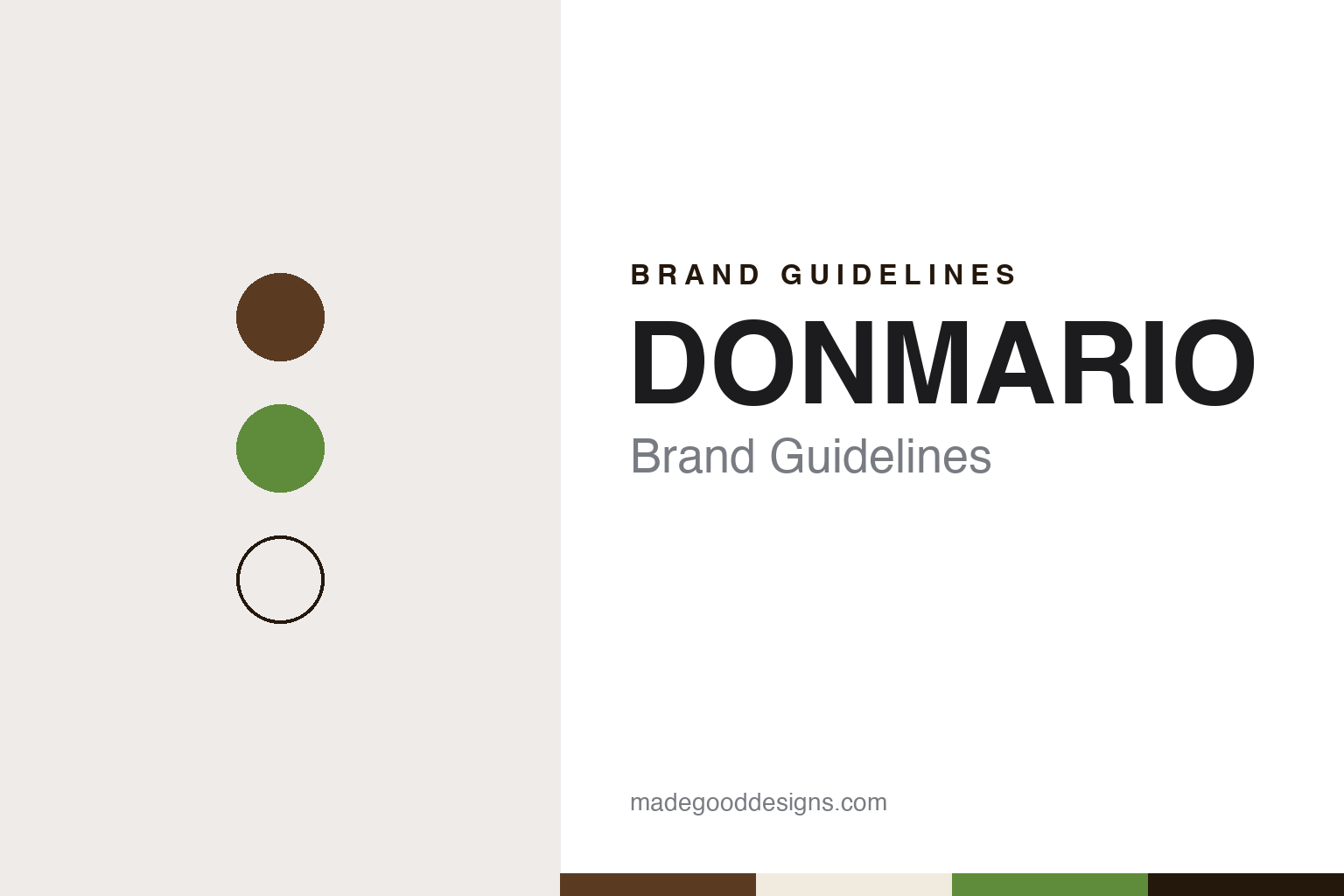
Two constants: a DONMARIO soil brown and leaf green palette and a Plain sans register. Abstract homage — not a DONMARIO product or mark; no seed bag, logo or label is reproduced.
Chacabuco, 1982
Borrowed hectares and a soybean bet.
DONMARIO began on borrowed land. The Argentine farm news site Bichos de Campo, interviewing co-founder Gerardo Bartolomé in November 2019, reported that the company was born in 1982 in Chacabuco, in Buenos Aires province, when a group of young agronomists sowed a trial of soybeans on 50 hectares lent by the mother of one of them, César Belloso, a Pergamino farmer who had studied with Bartolomé. A third agronomist, Daniel Canova, joined them. Soybeans then covered about one million hectares in Argentina, the site reported, and seed came mainly from a few suppliers and from varieties brought in from American universities.
GDM, the group the company has become, tells a similar story on its website: in the early 1980s Gerardo Bartolomé, his brother Alejandro and four friends travelled from San Isidro to Chacabuco and, under the name “Don Mario,” grew an American soybean variety, Mitchell. That seed, GDM says, led to one of its most successful varieties, DM49.
The name came from Alejandro Bartolomé’s second name, Mario, Bichos de Campo reported. The seed business proper took shape in the mid-to-late 1980s, when the partners saw how few soybean varieties Argentine farmers could choose from and set out to build an Argentine seed brand. They brought in earlier-maturing Group IV varieties at a time when Group V seed was the norm. The first variety was registered in 1988, according to the 2019 interview; GDM says that by 1989 Don Mario had developed its first variety.
The brand’s website still gives its head office, its “casa central,” on Route 7 at Chacabuco, with a second office at San Isidro, north of the city of Buenos Aires.
Colour
Soybean first, then wheat.
Soybeans stayed at the centre. Bartolomé told Bichos de Campo that the company began its own trials in the mid-1990s, and that when glyphosate-tolerant RR soybean reached Argentina it was the first to launch a Group IV variety carrying the trait — his account. He described the company as a specialist in soybean improvement. The brand’s Argentine website today offers soybean and wheat, presents soybean lines under the names DM Enlist and DM Conkesta, and promotes a programme it calls Sembrá Evolución, “sow evolution.”
Growth came in steps. The first move abroad was across the River Plate to Uruguay; from 2003 the company entered Brazil, Bolivia and Paraguay; and it began research in the United States in 2008, Bartolomé said in 2019. Brazil, the world’s second-largest soybean producer after the United States, was the key step, the site wrote. By 2019 the company had also set foot in Eastern Europe and South Africa and had finished its first trials of its own varieties in China, the original home of the crop, he said. By then, he explained, “Don Mario became a brand,” and GDM served as an umbrella for eight to ten brands across the countries where it worked.
GDM now describes itself as a global leader in plant genetics for row crops and says that 47 percent of the world’s soybean production is grown from its genetics; both are the company’s own statements. KWS, announcing the AgReliant sale in 2025, called GDM the world leader in soybean genetics. Its website lists sites in the United States, Brazil, Argentina, Uruguay, Paraguay, Canada, Spain, France, Hungary, South Africa and China, names Ignacio Bartolomé as chief executive, and gives its offices at San Isidro. In 2026 its news pages covered its presence at the ISF World Seed Congress.
Typography
Design and documentation.
Grass, forage and field seed companies sell something that looks almost the same in every bag, so much of their identity sits in where the seed ends up. Their pictures tend to come from three places: the finished turf of a football stadium or golf course, the cattle or sheep grazing a pasture, and the breeding plots where new varieties are tested in long rows before they reach a farmer. The Danish encyclopedia Lex, for example, illustrates its entry on DLF with a stadium pitch in Paris and a golf tournament in Arizona.
The seed bag itself often carries the brand. Bags stacked on pallets in a warehouse or a dealer’s yard are a common sight in the trade, and some companies make the bag the signature: Barenbrug says its grass seed is sold in yellow bags, and a 2020 release from its New Zealand business described the new name going onto those bags.
Many of these firms are owned by farmers or families rather than by listed groups, and they say so. DLF is held by a cooperative of Danish seed growers, according to Lex, while Barenbrug describes four generations of family ownership. Founding dates, anniversaries and long histories of mergers are therefore part of how such companies present themselves.
The trade also meets in person. Field days, demonstration plots and agricultural fairs such as Agritechnica in Germany and Farm Progress in the United States are where breeders show varieties to farmers, dealers and contractors. This guide sets out what can be checked about each company, who founded it, who owns it and what it sells, and marks clearly what rests only on the company’s own word.
Aa
A plain sans — DONMARIO as one word in capitals. (Specimen set in Inter Tight, a sans STAND-IN; NOT the DONMARIO logo.)
DONMARIO
A founding brand inside GDM.
The group has since reached well beyond soybeans. On 2 August 2024 the German breeder KWS said it had closed the sale of its South American corn business to GDM, under an agreement reached that March. In June 2025 KWS and Limagrain announced the sale to GDM of AgReliant Genetics, the North American corn and soybean seed joint venture they had set up in 2000, with closing expected in the third quarter of that year. In February 2026 GDM announced a realignment of its US brands around AgriGold, Mustang Seeds and a new Producers Hybrids, effective for the 2027 season, with LG Seeds folded in; it said its other US brands, “including DONMARIO,” would carry on as usual.
That leaves DONMARIO as the founding name inside a larger group. The company writes it in capitals and as one word, DONMARIO, while the press often writes “Don Mario,” as Bichos de Campo did in 2019. Its Argentine website calls it a leader in research and genetics for seed, says it has worked “codo a codo,” shoulder to shoulder, with farmers for more than 40 years, and leans on a network of seed multipliers across the region.
For a design guide, DONMARIO shows a founding name kept as a product brand after its company took a new group name. Compare KWS, which sold its South American corn business to GDM, and Limagrain, a former partner in AgReliant. For this guide we use a soil brown and a leaf green with a sans, an unofficial interpretation; no product or logo is reproduced.
Explore & save
Keep DONMARIO’s identity on hand — save it to a board in the Made Good inspiration library.
DONMARIO identity set
Pin the DONMARIO soil brown and leaf green palette and the Plain sans register to your own board.