Mahyco Brand Guidelines
A Jalna seed company that put hybrids, and Bt cotton, into Indian fields.
Aa
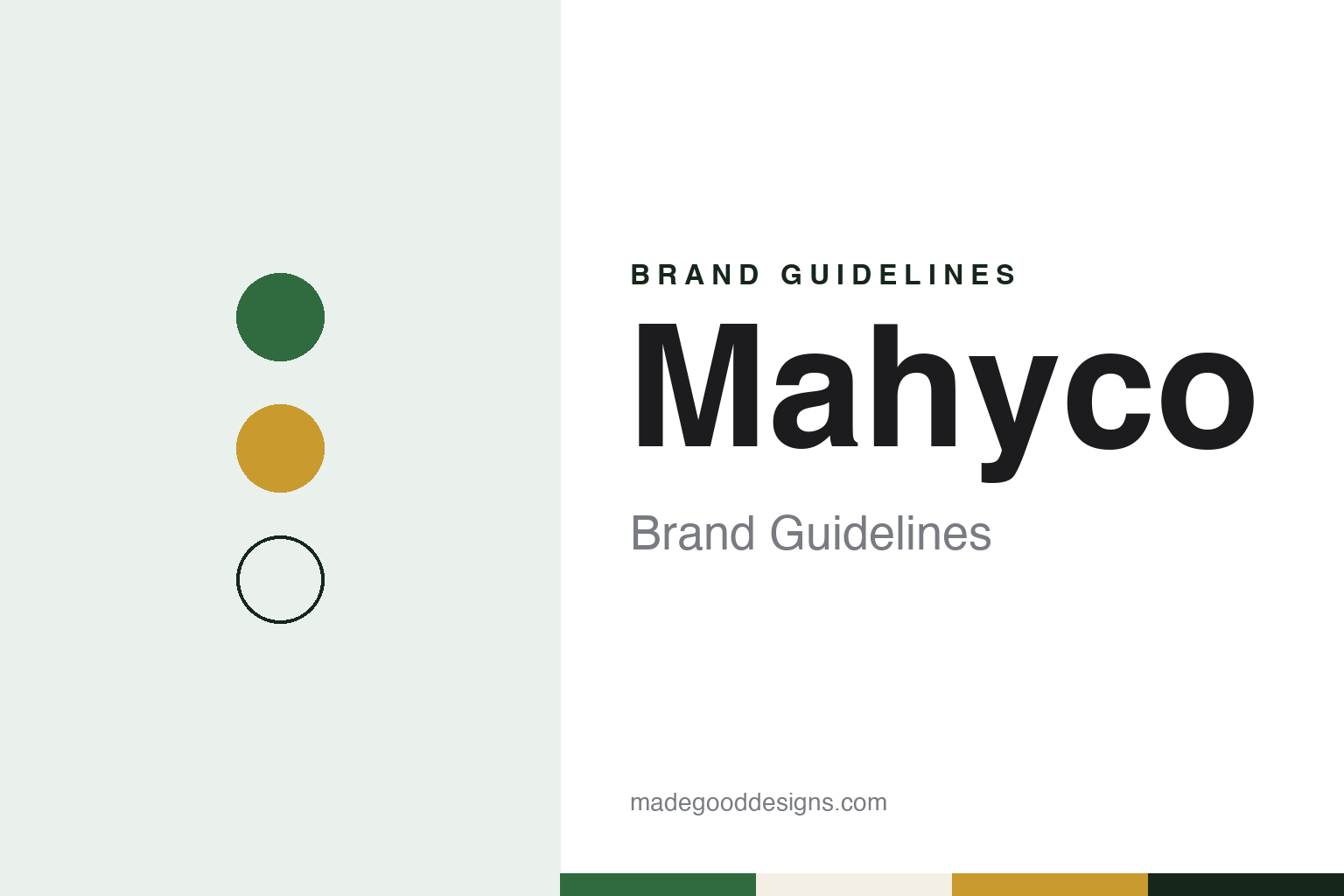
Two constants: a field green, wheat gold and cotton white palette and a plain sans register. Abstract homage — not a Mahyco product or mark; no seed bag, logo or variety artwork is reproduced.
Maharashtra Hybrid Seeds
A private seed company from the Marathwada plains.
Mahyco is short for Maharashtra Hybrid Seeds Company. English Wikipedia and the company agree that B. R. Barwale founded it in 1964, and the Access to Seeds Index, in a company scorecard last updated in November 2018, also gives 1964 as the year it was established. The company, which now trades as Mahyco Private Limited, names Barwale as its founder chairman and says it was started with the aim of changing India’s farming and making the country self-sufficient in food.
Its home is in Marathwada, in central Maharashtra. The company gives its head office at Dawalwadi, near Jalna, with a corporate office in Mumbai and another in New Delhi, and English Wikipedia places its main research and development centre at Dawalwadi near Jalna, with further research centres and offices elsewhere in India. The Access to Seeds scorecard gives the headquarters more broadly as Aurangabad and describes Mahyco as privately owned.
The company describes its business as the research, production, processing and marketing of seed for Indian growers. It calls itself “the pioneer of high quality hybrid and open pollinated seeds” in India, a claim in its own words. Its stated purpose is “We create better lives for farmers through science,” and it lists “We put Farmers First” among its values.
Colour
Hybrids, Monsanto and Bt cotton.
Mahyco’s range is broad. English Wikipedia lists seed for cotton, wheat, rice, sorghum, pearl millet, maize, oilseeds and vegetables, and the Access to Seeds scorecard lists crops from okra, tomato and eggplant to mustard and watermelon, in hybrid, open-pollinated and genetically modified forms. English Wikipedia also credits Mahyco with India’s first hybrid wheat seed, Pratham 7070.
The most reported chapter in the company’s history is Bt cotton. A timeline published by Outlook in 2022 records that Mahyco was given permission in 1996 to import Monsanto’s Bollgard cotton and cross it with Indian lines, and that in April–May 1998 Monsanto acquired a 26 per cent stake in Mahyco. The two then formed a 50:50 joint venture, Mahyco Monsanto Biotech, to market Bollgard hybrid cotton seed, BioSpectrum India reported in 2004; the Access to Seeds scorecard still listed Monsanto as holder of 26% of Mahyco’s shares in 2018.
The trials were contested. Outlook’s timeline records that Mahyco received permission for Bt trials in 1998, that crops in Bt cotton trial fields in Karnataka and in Warangal district of Andhra Pradesh were burnt in November and December 1998, and that in June 2001 India’s Genetic Engineering Approval Committee told Mahyco to repeat its trials. In March 2002 that committee permitted three Mahyco Bt cotton hybrids, MECH 162, MECH 12 and MECH 184, for commercial cultivation in 70 districts of six states, BioSpectrum India reported, initially for three years; in July 2004 it approved further Mahyco hybrids, including Bollgard II types with two stacked genes. The joint venture also sublicenses the technology to other Indian seed companies, according to English Wikipedia and Access to Seeds.
Behind the cotton sits a wider research operation. English Wikipedia describes a hybrid breeding programme in more than 30 crop species at the Dawalwadi centre, with further research centres working on molecular breeding, applied genomics, crop transformation and plant–virus interaction, and more than 150 scientists in all. The Access to Seeds scorecard describes the Mahyco Research Centre’s breeding programme as focused on traits such as insect resistance through genetic modification and tolerance of salinity, drought and herbicides.
Typography
Seeds, breeding and documentation.
Vegetable seed companies sell something their customers rarely see in finished form. A breeder’s product is a variety: a tomato, a pepper, a carrot or a cabbage with traits that took years of crossing and selection to fix. The seed itself is small, dry and uniform, so most of these companies present themselves through what the seed becomes, and through the places where it is tested.
That is why the same images recur across the category. Trial fields in rows, greenhouses filled with trained tomato and cucumber plants, and close views of leaves and roots show the work of selection. Catalogues and websites favour cut tomatoes, peppers and cucumbers photographed on white, so that colour, shape and the inside of the fruit can be compared. Named varieties carry much of the message.
The audience is professional. Breeders such as these sell to commercial growers, propagators, processors and retailers rather than to home gardeners, and their packs and brochures carry practical information on sowing, growing conditions and the traits each company claims for its varieties. Several firms also show the stages that follow breeding: seed production by contract growers, then cleaning, sorting, germination testing and packing.
Open days are the most public face of the trade. In the north of North Holland, where companies including Enza Zaden and Bejo belong to the Seed Valley network, breeders invite customers to walk their trial fields and greenhouses each year; in September 2023 NH Nieuws reported that Bejo’s open days in Warmenhuizen drew visitors from about 70 countries. This guide sets out what can be checked about each company, and marks clearly what rests on its own word.
Aa
A plain sans with Indian roots. (Specimen set in Hind, a sans STAND-IN; NOT the Mahyco logo.)
Mahyco
Regulators, brinjal and Africa.
Regulation has shaped the brand since. English Wikipedia says the joint venture’s later attempt to bring Bt brinjal, a genetically modified eggplant, to India was controversial and did not succeed; the Access to Seeds scorecard notes instead that Mahyco licensed its hybrid eggplant royalty-free to the Bangladesh Agricultural Research Institute, through the Agricultural Biotechnology Support Project II, and that adoption by Bangladeshi farmers was rising. In 2012 the government of Maharashtra blocked sales of Mahyco Bt cotton seed over distribution and transparency problems, and the licence was restored in May 2013, English Wikipedia says.
Mahyco has also looked abroad. English Wikipedia says that by 2015 it worked in Vietnam, Indonesia, the Philippines and Bangladesh, and the Access to Seeds scorecard records a controlling stake in Quton Seed Company of Harare, Zimbabwe. The same index ranked Mahyco 19th of 24 companies in its 2019 South and Southeast Asia index, mainly for limited public disclosure, while noting its research programme and a hybrid-rice collaboration with the International Rice Research Institute. The company states that its ISO 9001 certification covers 59 locations and that it is certified by the International Seed Testing Association, according to the scorecard.
On its own website Mahyco presents itself plainly, through its founding year, its research centre and its “Farmers First” value rather than a single product. English Wikipedia lists recognition from the Association of Biotechnology Led Enterprises in 2013 and earlier awards from FICCI.
For a design guide, Mahyco shows how a seed brand becomes known through the technology it carries as much as its name. Compare Nuziveedu Seeds, another Indian seed company, and Syngenta. For this guide we use field green, wheat gold and cotton white with a sans, an unofficial interpretation; no product or logo is reproduced.
Explore & save
Keep Mahyco’s identity on hand — save it to a board in the Made Good inspiration library.
Mahyco identity set
Pin the Mahyco field green, wheat gold and cotton white palette and the plain sans register to your own board.