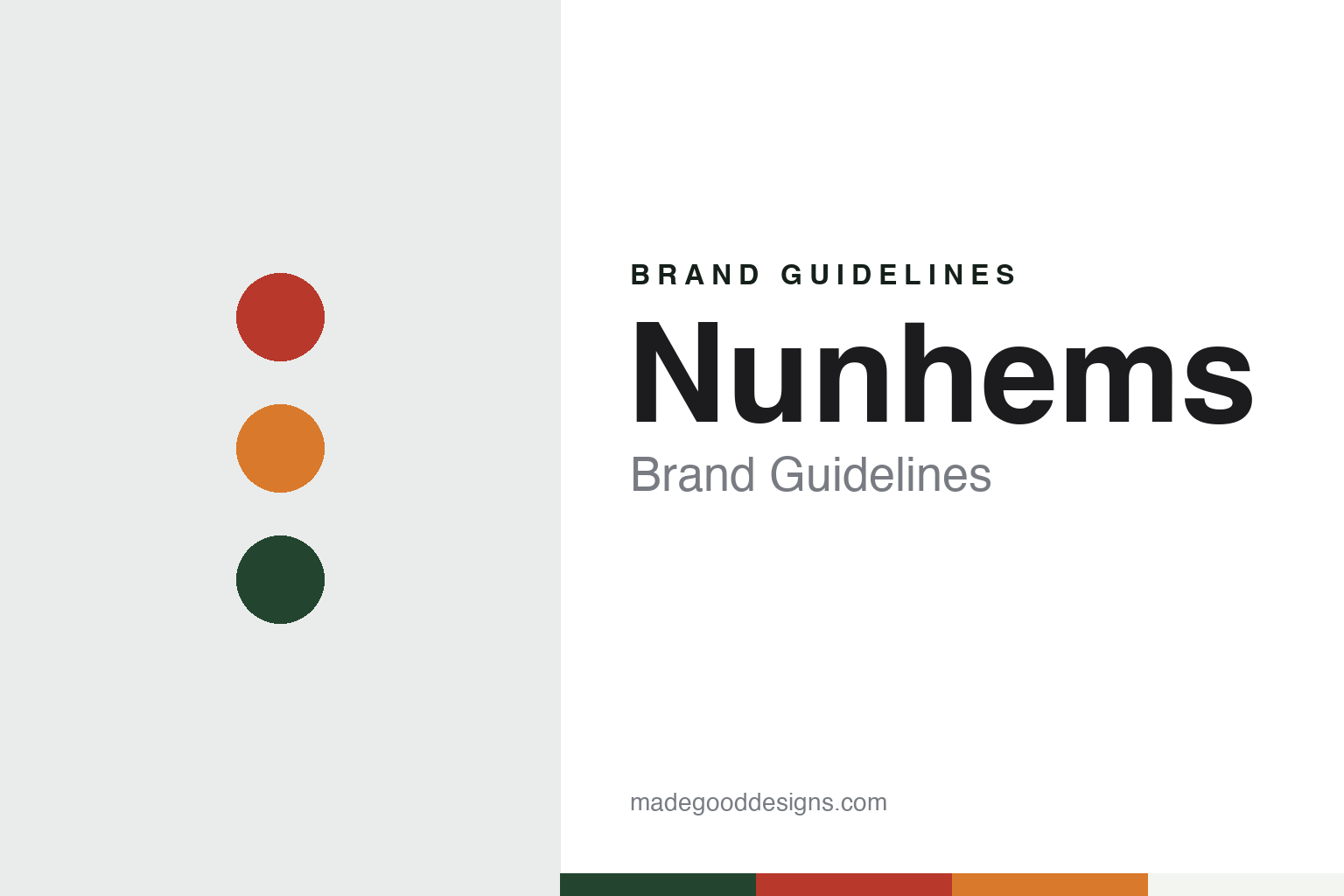
Nunhems Brand Guidelines
A village name carried through Bayer and BASF.
Aa
Two constants: a deep green, tomato red and carrot orange palette and a friendly humanist sans register. Abstract homage — not a Nunhems product or mark; no seed packet, logo or variety name is reproduced.
Nunhem
A brand named after its village.
Nunhems takes its name from Nunhem, a village in the Dutch municipality of Leudal, where the business still has its headquarters and its seed processing facilities. The company says it has more than 100 years of breeding experience. In April 2026 the mayor of Leudal, quoted by FreshPlaza, said that the firm had shaped the economic landscape of the region “for more than 110 years,” and that many people still know it as Nunhems Zaden — Dutch for Nunhems Seeds. The sources read for this guide do not describe the firm during the German occupation of the Netherlands in 1940–45.
Nunhem is the hub through which the whole business runs. According to the same FreshPlaza report, seed produced across the company’s global supply chain is shipped there for cleaning, processing, testing and final preparation before it goes to customers around the world. The processing buildings then covered about 20,000 square metres, and the company announced a modernisation that would add about 6,000 square metres, with construction starting in the second quarter of 2026 and completion planned for the end of 2028. The project renovates two existing processing buildings and adds new facilities to store, pack and ship seed, the report said.
The company describes a wider network around that centre. On its website it says it breeds in nine countries and produces seed in more than 20, runs research hubs in Nunhem and in West Sacramento, California, and has seed processing centres in the Netherlands, the United States and India. It lists about 2,000 employees, roughly a third of them in research and development, and a presence in more than 100 countries.
Colour
Bayer, a new identity and a sale.
For most of the past quarter-century Nunhems has belonged to large chemical groups. English Wikipedia says Bayer AG acquired the Dutch seed company in 2002, the same year it bought Aventis CropScience and merged it with its own crop protection division to form Bayer CropScience.
In 2014 Bayer changed the brand’s place in its identity. Eurofruit reported on 4 April that the vegetable seed business would change its visual identity and be marketed under the Bayer CropScience brand: the subsidiary became Bayer CropScience Vegetable Seeds, responsible for all vegetable seed activities worldwide, while Nunhems stayed on as the product brand. The new look was aligned with Bayer CropScience’s seed and crop protection product brands, and packaging, advertisements, brochures and websites were redesigned and introduced gradually from 1 April, the report said.
That arrangement ended with Bayer’s takeover of Monsanto. In October 2017, English Wikipedia says, BASF announced that it would buy seed and herbicide businesses from Bayer in the context of that deal. On 16 August 2018 BASF closed its acquisition of Bayer’s global vegetable seed business, “mainly operating under the brand Nunhems,” Tomato News reported; Agriland reported the closing the same day. At the time the business covered 24 crops and about 2,600 varieties, including tomatoes for processing, and ran more than 100 breeding programmes in more than 15 crops, Tomato News said.
BASF presented the purchase as part of a larger farming business. Agriland reported that the company said the vegetable seeds would strengthen its seed platform and sit alongside an Agricultural Solutions portfolio that included seeds and traits, chemical and biological crop protection, soil management and digital farming, and that around 4,500 Bayer employees would join that BASF team as a result of the wider deal.
Typography
Fields, glasshouses and catalogues.
Vegetable seed companies sell something their customers rarely see in finished form. A breeder’s product is a variety: a tomato, a pepper, a carrot or a cabbage with traits that took years of crossing and selection to fix. The seed itself is small, dry and uniform, so most of these companies present themselves through what the seed becomes, and through the places where it is tested.
That is why the same images recur across the category. Trial fields in rows, greenhouses filled with trained tomato and cucumber plants, and close views of leaves and roots show the work of selection. Catalogues and websites favour cut tomatoes, peppers and cucumbers photographed on white, so that colour, shape and the inside of the fruit can be compared. Named varieties carry much of the message.
The audience is professional. Breeders such as these sell to commercial growers, propagators, processors and retailers rather than to home gardeners, and their packs and brochures carry practical information on sowing, growing conditions and the traits each company claims for its varieties. Several firms also show the stages that follow breeding: seed production by contract growers, then cleaning, sorting, germination testing and packing.
Open days are the most public face of the trade. In the north of North Holland, where companies including Enza Zaden and Bejo belong to the Seed Valley network, breeders invite customers to walk their trial fields and greenhouses each year; in September 2023 NH Nieuws reported that Bejo’s open days in Warmenhuizen drew visitors from about 70 countries. This guide sets out what can be checked about each company, and marks clearly what rests on its own word.
Aa
A friendly humanist sans for a field-and-glasshouse register. (Specimen set in Figtree, a sans STAND-IN; NOT the Nunhems logo.)
BASF | Nunhems
A companion brand.
Under BASF the village name moved back to the front. The company now signs itself BASF | Nunhems, and the BASF brand portal presents Nunhems as a companion brand for vegetable seeds within BASF Agricultural Solutions, with its own corporate design pages, logo files and templates. Its line is “Vegetables People Love,” and the portal sums up its proposition as “the passionate solution partner, committed to develop Vegetables People Love.” It lists the character it wants the brand to show: creative, open, responsible and entrepreneurial, among other traits. The company says it brings seeds together with crop protection and digital tools as part of that wider BASF business.
The range is described by crop. The company says it offers about 1,200 commercial varieties across 20 crops, and its website leads with fresh tomato, carrots and watermelon; it says it has produced carrot seed for more than 50 years. It says it tailors varieties to particular climates, growing systems and cultural preferences, and launches more than 80 new innovations a year. Its news in October 2026 announced a new automated greenhouse for lettuce breeding at ’s-Gravenzande. Among its certifications the website names Naktuinbouw authorisations for laboratories and field inspection, and Good Seed and Plant Practices.
For a design guide, Nunhems shows a seed brand that has been folded into a parent identity and then given a named place beside one: a product brand under Bayer CropScience from 2014, a companion brand paired with BASF today. Compare Rijk Zwaan, another Dutch vegetable breeder, and Enza Zaden. For this guide we use a deep green, a tomato red and a carrot orange with a sans, an unofficial interpretation; no product or logo is reproduced.
Explore & save
Keep Nunhems’s identity on hand — save it to a board in the Made Good inspiration library.
Nunhems identity set
Pin the deep green, tomato red and carrot orange palette and the friendly humanist sans register to your own board.