BISCO Brand Guidelines
Byoung In Suh’s bonding specialist from Schaumburg, Illinois.
Aa
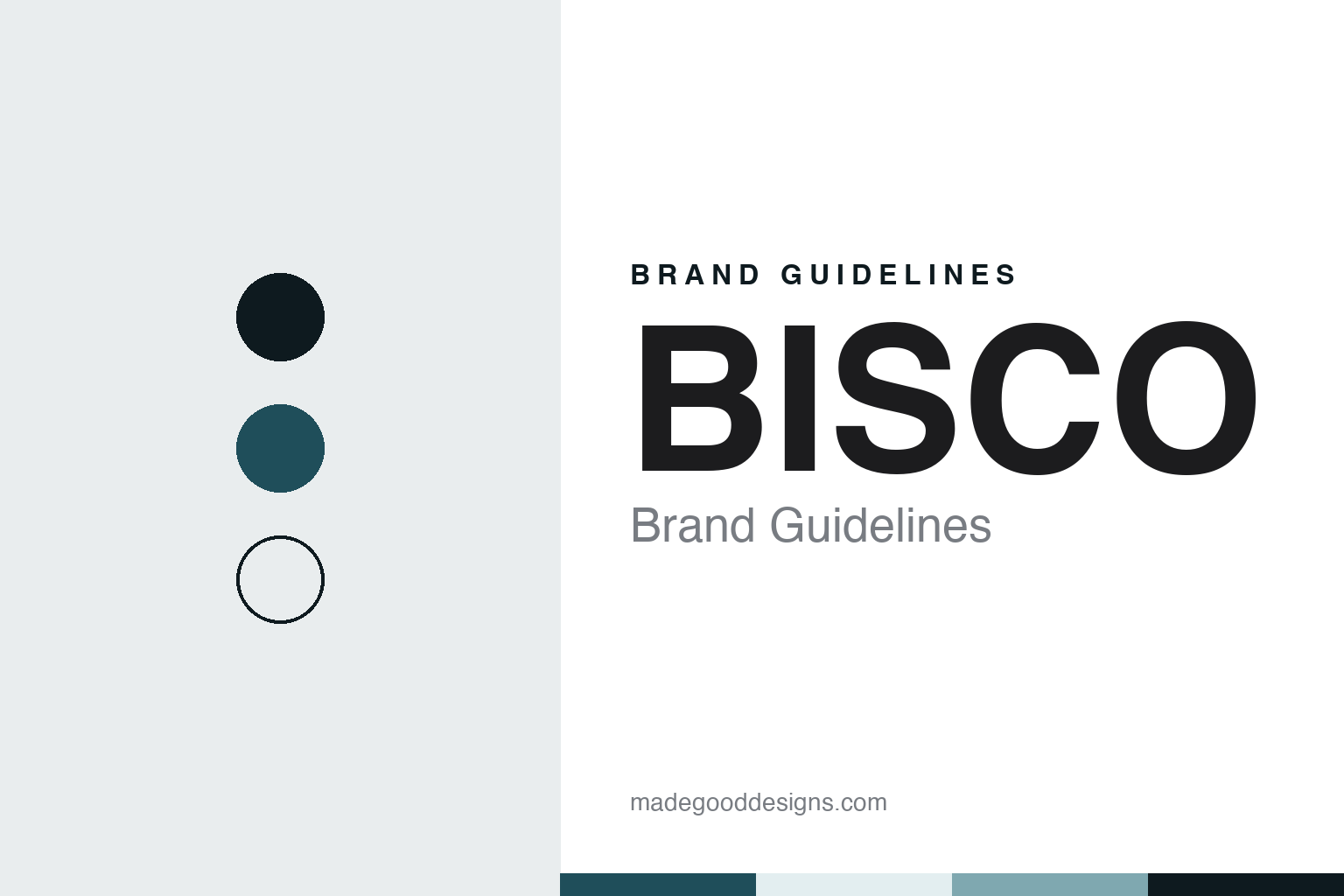
Two constants: a BISCO deep teal and sea grey palette and a Clinical sans register. Abstract homage — not a BISCO product or mark; no package, logo or label is reproduced.
BIS+CO
A chemist’s initials.
BISCO was founded in 1981 by the research chemist Byoung In Suh. DentistryIQ gave that date and founder in April 2006, when the company marked 25 years, and Dental Product Shopper reported in June 2018 that Suh named the company using his own initials. BISCO’s own 35th-anniversary account, reposted by its Canadian distributor Curion in February 2018, spells it out as “BIS+CO” and gives the founding date as 2 July 1981 and the first location as Lombard, a suburb west of Chicago.
The same company account traces Suh’s route into dental chemistry. It says he took a master’s degree in chemistry in California in 1968, then moved to Chicago to work for a dental company, where he formulated a restorative composite. In 1980 he left to work on his own ideas, and the company says his founding idea was a product that would bond to dentin and another that would bond to metal. BISCO says he later received a doctorate in dental medicine from Tsurumi University in Yokohama in 2005, and its website says he published a book, Principles of Adhesion Dentistry, in February 2013.
The company left Lombard in 1997. Both DentistryIQ in 2006 and Dental Product Shopper in 2018 placed its headquarters in a 91,000-square-foot building in Schaumburg, Illinois, northwest of Chicago, with a research and development laboratory on site. BISCO’s own account adds that the building houses its manufacturing, packaging and warehousing as well as its offices.
Colour
All-Bond and after.
Bonding has been BISCO’s core subject from the start. Its company account says the first All-Bond adhesive came after about ten years of work, followed by All-Bond 2 in 1991; it also lists the Uni-Etch etchant in 1991 and One-Step in 1996. DentistryIQ wrote in 2006 that BISCO became a leader in adhesion dentistry in the 1990s with All-Bond 2 and One-Step, and that with All-Bond 2 it promoted the total-etch and wet-bonding techniques. At that point, the magazine said, BISCO offered more than 30 brand-name products, among them the Aeliteflo flowable composite and the D.T. Light-Post, and in 2002 it had added the Tescera ATL indirect composite system for dental laboratories.
The newer products came in the 2010s. Dental Product Shopper dated TheraCal LC, a light-cured resin-modified calcium silicate used as a liner and for pulp capping, to 2011; All-Bond Universal, a one-bottle adhesive for total-etch, self-etch and selective-etch techniques, to 2012; and TheraCem, a dual-cured self-adhesive resin cement, to 2016. All three were favourites of the magazine’s evaluators in its 2018 survey. The website now groups its range into adhesives, cements, composites, core build-ups, etchants, primers and pulp-treatment materials, with a calcium-releasing “THERA” family and a newer Quantium universal composite.
The company has kept education close to sales. DentistryIQ noted in 2006 that BISCO was an ADA CERP recognised provider of continuing education and ran the BISCO Institute for clinicians. Its website today offers webinars, podcasts, e-books and an “ask the experts” section. In 2006, DentistryIQ said, it sold directly to dentists and laboratories in the United States and through exclusive distributors abroad; in Germany, Austria and Switzerland, the trade site ZWP online reported in May 2018, American Dental Systems of Vaterstetten, near Munich, had taken on the BISCO range in March of that year.
Typography
Design and documentation.
Dental materials companies sell to a narrow, expert audience, and their visual language reflects it. Catalogues and product pages tend to show the object itself: a syringe of composite, a capsule of cement or a cartridge of impression material photographed on a plain white ground, often beside the shade guide that tells a clinician which tone of tooth-coloured material to pick. Colour matters in this trade in a practical sense, because shades are part of the product.
The delivery system is part of the brand too. Makers present their materials in the form they reach the surgery — single-dose capsules, automix cartridges that fit a dispensing gun, paste-paste syringes and bottles of adhesive — and many give each range a short, memorable name that is printed large on the pack. Curing lights, mixers and dispensers add a second, equipment-led strand to many catalogues.
The other recurring image is the clinician at chairside. Companies show dentists and assistants at work, run continuing-education courses and publish clinical cases, so that the brand appears as a working tool rather than a consumer good.
Trade fairs remain central. The International Dental Show in Cologne and the Chicago Midwinter Meeting, run by the Chicago Dental Society, are where many makers launch products and build their stands, and those booths — product walls, demonstration chairs and hands-on tables — are among the most visible expressions of each company’s identity. This guide sets out what can be checked about each brand, and marks clearly what rests on the company’s own word.
Aa
A clinical sans — BISCO in capitals. (Specimen set in Archivo, a sans STAND-IN; NOT the BISCO logo.)
BISCO
Restoration simplified.
BISCO’s website names Byoung Suh as chairman emeritus and says he remains involved in research and development; Julie Suh, with the company since 2002, is president, and Carolyn Suh leads sales and marketing. BISCO says Suh has lectured in more than 40 countries and written or co-written more than 150 articles and abstracts on bonding, and that he received the American Academy of Cosmetic Dentistry’s Presidential Award in 2003 and the Eugene W. Skinner Award for Innovation in 2006. Its 35th-anniversary account named integrity, respect and the sharing of knowledge as the core values he set; the website now lists sharing knowledge, innovative thinking, a growth mindset and integrity.
On manufacturing, Dental Product Shopper wrote in 2018 that all of BISCO’s products are manufactured in the United States, and the company’s own account places its manufacturing in the Schaumburg building, where its website names Won Suh as director of manufacturing operations. Its tagline on the website is “Restoration simplified,” and its stated themes are fewer steps, less chair time and products designed to work together as a system.
The name is a common one, and it is easy to confuse. In Britain, BISCO was also the abbreviation of the British Iron & Steel Corporation, according to Wikipedia; the dental company writes its name in capitals and trades from bisco.com. Several of its newer materials, including TheraCal LC and TheraCem, share the “Thera” prefix.
For a design guide, BISCO shows a specialist built around one chemical problem, bonding, and a founder’s initials. Compare Ultradent, another American dental materials maker, and Kerr Dental, another American name in restorative materials. For this guide we use a deep teal and a sea grey with a sans, an unofficial interpretation; no product or logo is reproduced.
Explore & save
Keep BISCO’s identity on hand — save it to a board in the Made Good inspiration library.
BISCO identity set
Pin the BISCO deep teal and sea grey palette and the Clinical sans register to your own board.