Septodont Brand Guidelines
A Paris laboratory that made dental anaesthesia its niche.
Aa
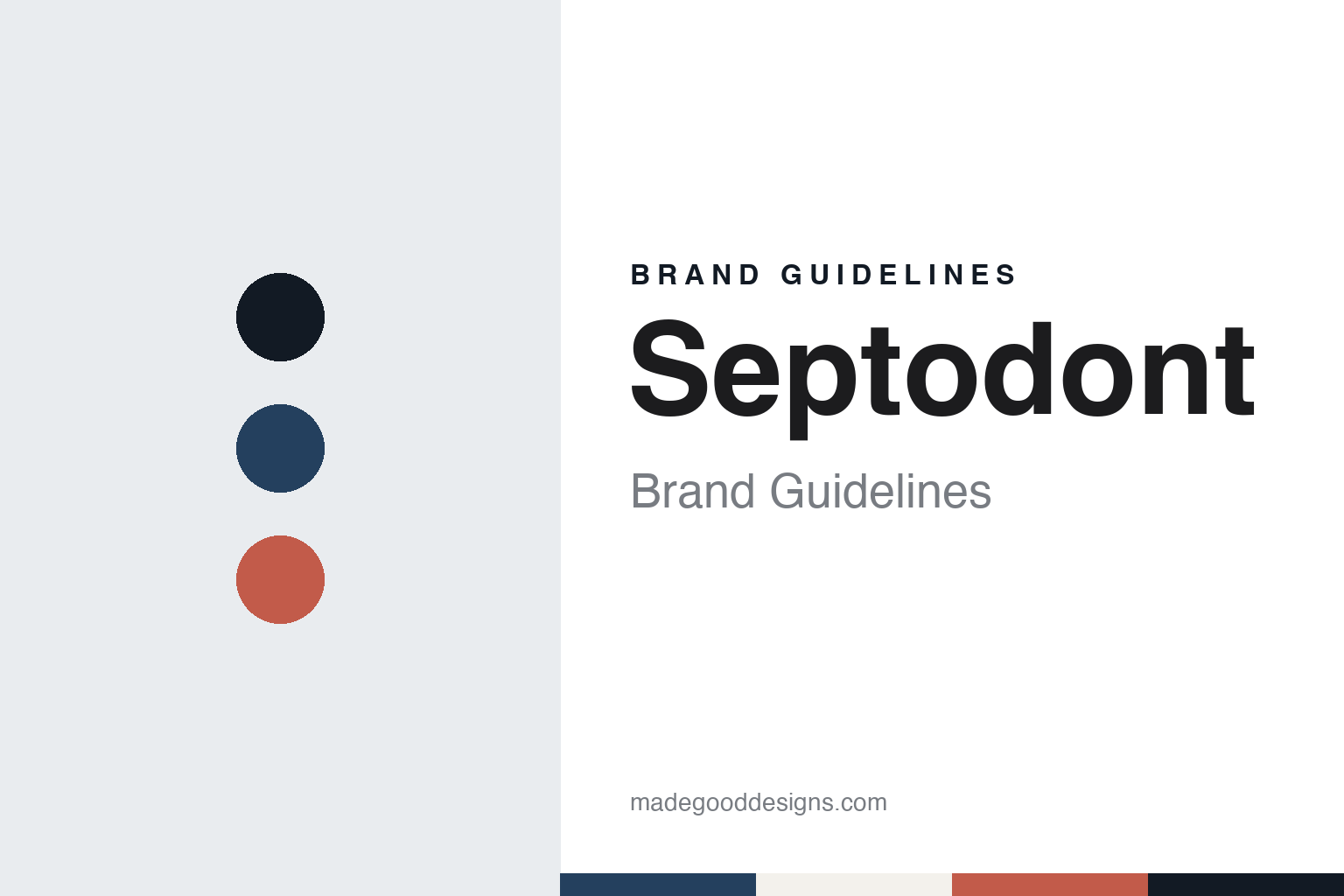
Two constants: a blue, white and coral palette and a laboratory serif register. Abstract homage — not a Septodont product or mark; no cartridge, pack or logo is reproduced.
A Paris flat, 1932
A physicist, a niche and a building in the 10th arrondissement.
Septodont was founded in 1932. Its corporate website names the founders as Annie and Nestor Schiller, and a 2018 interview with the German subsidiary in the trade publication ZWP online described them as the grandparents of Olivier Schiller, then the chief executive. Speaking at a seminar of the École de Paris du management in June 2015, Olivier Schiller said his grandfather, a doctor of physics who had worked for large pharmaceutical groups, had noticed how few products were made specifically for dentists, and set up the company to win a strong position in that niche rather than be one player among many in a larger market.
The first premises, he said, were a flat on the rue des Petites-Écuries in the 10th arrondissement of Paris. The company grew until it occupied the whole building, and by the end of the 1970s it had outgrown it. His father, Henri Schiller, then moved the business to Saint-Maur-des-Fossés, in the Val-de-Marne east of Paris, to a site chosen to suit its work and close to a suburban rail station for the staff. The sources read for this guide do not describe the company during the German occupation of France in 1940–44.
The 1950s set the course. The company’s timeline marks 1950 as the moment Septodont became a front runner in dental anaesthetic cartridges, and the 2018 ZWP online interview named three products developed in that decade — Endomethasone N, Alveogyl and Racestyptine — as still used in many practices. In the 1980s, Olivier Schiller said, his father took the company through approval by the US Food and Drug Administration and built distribution to export to the United States.
Colour
Cartridges, articaine and bioceramics.
Pain control remains the core. In 2015 Olivier Schiller said three-quarters of the business concerned it, chiefly through anaesthetics, and in 2000 Septodont launched the anaesthetic articaine in the United States under the name Septocaine, which its timeline calls the first articaine on the US market. The UK website describes the company as a world leader in dental pain management. The corporate site also presents the group as an expert contract development and manufacturing organisation for injectable medicines, through its Novocol Pharma division in Canada.
The materials side has grown since 2010. The timeline lists Biodentine, which the company describes as a dentine substitute, in 2010; the BioRoot RCS root-canal sealer in 2015; Biodentine XP and BioRoot Flow in 2022; and a synthetic membrane, R.T.R.+, in 2023. Injection hardware sits beside the drugs: a needle plant, Sofic, in France from 1990, and the Ultra Safety Plus Twist syringe system in 2020.
Septodont manufactures in several countries. In January 2025, at a second École de Paris seminar, Olivier Schiller listed seven production sites on three continents. Saint-Maur-des-Fossés makes restorative and endodontic materials as well as injectable and topical anaesthetics; Mazamet, in the Tarn, makes needles and injection devices; Cambridge, in Canada, makes anaesthetics; Pomerode and Catanduva, in Brazil, make restorative accessories and anaesthetics; and Taloja, in India, makes materials. In 2018 the German subsidiary said a new anaesthetics plant near Paris had been built between 2014 and 2016.
Typography
How dental materials makers present themselves.
Dental materials companies sell to a narrow, expert audience, and their visual language reflects it. Catalogues and product pages tend to show the object itself: a syringe of composite, a capsule of cement or a cartridge of impression material photographed on a plain white ground, often beside the shade guide that tells a clinician which tone of tooth-coloured material to pick. Colour matters in this trade in a practical sense, because shades are part of the product.
The delivery system is part of the brand too. Makers present their materials in the form they reach the surgery — single-dose capsules, automix cartridges that fit a dispensing gun, paste-paste syringes and bottles of adhesive — and many give each range a short, memorable name that is printed large on the pack. Curing lights, mixers and dispensers add a second, equipment-led strand to many catalogues.
The other recurring image is the clinician at chairside. Companies show dentists and assistants at work, run continuing-education courses and publish clinical cases, so that the brand appears as a working tool rather than a consumer good.
Trade fairs remain central. The International Dental Show in Cologne and the Chicago Midwinter Meeting, run by the Chicago Dental Society, are where many makers launch products and build their stands, and those booths — product walls, demonstration chairs and hands-on tables — are among the most visible expressions of each company’s identity. This guide sets out what can be checked about each brand, and marks clearly what rests on the company’s own word.
Aa
A laboratory serif for a Paris pharmaceutical house. (Specimen set in Source Serif 4, a serif STAND-IN; NOT the Septodont logo.)
Septodont
A family company that grows by buying.
Septodont is still a family company. In January 2025 Olivier Schiller said its capital was held entirely within the Schiller family, and that he had set up an advisory board in 2015 to challenge the management’s strategy. The corporate website says he became chairman in 2025 and that Karim Khadr, who joined in 2021 to run the dental division, was appointed chief executive in June 2025. The company says it is present in more than 110 countries through subsidiaries and distributors, and it looks ahead to its centenary in 2032.
Its approach to markets has been practical. In 2015 Olivier Schiller explained that Septodont keeps working through distributors where they give it enough reach and opens its own subsidiary where they do not; at that time it ran four research and development centres, in France, the United States, Canada and Brazil, and had partnerships with around thirty research centres worldwide.
Acquisitions have shaped the group. In 1990, Olivier Schiller said, Septodont bought half of the Canadian pharmaceutical company Novocol in a joint venture, and later bought out its partner; the Cambridge plant is now the group’s North American base for anaesthetics. Between 2014 and 2016 it bought TDV, a Brazilian maker of restorative accessories, Duoject, a Canadian design and engineering firm, and DLA Pharma, an anaesthetics site in Brazil. The American anaesthetic brand Cook-Waite followed in 2017 and a portfolio of four dental products from Sanofi in 2021.
The pace continued. Septodont bought Biomedical Tissues, a French maker of surgical biomaterials, took a minority stake in the Chinese medical distributor Medtech in 2023, and in 2024 took a majority stake in Inibsa, a maker of dental anaesthetics based near Barcelona. In 2025 its timeline added Buffer Pro, a product for buffering local anaesthetics before injection.
For a design guide, Septodont shows how a narrow specialism, chosen in a Paris flat, can become a family group’s whole identity. Compare Ivoclar, another long-established European dental-materials maker, and COLTENE, from Altstätten in Switzerland. For this guide we use a deep blue, an off-white and a brick coral with a serif, an unofficial interpretation; no product or logo is reproduced.
Explore & save
Keep Septodont’s identity on hand — save it to a board in the Made Good inspiration library.
Septodont identity set
Pin the Septodont blue, white and coral palette and the laboratory serif register to your own board.