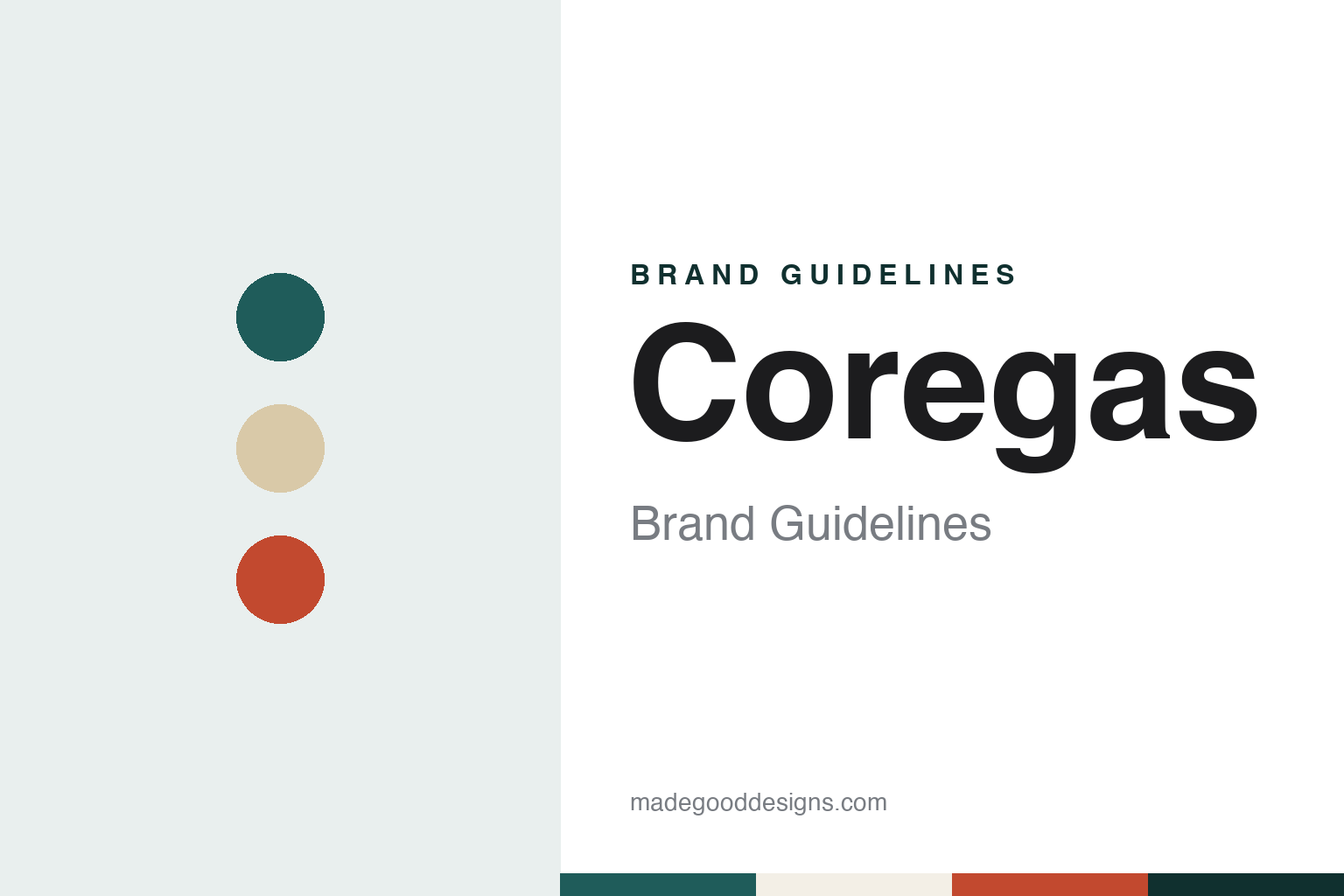
Coregas Brand Guidelines
The Linde unit that became an Australian gas name of its own.
Aa
Two constants: a teal, sand and ochre palette and an industrial sans register. Abstract homage — not a Coregas product or mark; no cylinder, tank, logo or label is reproduced.
Linde Gas Australia
A business sold by order and renamed.
Coregas did not start under its own name. Until 2007 it was Linde Gas Australia, a division of the German group Linde AG. Forkliftaction News reported on 1 February 2007 that the business had operated in Australia for more than 30 years, was based at Yennora in Sydney with a national network of agents and distributors, and supplied medical, industrial, cutting and welding, and specialty gases. A February 2026 article from NATA, Australia’s laboratory accreditation body, says Coregas has supplied specialty, medical and industrial gases across Australia and New Zealand for more than 50 years.
The name change came from a competition ruling. On 5 September 2006 Linde AG acquired the British industrial gas group BOC, which already had a large Australian business. Forkliftaction News reported that disposing of Linde Gas Australia was a condition set by the Australian Competition and Consumer Commission after that acquisition. The buyer was the Perth conglomerate Wesfarmers, and the same report said that, under Wesfarmers, the business would be renamed Coregas Pty Ltd and run as a stand-alone business within the Wesfarmers Energy division.
For eighteen years Coregas was one of Wesfarmers’ industrial companies; by December 2024, Wesfarmers described it as part of its Industrial and Safety division, alongside the industrial supplies business Blackwoods and Workwear Group.
Colour
Air separation, hydrogen, helium and cylinders.
Coregas sells gases in two broad ways. In December 2024 Wesfarmers described it as one of Australia’s largest manufacturers and suppliers of industrial gases, distributing industrial, medical and specialty gases in cylinders and offering a wide range of bulk gases to medium and large users across Australia and New Zealand. The New Zealand business trades through its own company, Coregas NZ.
The clearest public account of where its gases are made comes from the competition regulator. In its 2025 review of the sale of Coregas, the ACCC said the company operates air separation units at Port Kembla and Mackay, a hydrogen reformer at Port Kembla, a helium import and decant facility in Sydney, and cylinder filling facilities in most states and territories. The ACCC added that Coregas supplies liquid petroleum gas in various cylinder sizes, and welding consumables through subsidiaries in Victoria and Queensland; one of those, Blacksmith Jacks, was named in the review as part of the business being sold.
The newest plant is in Queensland. On 19 March 2026 the cryogenic equipment group Nikkiso Clean Energy & Industrial Gases announced that it had completed commissioning an air separation unit for Coregas at Darra, in Brisbane. Nikkiso said the plant would produce liquid oxygen and nitrogen each day, mainly for the Queensland industrial, specialty and medical markets, and was designed so that capacity could be added later. Nikkiso also said key equipment was manufactured at its facility in India and combined with locally made components and installation work in Australia.
Laboratory gases are a smaller but visible part of the trade. The 2026 NATA article describes Coregas supplying calibration gases and specialty mixtures to accredited laboratories and test facilities, in a range of container sizes and supply modes.
Typography
Gases and how they are shown.
Industrial gas companies sell something nobody sees. Oxygen, nitrogen, argon, carbon dioxide and hydrogen are colourless, so the identity of a gas supplier has to live on the things that hold and move the product: the cylinder, the storage tank, the delivery truck and the plant where air is separated into its parts.
The cylinder is the most familiar object in the category. Rows of steel and aluminium bottles, their shoulders painted in colours that identify the contents, appear in almost every supplier’s photography, often chained in racks at a welding shop or a filling plant. Beside them stand the larger forms of the trade: white or pale-grey bulk tanks outside factories and hospitals, and long tanker trucks that carry liquefied gases from plant to customer, usually wearing the supplier’s name and colours along the side.
The plants themselves have become an image of their own. An air-separation unit is a tall column, often wrapped in cladding and pipework, that cools air until its components can be drawn off one by one. Photographed at night, lit against a dark sky, these columns give the sector its most dramatic pictures, and many companies use them in annual reports and on their home pages.
The human scenes are fewer and more settled. A welder behind a mask in a shower of sparks stands for the industrial side; a hospital corridor or a patient at home with an oxygen concentrator stands for the medical side. Between the hardware and those two scenes, most of the visual language of the category is set. The brands in this guide work within that shared vocabulary, and what separates them is largely the name on the truck and the colour of the paint.
Aa
An industrial sans — for a name made up in 2007. (Specimen set in Barlow, a sans STAND-IN; NOT the Coregas logo.)
Coregas
A second sale, and a name kept.
Wesfarmers sold Coregas after almost two decades. On 20 December 2024 it announced an agreement to sell the business to a subsidiary of Nippon Sanso Holdings Corporation, the Tokyo-listed gas group whose Australian arm already owned the gas and LPG supplier Supagas. The ACCC began its review on 12 March 2025 and announced on 24 June 2025 that it would not oppose the deal, concluding that the merged business would still face significant competition from BOC and Air Liquide. In the regulator’s account, BOC and Air Liquide each had larger production, supply and distribution footprints in Australia than either Coregas or Supagas, and BOC would remain the largest supplier after the deal; the overlap between the two buyers’ liquid nitrogen plants was limited, since Supagas produces in Dandenong, Victoria, and Coregas at Port Kembla. Wesfarmers confirmed on 1 July 2025 that the sale had been completed.
The name survived the second sale, as it had been created by the first. In a January 2026 announcement, Supagas said the two businesses would initially continue to operate separately under the Nippon Sanso umbrella, each with its own customers and product focus, while maintaining their distinct market identities. The NATA article of February 2026 describes Coregas as remaining a local operation with local teams, now backed by the wider group; the Nikkiso announcement of March 2026 calls it “a Nippon Sanso company.” That puts Coregas in the same family as the American gas company Matheson, which in April 2026 took the Nippon Sanso name itself.
The ownership record is short and well documented: Linde AG until 2007, Wesfarmers from 2007 to 2025, and the Nippon Sanso group since 1 July 2025, with the regulator’s 2025 review setting out the plants that went with it.
For a design guide, Coregas shows how a business carved out of a global group can build a national name of its own and keep it through a change of owner. Compare its new parent, Nippon Sanso, and BOC, whose purchase by Linde set the sale in motion. For this guide we use a deep teal, a warm sand and an ochre red with a sans, an unofficial interpretation; no product or logo is reproduced.
Explore & save
Keep Coregas’s identity on hand — save it to a board in the Made Good inspiration library.
Coregas identity set
Pin the Coregas teal, sand and ochre palette and the industrial sans register to your own board.