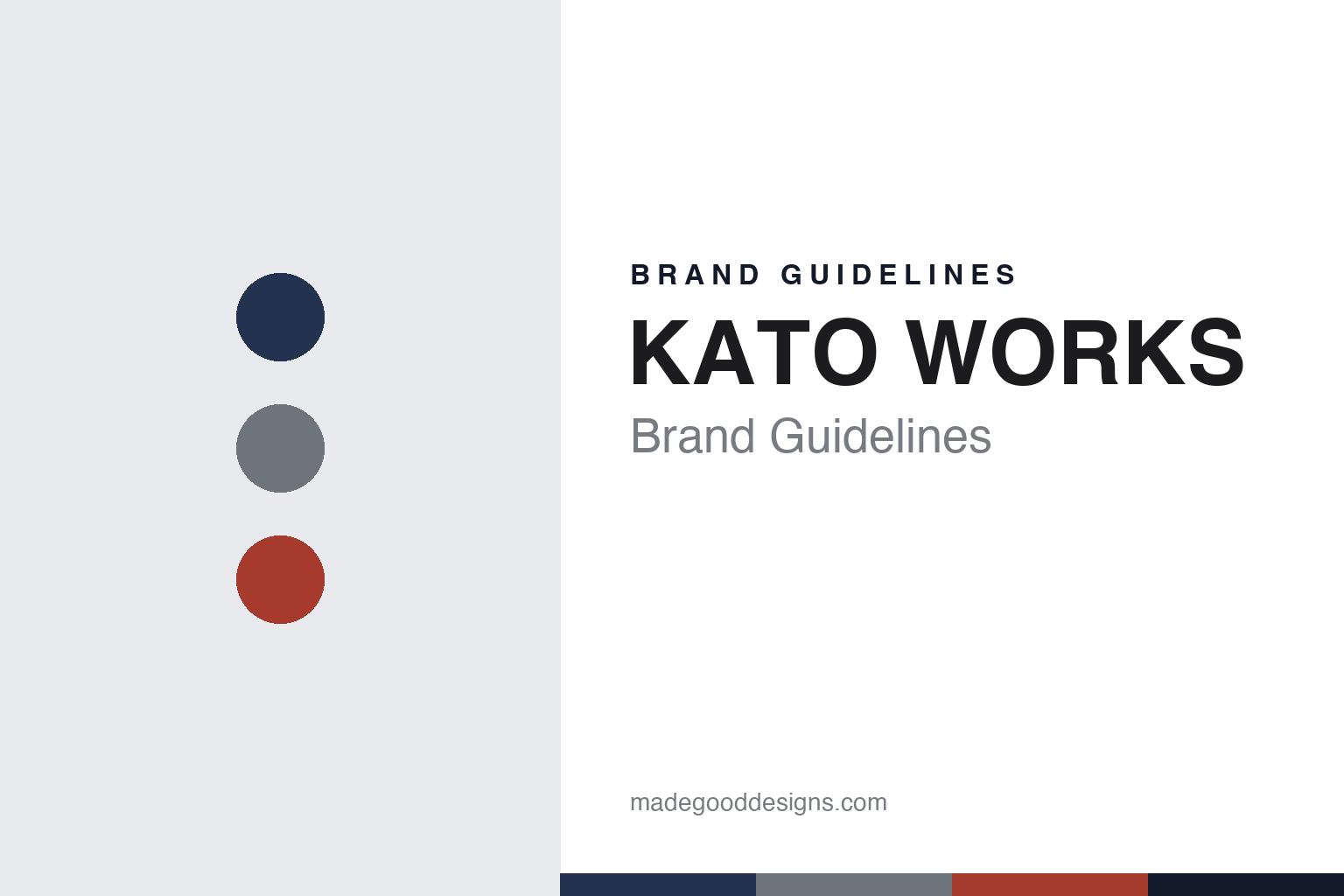
KATO WORKS Brand Guidelines
From cast locomotive nameplates to a crane name Japan uses as a noun.
Aa
Two constants: a navy, steel and brick red palette and an engineering sans register. Abstract homage — not a KATO WORKS product or mark; no crane, logo or nameplate is reproduced.
Kato Iron Works
Locomotives first, cranes later.
KATO WORKS dates its founding to 1895, when the business began as a sole proprietorship called Kato Iron Works, according to the company’s own timeline and Japanese Wikipedia. In 1923, both say, it succeeded in building internal-combustion locomotives and railway motor cars, and became a designated works for the national railway ministry. The business was incorporated as Kato Seisakusho, KATO WORKS in English, in January 1935; Japanese Wikipedia names Kato Hidesaburo as its representative director at that time. In 1938 it began making engines, tractors, road rollers and crane vehicles, the company says.
The locomotives gave the company its first trademark. Japanese Wikipedia, which draws on locomotive histories published with the company’s cooperation in 1987 and 2014, says the words KATO WORKS were cast into the side of the frame and above the radiator, and that some pre-war and wartime machines carried the name in katakana instead; the short form KST was long used on bearing covers and in catalogues.
The war years are part of that record. Before and during the Second World War, Japanese Wikipedia says, deliveries to the Navy Ministry made up a large share of the business; on those locomotives the navy’s anchor mark was cast in place of the company name, and most were shipped during the war to build airfields in south-east Asia and on the Asian mainland. After the war the main customer was the Ministry of Construction, for railways used on river works, and KATO WORKS became one of the two large Japanese makers of small industrial diesel locomotives, alongside Sakai Kosakusho. As lorries replaced construction railways, it left the locomotive business in the late 1960s and turned to construction machinery.
Colour
Roughter, Allterr and a hybrid.
Cranes became the core. The company’s timeline lists hydraulic truck cranes and earth drills from 1959, the first phase of the Ibaraki works at Goka in 1963, and in 1969 the NK-750 “Jumbo,” which the company calls the largest all-hydraulic truck crane in the world at the time. A works at Ota in Gunma followed in 1980, the year KATO WORKS began making rough-terrain cranes; the KA-800 all-terrain crane was shown in 1987, and the 500-tonne NK-5000 truck crane was completed in 1994, the company says. Japanese Wikipedia says the Ibaraki plant builds the cranes, while Gunma makes excavators and earth drills.
Two product names carry the brand. KATO WORKS registered Roughter as a trademark for its rough-terrain cranes and Allterr for its all-terrain cranes, Japanese Wikipedia says, adding that “Roughter” spread so widely in Japan that other makers’ rough-terrain machines are often introduced as “roughter cranes.” The company also sells truck-loader cranes, which Japanese Wikipedia says are supplied by Furukawa UNIC, and hydraulic excavators under the REGZAM name, alongside road sweepers, the MultiVac suction vehicle and airport snow sweepers.
The newest crane is the SR-250HV. In May 2026 the trade news site kikai-news.net reported that KATO WORKS would exhibit at the CSPI2026 construction and surveying show at Makuhari Messe that June, its first appearance there in seven years, with the hybrid rough-terrain crane and its EK-UNIT external power unit as the main exhibit. The company describes the SR-250HV as the first hybrid rough-terrain crane in the world that can switch between engine drive and electric drive from an external supply. The same report previewed the HD514MR-9 excavator and the IC110R crawler carrier.
Typography
How crane makers present themselves.
Crane makers present very large machines largely through pictures. Their catalogues and websites lean on a small set of pictures: a tower crane standing over an unfinished skyline, a mobile crane with its telescopic boom fully extended, a crawler crane lifting a turbine section on a wind farm, or a loader crane folded neatly behind a truck cab. The machine itself becomes the logo at a distance, so the paint matters as much as the nameplate.
That is why colour does so much work in this category. Booms and jibs are painted in strong, flat tones, often yellow, red or white, with the maker’s name lettered large along the steel so it can be read from the street. Some makers go as far as naming their colours and applying them across a whole fleet, so that a crane on a distant site can be placed before its lettering can be read.
Closer in, the presentation shifts to the operator. Cab interiors, joysticks, load-moment displays and remote controls appear in brochures alongside outrigger layouts and load charts, with lettering that has to work on a decal, in a manual and on a small screen.
Trade fairs are the other stage. bauma in Munich, ConExpo-Con/Agg in Las Vegas, bauma CONEXPO INDIA and national shows in China and Japan are where new cranes are unveiled, often fully rigged on outdoor stands, and where companies announce acquisitions and new models. This guide sets out what can be checked about each maker — who founded it, who owns it and where its cranes are built — and marks clearly what rests only on the company’s own word.
Aa
An engineering sans for a crane and excavator maker. (Specimen set in Barlow, a sans STAND-IN; NOT the KATO WORKS logo.)
KATO WORKS
A Tokyo company with plants at home and abroad.
KATO WORKS is listed in Tokyo: Japanese Wikipedia records a listing on the second section of the Tokyo Stock Exchange in 1962 and on the first section in 1970. The company gives its head office as Shinagawa, Tokyo, and Kato Kimiyasu has been its president since 2004. For years the KATO name also hung as an advertisement along the first-base side of Korakuen Stadium and then the Tokyo Dome, until 2000, Japanese Wikipedia says.
In 2016 KATO WORKS bought all the shares of IHI Construction Machinery, a subsidiary of the engineering group IHI, renamed it KATO HICOM and absorbed it in 2018; the former IHI joint venture at San Gimignano in Italy became KATO IMER and, from January 2026, KATO Construction Machinery Europe, according to the company. Production is spread across Japan and abroad. The company lists works at Ibaraki, Gunma and Bando, a wholly owned plant in Rayong, Thailand, that it says builds truck and rough-terrain cranes for south-east Asia and the Middle East, mini excavators in Italy, and excavator operations in China. In 2024, Japanese Wikipedia says, it announced plans to end local production in China, citing a weak market and stronger competition. The company marked its 130th year in 2025 with a factory festival at Ibaraki, called KATO fes, and in 2026 announced four new REGZAM hydraulic excavators.
For a design guide, KATO WORKS shows how a product name can travel further than its maker: Roughter became everyday site language in Japan. Compare Tadano, another Japanese crane maker, and Liebherr. For this guide we use a night navy, a steel grey and a brick red with a sans, an unofficial interpretation; no product or logo is reproduced.
Explore & save
Keep KATO WORKS’s identity on hand — save it to a board in the Made Good inspiration library.
KATO WORKS identity set
Pin the KATO WORKS navy, steel and brick red palette and the engineering sans register to your own board.


