WEBER RESCUE Brand Guidelines
The rescue-tool brand of a Swabian hydraulics family firm.
Aa
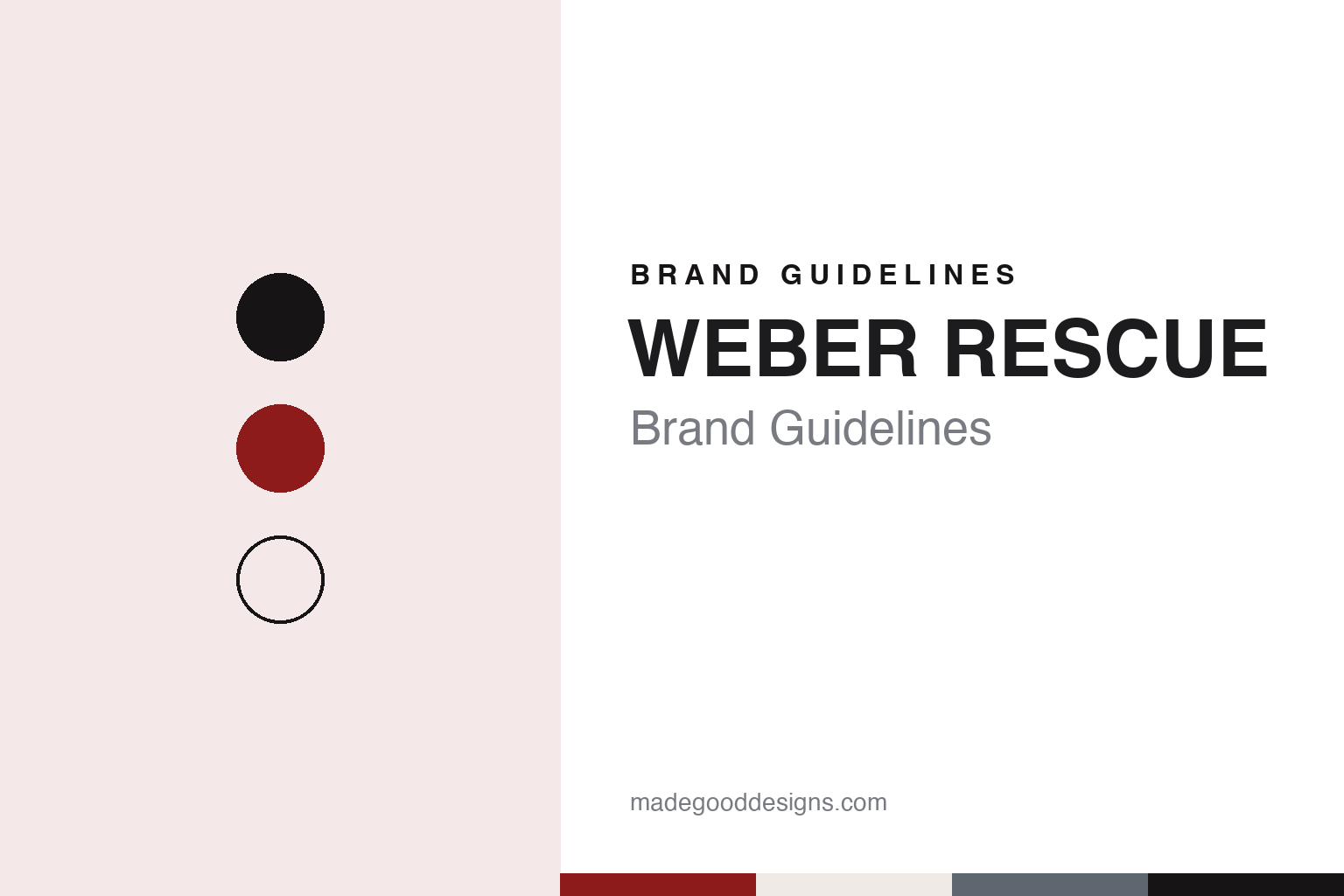
Two constants: a WEBER RESCUE red and gunmetal palette and an Engineering sans register. Abstract homage — not a WEBER RESCUE product or mark; no tool, logo or nameplate is reproduced.
Untertürkheim, 1939
A jack maker in wartime Stuttgart.
WEBER RESCUE SYSTEMS is the rescue-equipment brand of WEBER-HYDRAULIK GMBH, a family-owned hydraulics company in Güglingen, in the Heilbronn district of Baden-Württemberg. Its roots go back further than the rescue tools. English Wikipedia says the company was founded in 1939 by Emil Weber in Stuttgart-Untertürkheim to make hydraulic lifting equipment; the group’s own history calls the first business a “manufacture of hydraulic lifting equipment.”
A local-history account fills in the early years. In an address given in Güglingen in April 1990 and printed in the journal of the Zabergäuverein, the local historian Hermann Krauß recorded that Weber had trained as an apprentice at Daimler-Benz, went into business for himself, and had his firm entered in the Stuttgart craft register on 9 October 1939, already building hydraulic car jacks. War service and wartime events, Krauß wrote, prevented any normal development. When bombing destroyed the workshop in Untertürkheim, Weber moved the business in 1944 to Güglingen; the company history adds that only a few machines could be saved.
The restart was modest. According to Krauß, the firm worked from a barn, repairing whatever it could find parts for — farm equipment, bicycles, household appliances and radios. In 1945 the American military government appointed Weber mayor of Güglingen and two neighbouring villages, and only after April 1948 did he return full time to his company, which by then had moved into a former army shed in the town. It then went back to hydraulics: car jacks supplied by vehicle makers with their cars, and work on oil-resistant hoses and seals. Krauß gives its staff as 50 in 1950 and 260 by 1964.
Colour
From jacks to rescue tools.
The company broadened in the 1950s and 1960s. Its history lists jacks of all kinds, brake-cylinder release devices, barber-chair pumps and props for mining; a new logo bearing the name WEBER-HYDRAULIK, created by what was then Emil Weber Apparatebau, which became the basis of the later company name; the takeover of Strassacker-Ölhydraulik of Esslingen, dated 1966 by English Wikipedia, which brought it into hydraulic cylinders; and cab-tilting systems for trucks from 1965.
Rescue equipment grew out of that hydraulic work. English Wikipedia, citing the Allgemeine Bauzeitung in 2024, says a separate rescue-technology division developed from the late 1960s; that a site opened at Losenstein in Upper Austria in 1969, followed by a new production plant in Güglingen in 1970; and that production of hydraulic rescue equipment began in 1974, later marketed under a separate brand. The company’s history describes the Losenstein site as built for hydraulic cylinders and rescue equipment, and records that the WEBER RESCUE SYSTEMS brand was later officially registered.
The brand reached North America through partnerships. The group’s history records a joint venture in the United States to assemble and sell rescue equipment. Its American partner, Genesis Rescue Systems of Kettering, Ohio, says it began working with Weber in 1992 and formed a joint venture with it in 1999, and English Wikipedia lists Genesis among the group’s locations.
Other milestones came in the hydraulics business: the purchase of the East German jack maker Madix of Dresden in 1990, and of LOG Hydraulik and Fluid-Team Automationstechnik in 2007, according to English Wikipedia, and a plant at Nowogrodziec in Poland in 2005.
Typography
Rescue and emergency equipment.
Rescue and emergency medical equipment is bought by people who will use it under pressure, so the makers in this field tend to present themselves through the equipment at work rather than through lifestyle imagery. The typical brochure shows a stretcher being loaded into an ambulance, a crew lifting a patient down a narrow stair, or a basket stretcher being lowered on ropes, with the product carrying most of the colour in the frame.
That colour is often functional before it is decorative. Orange and yellow stretchers, spine boards and evacuation chairs are meant to be seen against grey streets, snow or dark water, and product photographs often make those working colours the focus of the frame, set against equipment in dark navy, graphite or black. The language is technical: load ratings, materials, fastening systems and named product lines rather than adjectives.
Training is the other stage where these brands are seen. CPR manikins laid out in rows in a training room, hydraulic cutters and spreaders opening a scrapped car at a vehicle extrication drill, and ambulances and fire trucks parked with their doors open for inspection all serve as the industry’s own advertising. The photographs are rarely staged far from that reality, because the buyers are paramedics, firefighters and fleet managers who know the work.
Trade fairs give the category its calendar. Interschutz in Hannover, RETTmobil in Fulda and EMS World Expo in the United States are where makers show new stretchers, rescue tools and vehicles side by side, and where a stand’s colours and signage have to read from across a crowded hall. For a designer, the lesson of the category is that a brand earns its look from the job its equipment does: clear colour, clear type and the product shown in use.
Aa
An engineering sans — WEBER in capitals. (Specimen set in Archivo, a sans STAND-IN; NOT the WEBER RESCUE logo.)
WEBER RESCUE
A brand on an equal footing.
The company is still owned by the founding family, English Wikipedia says. In 2017 Christine Grotz, whom the company describes as its third-generation managing partner, took over its management; today she leads it with Yannick Weber. In 2019 it set up Rescue Digital Systems, a joint venture with sites in Güglingen and Bad Neuenahr-Ahrweiler that develops apps for fire brigades and other emergency services. In 2024, English Wikipedia says, citing the local paper Eilbote, the group’s brands were brought together under the umbrella name WEBER SYSTEMS GROUP, with the legal companies unchanged; the company says WEBER-HYDRAULIK and WEBER RESCUE SYSTEMS now stand “on an equal footing.” It has since organised itself into three business units: Hydraulics, Rescue and Valves.
The rescue brand lists two locations, both under WEBER-HYDRAULIK GMBH: Güglingen, and Losenstein in Austria, which the company calls its competence centre for rescue equipment and has expanded with a new building. Its range runs from hydraulic cutters, spreaders, combination tools and rescue rams, with hose-fed power units, to E-FORCE and SMART-FORCE battery tools, pneumatic lifting bags and stabilisation gear. The company says SMART-FORCE tools build in wireless connections, app control, a pressure display and training and theft modes. Further lines serve defence and security users and industry, and digital products — RETTERSeismo, RETTERAlarm, RETTERAcademy and RETTERAR — sit alongside training days it brands rescueDAYS.
Its name is written in capitals throughout its own pages. The palette here is our own interpretation, not a documented brand colour set.
For a design guide, WEBER RESCUE shows how a rescue brand can grow out of an industrial family firm and keep that parent’s name in capitals. Compare Genesis Rescue Systems, its American partner, and LUKAS, another German maker of hydraulic rescue tools. For this guide we use a deep red and a gunmetal grey with a sans, an unofficial interpretation; no product or logo is reproduced.
Explore & save
Keep WEBER RESCUE’s identity on hand — save it to a board in the Made Good inspiration library.
WEBER RESCUE identity set
Pin the WEBER RESCUE red and gunmetal palette and the Engineering sans register to your own board.