Sun Nuclear Brand Guidelines
Melbourne QA arrays, SunCHECK and a place in Mirion Medical.
Aa
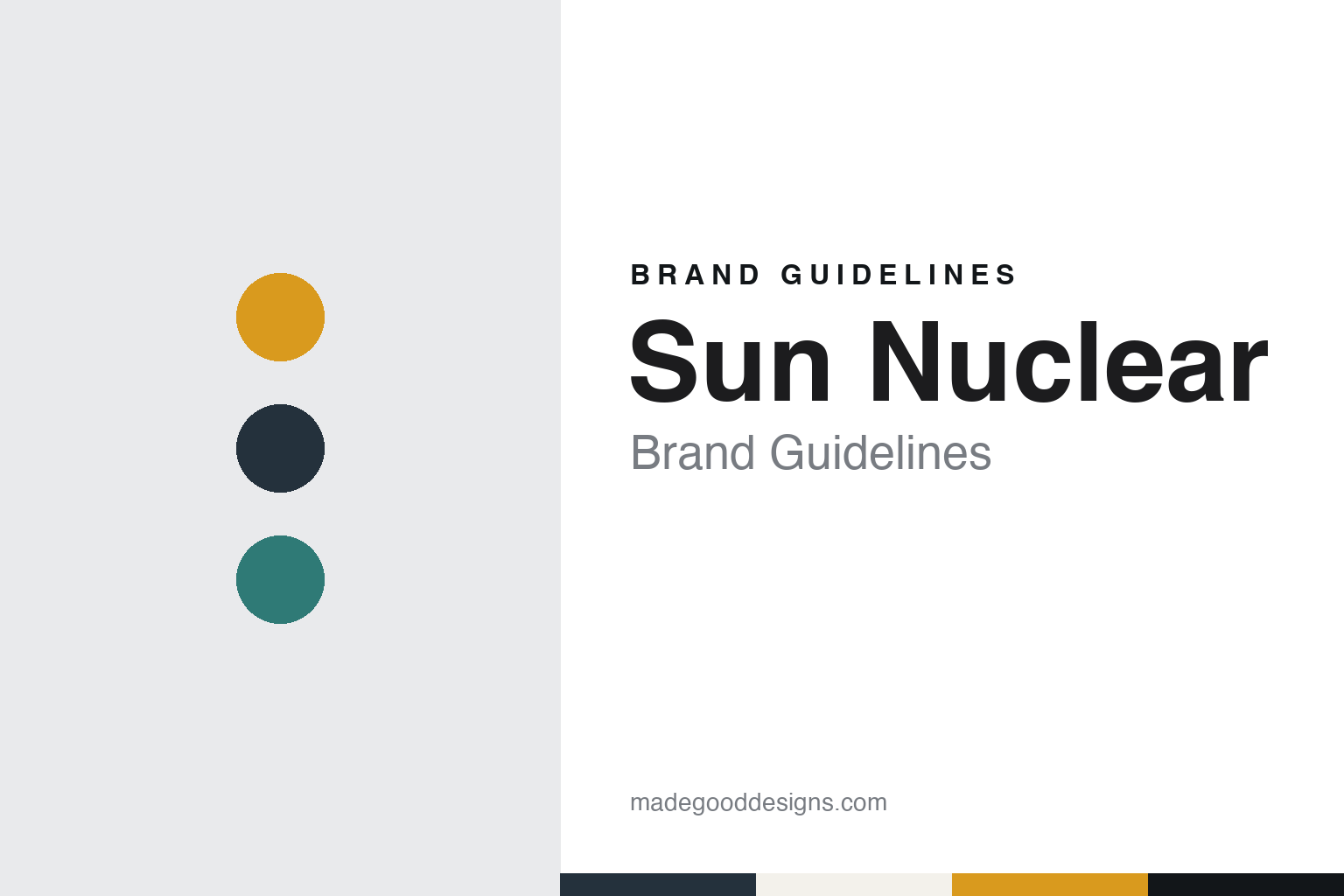
Two constants: an amber, slate and teal palette and an instrument sans register. Abstract homage — not a Sun Nuclear product or mark; no device, logo or nameplate is reproduced.
Melbourne, Florida
A measurement business that joined Mirion.
Sun Nuclear makes quality-assurance equipment and software for radiotherapy and diagnostic imaging, and is based in Melbourne, Florida. Since 2021 it has belonged to Mirion: Mirion Technologies announced on 7 January 2021, in a release from San Ramon, California, that it had acquired Sun Nuclear Corporation, and the deal tracker PrivSource records the acquisition under the same date. At the time Mirion described itself as a portfolio company of the private equity firm Charterhouse Capital Partners. In the same release Mirion’s chief executive, Thomas Logan, said the two companies would use their combined expertise, brand equity and relationships to extend Mirion’s position in the cancer therapy market, while Sun Nuclear’s chief executive described Mirion’s focus on radiation as a match for his company’s next stage of growth.
The company is closely tied to the Simon family. The 2021 release named Bill Simon as the “founder of Sun Nuclear’s medical device business” and its chief science officer, with a career in radiotherapy measurement of more than 44 years, and Jeff Simon as chief executive. Mirion’s 2022 release on its medical group credited Sun Nuclear with “nearly 40 years of service,” and the company’s website now speaks of 40 years of partnerships with fellow vendors, scientific associations and customers.
The product line widened through acquisition. Sun Nuclear says it bought Gammex in 2014, adding Solid Water and other tissue-mimicking phantom materials, patient-alignment lasers for CT simulation and treatment rooms, and diagnostic imaging QA products; in May 2020 it said those products would carry the Sun Nuclear name instead of Gammex. In March 2021 it opened a SunServices Center in Breda, the Netherlands, for service, repairs and support across Europe, the Middle East, Africa and India, noting offices at the time in Madison, Wisconsin and Hamburg, Germany.
Colour
Arrays, scanners and SunCHECK.
Sun Nuclear’s products check radiotherapy machines and treatment plans. Its range includes the SunCHECK quality-management platform, whose 2.0 release the company announced in April 2018; the SRS MapCHECK array for stereotactic treatments, which it says was introduced in 2018 and had reached 1,000 user sites by December 2023; and the SunSCAN 3D cylindrical water-scanning system, introduced in May 2022. Its Breda announcement named the Daily QA 3, MapCHECK 3 and IC PROFILER among the devices the centre services.
The company works alongside the makers whose machines its tools measure. Its news archive records a partnership with Accuray on QA for the Radixact system in October 2022, an alliance announced by Varian in September 2024, and, in September 2026, a validated adaptive QA solution for Accela, a new radiotherapy system from Siemens Healthineers. The company argues that independence and integration matter equally: independent checks, in its words, provide “unbiased assurance,” while integration with existing technology and workflows simplifies and standardises the work.
Software has taken a larger share of the line. On 30 April 2025 Sun Nuclear announced that it had acquired Oncospace, a company founded in 2018 that offers cloud-based, AI-driven tools, including Gateway, which converts patient archives from Philips Pinnacle to other treatment-planning systems. On 3 November 2026 it introduced Simon, which it calls a command center for linear-accelerator health, gathering QA data, machine logs and performance checks across a fleet. The product is named in honour of Bill Simon, whom that release calls a co-founder; it was previewed at the ASTRO meeting in Boston, with NYU Langone Health as a clinical partner.
Typography
Design and documentation.
Radiotherapy companies sell machines that most people never see. A linear accelerator sits in a shielded treatment room, often called a bunker, and is bought by hospital physicists, radiation oncologists and administrators rather than by the public. Their brand material is therefore built for a professional audience first, and the patient appears mostly through the treatment room and the people who work in it.
The dominant image is the machine itself: a large, rounded white gantry around a treatment couch, photographed in a calm room with soft lighting and, often, a coloured wall or ceiling panel. Close-ups of the gantry head, the couch and the imaging arms stand in for the engineering inside. The palette that follows is clinical: white and pale grey for the hardware, with one or two blues, teals or purples carried through the logo, the interface and the trade-show stand.
Software has become the second subject. Treatment-planning screens show a scan of the body with the planned dose laid over it as a colour wash, usually running from cool blues at the edges to warm reds and yellows at the centre, and those images are used in brochures as freely as the machines. Physicists and radiation therapists at a console, checking a plan or a quality-assurance result, supply the human scene.
Much of the industry’s visual calendar is set by congresses. The annual meeting of ASTRO, the American Society for Radiation Oncology, and the ESTRO congress in Europe are where companies launch systems, build their stands and publish the photographs and films that then circulate for the year. For a designer, the category is a study in presenting heavy, regulated equipment in a quiet, exact register.
Aa
An instrument sans for a two-word name and capitalised product names. (Specimen set in Manrope, a sans STAND-IN; NOT the Sun Nuclear logo.)
Sun Nuclear
A named brand inside Mirion Medical.
Mirion itself changed shape after the purchase. Wikipedia’s article on Charterhouse Capital Partners says the firm acquired Mirion in 2015, and that in June 2021 Mirion announced it would go public by merging with a Goldman Sachs-backed special purpose acquisition company. Mirion’s investor site now lists the company under the ticker MIR and gives its headquarters as Atlanta, Georgia.
In July 2022 Mirion grouped its healthcare businesses as Mirion Medical — Dosimetry Services, Sun Nuclear, CIRS, Biodex and Capintec — and Sun Nuclear now describes itself as part of that group. CIRS, a Norfolk, Virginia maker of imaging and radiotherapy phantoms that Mirion acquired in December 2021, had its products offered through Sun Nuclear from April 2022, according to Sun Nuclear’s news archive. The 2025 Oncospace release named Luis Rivera as Sun Nuclear’s president and an executive vice president of Mirion Medical, and the company’s product names are now trademarks of Mirion Technologies, Inc. or its affiliates.
Sun Nuclear keeps its own name, website and Melbourne headquarters inside the group. Its website says more than 6,000 facilities in over 130 countries use its solutions, including more than 90 per cent of US cancer treatment centres; those are the company’s figures. Its product names lean on capitals and compounds — SunCHECK, MapCHECK, SunSCAN — that carry the company name into each line.
For a design guide, Sun Nuclear shows how a family-founded instrument maker can keep a distinct name as one brand inside a larger listed group. Compare Varian, which announced an alliance with it in 2024, and Siemens Healthineers, whose Accela system it supports. For this guide we use a warm amber, a deep slate and a muted teal with a sans, an unofficial interpretation; no product or logo is reproduced.
Explore & save
Keep Sun Nuclear’s identity on hand — save it to a board in the Made Good inspiration library.
Sun Nuclear identity set
Pin the Sun Nuclear amber, slate and teal palette and the instrument sans register to your own board.