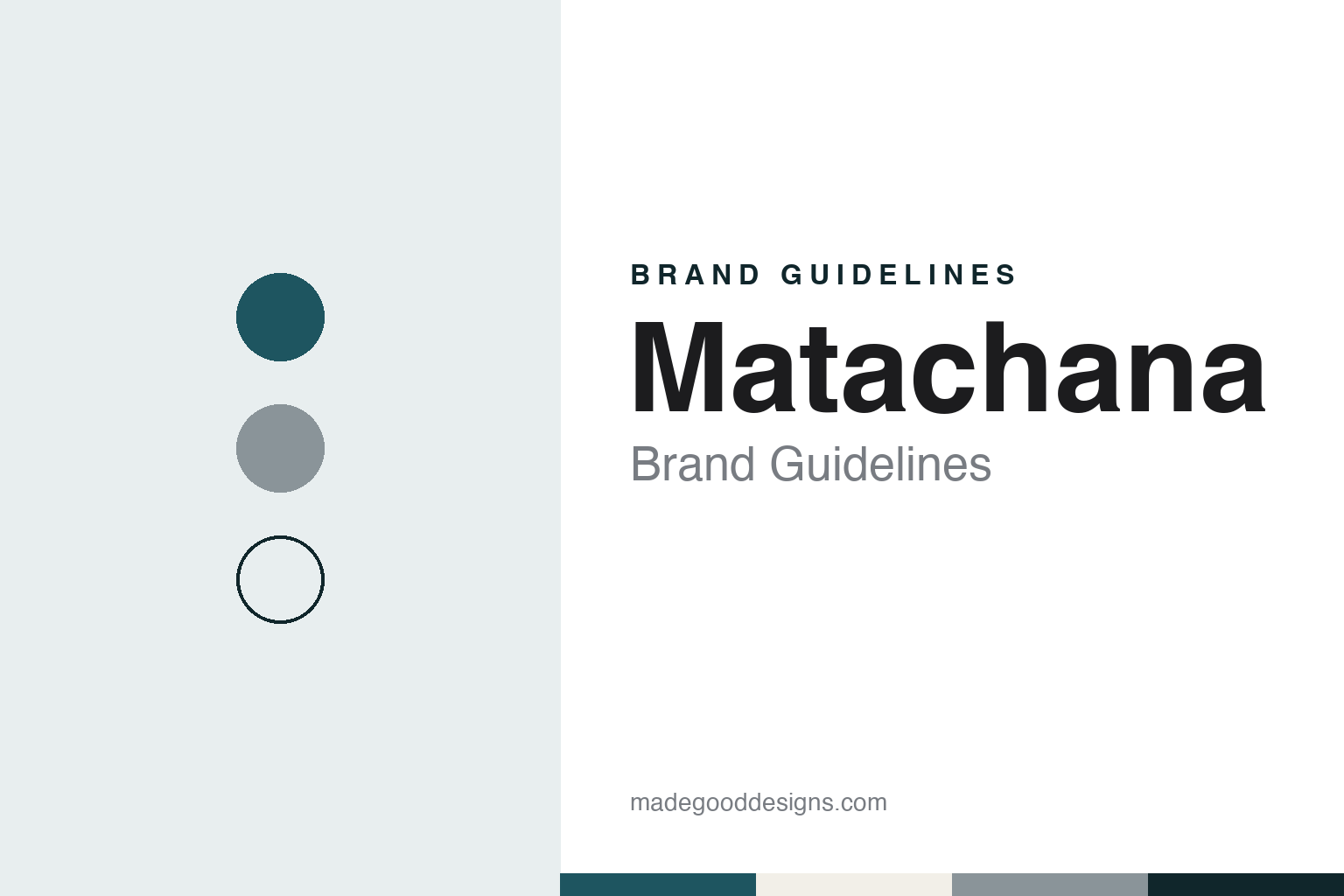
Matachana Brand Guidelines
The Barcelona steriliser maker that still carries its founder’s name.
Aa
Two constants: a Matachana teal, steel and linen palette and an engineering sans register. Abstract homage — not a Matachana product or mark; no machine, logo or nameplate is reproduced.
Barcelona, 1962
A founder’s name on a steriliser.
Matachana began in Barcelona in 1962. The company’s own history page credits its founding to Antonio Matachana, and the operating company still carries his name: Antonio Matachana, S.A. The same timeline says it built its first steriliser for the health sector in 1967, and in 1975 launched a full range of steam and low-temperature sterilisers for hospitals and laboratories.
Exports came next. The company dates its first sales to Europe and Latin America to 1982, and the introduction of microprocessor control in its machines to 1983. Subsidiaries opened in France in 1992 and in Argentina in 1993, and in 1995 it gained ISO 9001 certification, the company says. In 2000 it bought the German company WEBECO GmbH, and in 2007 it opened a subsidiary in Malaysia.
Writing in a September 2009 opinion column published by Biocat, the Catalan life-sciences organisation, Manuel Matachana, then the company’s director of marketing and sales, said the business was “now run by the second generation.” He described how a modest company had grown into a small multinational group, with offices in France, Germany, the United Kingdom, Argentina, Algeria and Malaysia, and said its main activity was making sterilisers for hospitals, laboratories, research centres and pharmaceutical companies. In Catalonia and the rest of Spain, he added, it also sold a wider range of products and provided its own technical support.
An exhibitor profile on the website of the World Federation for Hospital Sterilisation Sciences gives a similar picture: it says Matachana has made and sold equipment for the health and the hotel and catering sectors in Spain since 1962, and lists its sterilisers for hospital central sterilisation units, pharmaceutical laboratories, universities, and dental and ophthalmological clinics, as well as for treating hazardous biocontaminated waste.
Colour
Castelldefels and the sterile-services department.
In February 2011 Biocat reported that Matachana — which it called one of the oldest medical technology companies in the BioRegion of Catalonia — had opened a new production centre at Castelldefels, beside Barcelona. The 6,200-square-metre plant was to make large sterilisers for hospitals and research centres, replacing the company’s older facilities in Barcelona’s Zona Franca, and would also house its research and engineering departments, a training centre and an exhibition hall. The company’s own timeline dates the inauguration to 2010. At the time, Biocat said, the group had two further plants, at Cardedeu near Barcelona and at Tudela in Navarre, and affiliates in France, Germany, Argentina, Malaysia and Algeria, and alongside sterilisation, cleaning and surgical suites it had begun a new line of equipment for large-scale food preparation; its chief executive, Juan Antonio Matachana, told Biocat that the plant was a commitment to continued innovation and to Barcelona-based industry.
The range, as the company’s website sets it out, is built around the hospital’s central sterilisation unit. Steam sterilisers come in several series, among them the S1000, S2000, SC500 and S100, alongside low-temperature machines: the 130HPO and 50HPO, which the company lists under vaporised hydrogen peroxide and plasma, and the 130LF. Its MAT LD line covers washer-disinfectors and larger washing and thermal-disinfection cabins, and the website also lists automatic pre-wash units, sealing machines, flexible-endoscope reprocessors for the Spanish market, equipment for treating infectious waste, and indicators for monitoring each stage.
The company sells beyond hospitals. Its website lists ranges for life-science laboratories and research centres, for biosafety laboratories and for the pharmaceutical industry, as well as equipment for pathology departments, and says it designs, manufactures and sells its own equipment while also representing international brands. A news item on its site says that since May 2024 its steam and low-temperature sterilisers have held certification under the EU Medical Device Regulation, following an audit by its notified body, TÜV Rheinland.
Typography
Design and documentation.
Sterilisation equipment is bought by hospital engineers, infection-control teams and the managers of sterile services departments — the rooms where used surgical instruments are washed, checked, packed and sterilised before they go back to the operating theatre. The makers describe their ranges in the order of that route. Getinge calls washer-disinfectors the first step in the reprocessing flow, then moves through sterilisers to the racks and trolleys that carry sterile goods back into the hospital.
The imagery of the category is practical rather than decorative: stainless-steel chambers, sliding or hinged chamber doors set into a wall, loading trolleys, wire baskets and instrument trays folded into blue sterilisation wrap. STERIS notes that its steam sterilisers are “often referred to as autoclaves” and sorts them by how many instrument trays fit in one load; Getinge groups its range into steam sterilisers, low-temperature sterilisers, loading equipment, and trays and baskets.
Many of the larger names grew by buying other companies, so their brands are layered. STERIS still sells steam sterilisers under the AMSCO name of the American Sterilizer Company, which it bought in 1996. Getinge folded Maquet, Atrium and other acquired names into a single Getinge brand in 2017, keeping some of them as product-family names. The makers in this set are based in the United States, Sweden, Switzerland, Spain, Germany, Italy, Israel and China.
The trade meets at a few large fairs. MEDICA, the medical-technology fair, is held in Düsseldorf. In Dubai, the show founded in 1975 as Arab Health now runs as World Health Expo Dubai, a new name announced at its 50th edition, TradeArabia reported; its 2026 edition moved to Expo City Dubai, Gulf News reported.
Aa
An engineering sans for a steriliser maker. (Specimen set in Archivo, a sans STAND-IN; NOT the Matachana logo.)
Matachana Group
One name, several plants.
Matachana has kept growing through acquisitions and new buildings. In 2017, the company says, it unified its brands under the single MATACHANA name and bought the Italian company Metalarredinox S.p.A.; in 2019 it opened a further production centre at Santa Maria de Palautordera, in the province of Barcelona, and in 2021 a new office building at Castelldefels. By its account it added subsidiaries in the United States and Asia in 2015, launched its HPO hydrogen-peroxide sterilisers in 2016, and marked its 50th anniversary in 2012 and its 60th in 2022.
Today the website says the group works through subsidiaries in France, Germany, Argentina and Indonesia and through distributors in more than 120 countries, and that those subsidiaries employ more than a third of its staff. It describes its work as spanning sterilisation, washing and surgical suites, supported by its own technical service teams across Spain, and its research and development departments design new products in-house, the company says. Trade fairs have long been part of how it sells: Manuel Matachana wrote in 2009 that Antonio Matachana, S.A. had exhibited at MEDICA in Düsseldorf every year since 1980.
For a design guide, Matachana shows how a Barcelona manufacturer that still carries its founder’s name has gathered hospital, laboratory and pharmaceutical equipment under one unified brand. Compare Getinge and Belimed. For this guide we use a deep teal, a steel grey and a linen white with a sans, an unofficial interpretation; no product or logo is reproduced.
Explore & save
Keep Matachana’s identity on hand — save it to a board in the Made Good inspiration library.
Matachana identity set
Pin the Matachana teal, steel and linen palette and the engineering sans register to your own board.