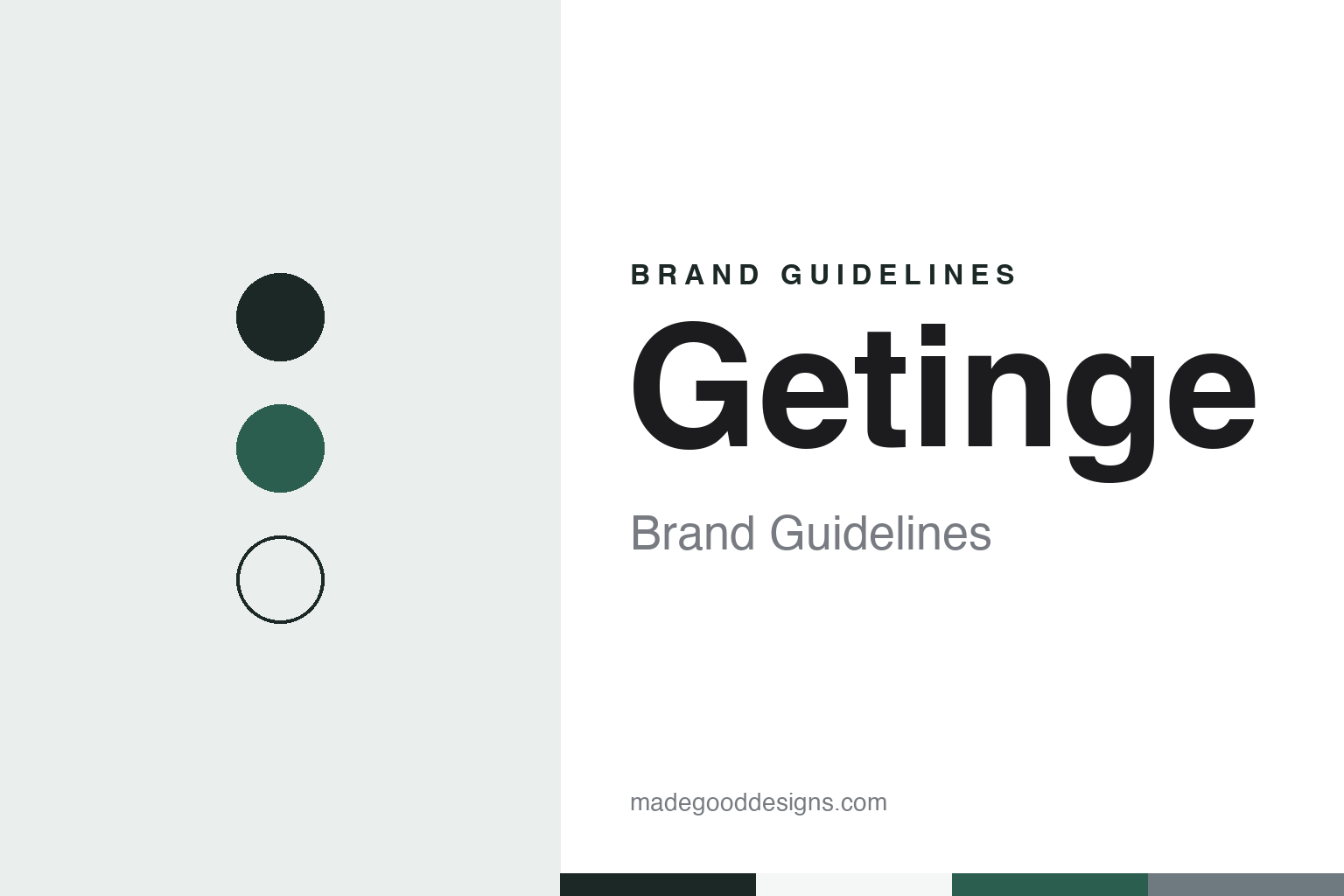
Getinge Brand Guidelines
The 1904 Swedish farm-tool maker that turned to sterilisers.
Aa
Two constants: a Getinge green, ink and steel palette and a Humanist sans register. Abstract homage — not a Getinge product or mark; no instrument, logo or nameplate is reproduced.
Getinge Mekaniska Verkstad
A village workshop in Halland.
Getinge takes its name from a village. In 1904, the company says, the Swedish entrepreneur Olander Larsson began making agricultural equipment in Getinge, a small community in Halland, in southern Sweden, and named the business after the place. Swedish Wikipedia, citing the company’s centenary history, Getinge 1904–2004, gives the first name as Getinge Mekaniska Verkstad — Getinge Engineering Works — and says it sold farm implements and did well with wind motors and horseshoe studs.
The founder did not keep it. Swedish Wikipedia says Larsson lost the company to its managing director, Rudolf Böös, in 1917, and that after several years of decline and a financial crisis the bank Götabanken took it over. In 1932, the company says, Getinge made its first move into medical technology by starting to produce sterilisers for medical equipment. In 1935, Swedish Wikipedia says, the industrialist Carl Steen bought the business.
The Växjö factory dates from the war years, when Sweden stayed neutral. The company says its factory in Växjö, about 150 kilometres from the village, opened on 5 April 1943 to make a range of stainless-steel products, and later specialised in dishwashers and disinfectors for hospitals.
In the 1960s, the company says, the appliance maker Electrolux bought Getinge — English Wikipedia gives the year as 1964 — and its international sales network helped Getinge expand abroad. In 1989 two former Electrolux managers, Rune Andersson and Carl Bennet, bought it from Electrolux, and in 1993 it was listed on the Stockholm Stock Exchange, then with 750 employees, the company says. English Wikipedia, citing the 2024 annual report, names Bennet’s holding company, Carl Bennet AB, as its main owner.
Colour
From sterilisers to operating rooms.
A long run of acquisitions followed. The company says Getinge bought more than 15 infection-control and sterilisation companies in Europe and the United States after 1989. In 2000 it bought the German company Maquet, founded in 1838 and a maker of operating tables, which took it into the operating theatre; in 2003 came Jostra, a maker of heart-lung machines, and Siemens’ ventilator business. English Wikipedia adds Heraeus Med in 2002, the British company Huntleigh Technology in 2007, Atrium Medical in 2011 and Pulsion Medical Systems in 2014. The patient-handling business, Arjo, was split off and distributed to shareholders in 2017, Swedish Wikipedia says.
Sterile reprocessing stayed at the core. The company says the Växjö plant is now its global hub for washer-disinfectors, with research and development and production of nine models, from the Aquadis 56 and the 86-series to the 9100 cart washer-disinfector, as well as the ED-Flow endoscope reprocessors; about 170 people work there. Its steriliser range includes steam models such as the GSS67H and the HS33-series and the Poladus 150, a low-temperature hydrogen-peroxide steriliser for heat-sensitive instruments, sold alongside loading trolleys and an automated loading system.
Production has also moved. In May 2013, Nordic Life Science reported, citing the regional broadcaster P4 Halland, that Getinge would cut 50 jobs at its sterilisation unit in Halland, which then had 300 staff, and that since 2009 the company had moved large parts of its production abroad. Its head office is now in Gothenburg; English Wikipedia says it stayed in the village of Getinge until 2014.
Typography
Design and documentation.
Sterilisation equipment is bought by hospital engineers, infection-control teams and the managers of sterile services departments — the rooms where used surgical instruments are washed, checked, packed and sterilised before they go back to the operating theatre. The makers describe their ranges in the order of that route. Getinge calls washer-disinfectors the first step in the reprocessing flow, then moves through sterilisers to the racks and trolleys that carry sterile goods back into the hospital.
The imagery of the category is practical rather than decorative: stainless-steel chambers, sliding or hinged chamber doors set into a wall, loading trolleys, wire baskets and instrument trays folded into blue sterilisation wrap. STERIS notes that its steam sterilisers are “often referred to as autoclaves” and sorts them by how many instrument trays fit in one load; Getinge groups its range into steam sterilisers, low-temperature sterilisers, loading equipment, and trays and baskets.
Many of the larger names grew by buying other companies, so their brands are layered. STERIS still sells steam sterilisers under the AMSCO name of the American Sterilizer Company, which it bought in 1996. Getinge folded Maquet, Atrium and other acquired names into a single Getinge brand in 2017, keeping some of them as product-family names. The makers in this set are based in the United States, Sweden, Switzerland, Spain, Germany, Italy, Israel and China.
The trade meets at a few large fairs. MEDICA, the medical-technology fair, is held in Düsseldorf. In Dubai, the show founded in 1975 as Arab Health now runs as World Health Expo Dubai, a new name announced at its 50th edition, TradeArabia reported; its 2026 edition moved to Expo City Dubai, Gulf News reported.
Aa
A humanist sans — one master brand. (Specimen set in Manrope, a sans STAND-IN; NOT the Getinge logo.)
Getinge
One brand, a star-shaped symbol.
By 2017 the group carried a long list of names. On 20 March 2017 Getinge announced from Gothenburg that it would become a single-brand company: brands built up through acquisitions over 25 years, such as Maquet, Lancer and Atrium, would give way to one name, and all of the group’s products would carry the Getinge logo. Some acquired names, such as Maquet, would continue as product-family names under the Getinge master brand, together with a redesigned logo and a new identity and tone of voice.
A second release, on 21 March 2017, described the new logo as a wordmark and a symbol, with the symbol inspired by the star of life, the emblem used by emergency medical services, and its several parts standing for the company’s areas of work. The release tied the brand to the line “Passion for life.” The company says it now employs around 12,000 people in 40 countries, in three business areas: Acute Care Therapies, Life Science and Surgical Workflows.
In October 2023 MedTech Dive reported that Getinge was buying Healthmark, a supplier of products for checking instrument cleaning and of sterilisation packaging, with sites in Michigan and France, to strengthen its sterile-reprocessing business in the United States; the same report said quality and supply problems at its cardiac-assist and cardiopulmonary units had led that year to several Class I recalls and the temporary suspension of two CE marks. English Wikipedia records a further purchase, Paragonix Technologies, in 2024.
For a design guide, Getinge shows how a group built from many acquisitions can gather them under one village name and one symbol. Compare STERIS, which kept the AMSCO name alive as a product brand, and Belimed, the Swiss sterilisation-equipment maker. For this guide we use a deep green, an ink and a steel grey with a sans, an unofficial interpretation; no product or logo is reproduced.
Explore & save
Keep Getinge’s identity on hand — save it to a board in the Made Good inspiration library.
Getinge identity set
Pin the Getinge green, ink and steel palette and the Humanist sans register to your own board.