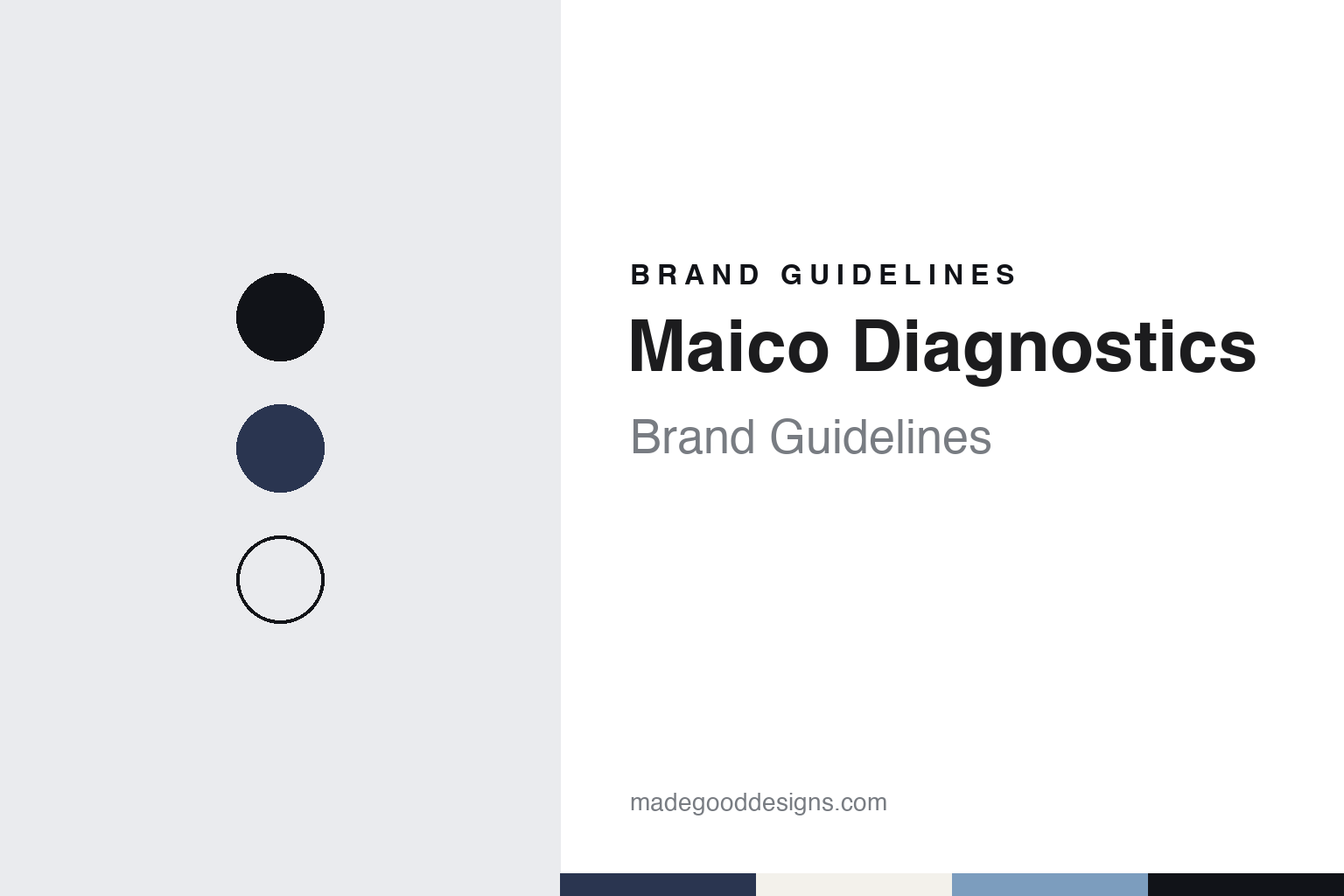
Maico Diagnostics Brand Guidelines
Leland Watson’s 1937 audiometer company, in Minneapolis and Berlin.
Aa
Two constants: a slate navy, sky blue and white palette and a friendly sans register. Abstract homage — not a Maico Diagnostics product or mark; no instrument, logo or nameplate is reproduced.
Minneapolis, 1937
A Rhodes scholar and the Medical Acoustic Instrument Company.
Maico began in Minneapolis in 1937. In a 2019 article on an early Maico audiometer in its collection, the Hennepin History Museum records that Leland A. Watson founded the Medical Acoustic Instrument Company there that year, and that the name was soon shortened to Maico. The museum, drawing on Minneapolis newspaper reports from 1941, says Watson had graduated from the University of Minnesota and then studied at Oxford as a Rhodes scholar, where he worked alongside engineers developing new hearing-aid technology, and brought that knowledge home to start the company.
The company tells a related story about its founding idea. MAICO Diagnostics says Watson was the son of an ear physician in Minneapolis and had worked as a sales clerk for hearing instruments, and that he saw the devices he sold to doctors as too complicated and set out to make easier ones. It also says Watson coined the term “audiometer,” a claim made by the company itself.
The early business grew quickly. The museum’s audiometer dates from 1940, and, citing the 1941 press, it says that within a few years of the company’s founding ninety percent of the audiometers in the United States were made by Maico. It records that Maico instruments were used by audiologists in hospitals, clinics and universities across the country, by the US Army and Navy, and by some foreign governments.
Maico also made hearing aids. English Wikipedia’s history of hearing aids names the Maico Transist-ear, alongside the Microtone Transimatic, as the first “all-transistor” hearing aids offered for sale, in 1952. German Wikipedia describes the Minneapolis company of the 1980s as an established American maker of both hearing aids and audiometers.
Colour
From Bern and Stuttgart to Demant.
Maico’s ownership moved to Europe in the 1980s. According to German Wikipedia’s article on Bernafon, the Swiss firm Gfeller AG of Bern — the company behind the Bernafon hearing aids — took over Maico Inc. of Minneapolis in 1986, as a way into the American hearing-aid market. In 1987 Gfeller merged with Autophon, Hasler and Zellweger Telecommunications to form the Ascom group, and its hearing business was renamed Ascom Audiosys.
The German side of today’s company came next. MAICO Diagnostics says the audiological division of Robert Bosch GmbH in Berlin merged with MAICO Minneapolis in 1991, and that the company has had headquarters in both Minneapolis and Berlin since then. English and German Wikipedia date the takeover of Bosch’s hearing-instrument activities by the Bernafon business to 1992, so the sources give different years. Both versions agree that the Bosch unit and Maico ended up under the same owner.
In January 1995 the Danish group then called Oticon Holding bought Bernafon, and Demant’s own history says that purchase included the diagnostic-equipment maker Maico, “laying the foundation” for the group’s diagnostics division. The trade journalist David H. Kirkwood, writing in Hearing Health Matters in September 2011, likewise dated Demant’s addition of Maico Diagnostics to 1995. In a 2022 interview on its website, a long-serving MAICO manager says the Berlin business was once called MAICO Audiometer GmbH and changed its name to MAICO Diagnostics as the range grew to include OAE and ABR testing.
Inside Demant, Maico now sits beside the group’s other diagnostics brands, including Interacoustics, which Demant bought in 2000, and Amplivox and Grason-Stadler, added in 2008 and 2009.
Typography
Hearing care and its makers.
Hearing-aid makers sell a product that is meant to be hard to see, and much of their imagery works around that. Devices are shown balanced on a fingertip to make their size clear, or in close-ups of the ear, where a behind-the-ear case and its thin tube or wire are the only visible trace. The Bern newspaper Der Bund noted in 2012 that hearing aids, unlike glasses, still had an image problem, and that makers were trying both to shrink them and to give them designed housings in a choice of colours.
Colour tends to follow the body rather than fashion. Many ranges come in skin tones, greys and silvers meant to blend with hair and skin, with brighter shells offered as options. Around the device sit the settings of professional care: the audiology booth, the fitting session and, more recently, the phone app used to stream sound or adjust a program.
The industry is concentrated and old. In 2007 Germany’s competition authority, the Bundeskartellamt, named Siemens, Phonak and Oticon as the main producers in the German market, with GN ReSound and Widex as the next-largest. Several of today’s brands began inside telephone and telegraph companies: Bernafon at a Swiss telephone maker in 1946, and GN Hearing’s forerunner Danavox in a Danish group that started with telegraph cables. Most are now part of a few groups that each run several brands side by side.
The trade meets at its own congresses. In Germany the annual EUHA congress of hearing-aid acousticians is where makers show new ranges to the trade; in the United States the American Academy of Audiology’s convention, long known as AudiologyNOW!, plays a similar role. This guide sets out what can be checked about each brand — who founded it, who owns it and where its products are made — and marks clearly what rests on the company’s own word.
Aa
A friendly sans for a screening-equipment maker. (Specimen set in Figtree, a sans STAND-IN; NOT the MAICO logo.)
MAICO
The hearing-screening company.
Today the brand trades as MAICO Diagnostics, with offices in Berlin and Minneapolis. The company describes itself as a medium-sized firm focused on hearing screening, with more than 85 years of experience, and says its devices are sold in 112 countries. In its 2022 anniversary interview, the same manager calls it “the hearing screening company” and says the Berlin office grew from nine employees in 1993 to about fifty.
Its range runs from basic audiometers to newborn-screening equipment. The company says its MA 25 audiometer had been sold 36,802 times by 2022. Other lines include the easyTone tablet audiometer, launched in 2022 by the company’s account; the easyScreen and ERO•SCAN screening devices; the touchTymp tympanometers; and the MB 11 BERAphone, which the company says marked its entry into newborn hearing screening in 2005. MAICO also sells sound booths and OtoAccess data software, shared with its sister brands.
On manufacturing, the company is specific about one part of its business: in the 2022 interview, the manager says the production and shipment of its screening devices are now carried out entirely from a site in Poland, where some configuration work was once done in Berlin. The company does not give the same detail for every product line.
The 1940 audiometer in the Hennepin History Museum’s collection connects the present company to its Minneapolis origins, and the museum notes that, many decades on, diagnostic instruments still carry the Maico name under an overseas owner. The company keeps Watson at the centre of its own history page, presenting ease of use as the idea he started with.
For a design guide, Maico Diagnostics shows how a brand can pass from an American founder to Swiss and then Danish owners while keeping its name and its founding idea. Compare Bernafon, the Swiss hearing-aid maker that brought Maico into the Demant group, and Interacoustics, its Danish sister diagnostics brand. For this guide we use a slate navy, a sky blue and a warm white with a sans, an unofficial interpretation; no product or logo is reproduced.
Explore & save
Keep Maico Diagnostics’s identity on hand — save it to a board in the Made Good inspiration library.
Maico Diagnostics identity set
Pin the Maico Diagnostics slate navy, sky blue and white palette and the friendly sans register to your own board.