Cantel Medical Brand Guidelines
From a 1946 Olympus distributor to an infection-control group absorbed by STERIS.
Aa
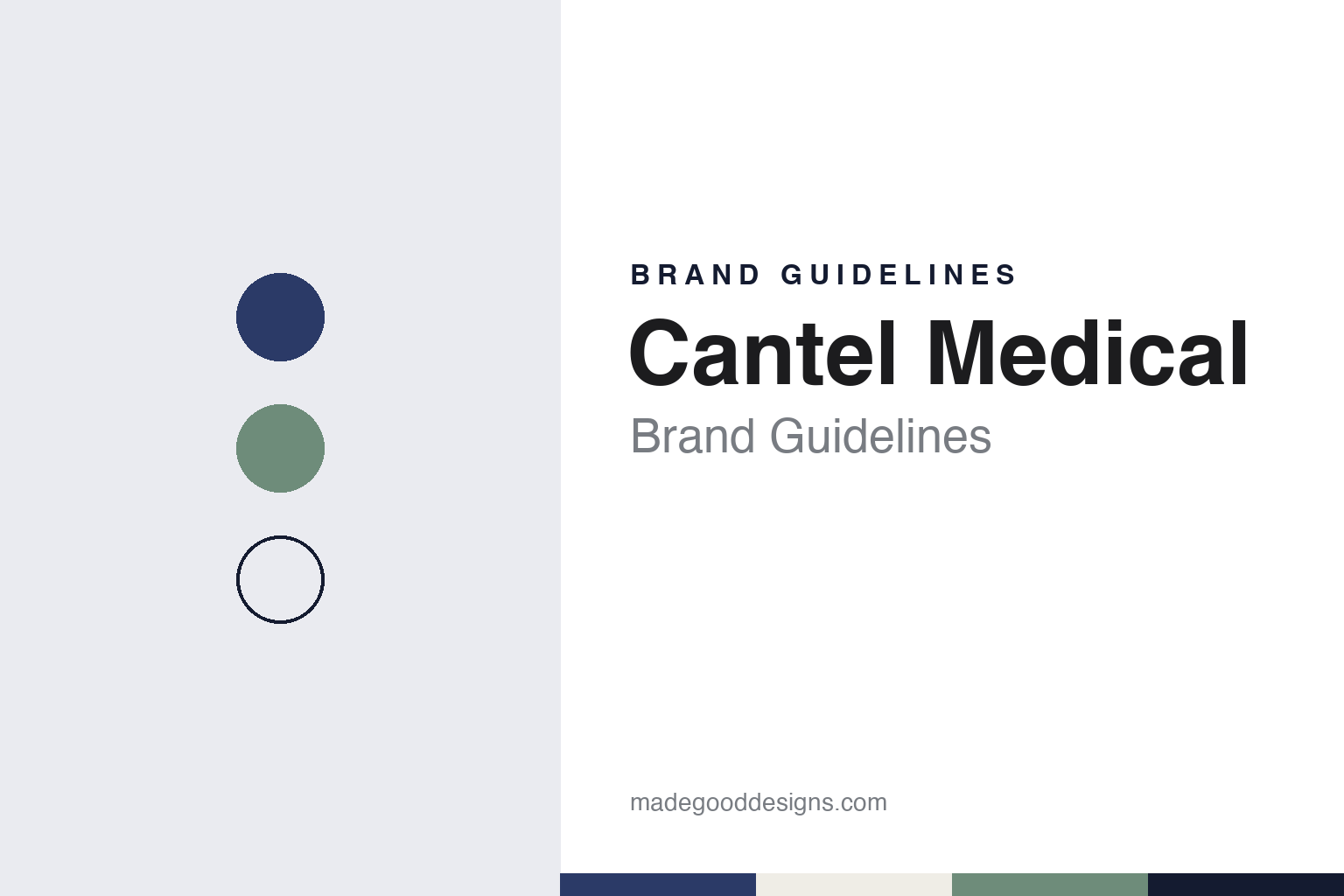
Two constants: a Cantel navy, sage and stone palette and an annual-report serif register. Abstract homage — not a Cantel Medical product or mark; no device, logo or nameplate is reproduced.
W. Carsen Co.
Cameras, microscopes and an Olympus agency.
Cantel Medical grew out of a Canadian distribution business. According to the International Directory of Company Histories, in a 2006 profile, the company traced its roots to W. Carsen Co., formed in Canada in 1946 by Walter Carsen. He began by selling 35mm cameras, and in 1949 started distributing products from Japan’s Olympus; over time he gathered marketing rights to microscopes, binoculars, telescopes and fibre-optic medical instruments, and the Olympus range would later include endoscopes.
In October 1962 Carsen sold the business to Charvoz-Carsen, a New Jersey company incorporated in 1952, which was reincorporated in Delaware in 1963 ahead of going public, the directory says. English Wikipedia instead dates Cantel’s founding to 1963 and names Charles M. Diker as its founder. Charvoz-Carsen distributed audio, optical, drafting and engineering equipment as well as graphic and fine-art supplies, and in September 1986 it moved into furniture by buying Stendig Industries, a maker and importer of residential and contract furniture, whose name it took that December. A controlling interest in Vitra Seating followed in 1987.
The furniture venture did not last. A reorganisation began in 1988, and after James P. Reilly became chief executive in 1989 the company sold businesses and, in April 1989, renamed itself Cantel Industries. Its focus became the medical side of its Canadian arm, the Carsen Group, whose most valuable asset, the directory says, was its Canadian distribution agreement with Olympus. It left furniture altogether in 1993.
Colour
From endoscopes to infection control.
The turn toward infection control came in March 1996, when Cantel bought MediVators of Minneapolis, which sold automated disinfection equipment for endoscopes. Its computer-controlled DSD-91 system, which could handle two endoscopes at once, had received US Food and Drug Administration approval in 1994, the directory says. MediVators also set the stage for Olympus to promote Carsen and MediVators equipment alongside its own endoscopes, and in March 1998 Cantel added lower-cost single and dual disinfection units bought from Chris Lutz Medical. In 2000 Carsen ended its consumer-products business, selling its stock of Olympus consumer goods back to Olympus, and the parent took the name Cantel Medical Corporation, with its headquarters in Little Falls, New Jersey.
Acquisitions shaped the rest of its history. In September 2001 Cantel bought Minntech of Plymouth, Minnesota, founded in 1974, which made disinfection and reprocessing systems for kidney dialysis as well as filtration products and chemical sterilants. The same year Carsen bought Technimed, a Canadian provider of hand-held surgical instruments and rigid-endoscope repair. Cantel listed on the New York Stock Exchange in May 2002. In August 2003 it added two water-treatment businesses, Biolab Equipment of Canada, founded in 1969, which specialised in ultra-pure water for biotechnology, pharmaceutical, research and semiconductor customers, and Mar Cor Services of Skippack, Pennsylvania, which were combined with Minntech’s water filters as Mar Cor Purification in 2005; it also bought the Dutch company Dyped Medical in 2003. In 2004 came Saf-T-Pak of Edmonton, which made packaging for shipping biological specimens, and in August 2005 Crosstex International of Hauppauge, New York, founded in 1953, which brought single-use products for dental offices such as patient bibs, face masks and barrier films. The same year Olympus ended its Canadian distribution contract with Carsen, choosing to handle that business itself. By the directory’s 2006 account the Carsen Group still marketed flexible and rigid endoscopes, endoscope disinfection equipment, microscopes and image-analysis hardware and software in Canada.
Later purchases, recorded by English Wikipedia, included the Belgian company Aexis Medical in 2018 and, in 2019, Vista Research Group of Ashland, Ohio, and the Chicago dental-instrument maker Hu-Friedy, which says on its website that it has made instruments since 1908.
Typography
Design and documentation.
Sterilisation equipment is bought by hospital engineers, infection-control teams and the managers of sterile services departments — the rooms where used surgical instruments are washed, checked, packed and sterilised before they go back to the operating theatre. The makers describe their ranges in the order of that route. Getinge calls washer-disinfectors the first step in the reprocessing flow, then moves through sterilisers to the racks and trolleys that carry sterile goods back into the hospital.
The imagery of the category is practical rather than decorative: stainless-steel chambers, sliding or hinged chamber doors set into a wall, loading trolleys, wire baskets and instrument trays folded into blue sterilisation wrap. STERIS notes that its steam sterilisers are “often referred to as autoclaves” and sorts them by how many instrument trays fit in one load; Getinge groups its range into steam sterilisers, low-temperature sterilisers, loading equipment, and trays and baskets.
Many of the larger names grew by buying other companies, so their brands are layered. STERIS still sells steam sterilisers under the AMSCO name of the American Sterilizer Company, which it bought in 1996. Getinge folded Maquet, Atrium and other acquired names into a single Getinge brand in 2017, keeping some of them as product-family names. The makers in this set are based in the United States, Sweden, Switzerland, Spain, Germany, Italy, Israel and China.
The trade meets at a few large fairs. MEDICA, the medical-technology fair, is held in Düsseldorf. In Dubai, the show founded in 1975 as Arab Health now runs as World Health Expo Dubai, a new name announced at its 50th edition, TradeArabia reported; its 2026 edition moved to Expo City Dubai, Gulf News reported.
Aa
An annual-report serif for a group built from acquisitions. (Specimen set in Newsreader, a serif STAND-IN; NOT the Cantel Medical logo.)
Into STERIS
Absorbed in 2021.
Cantel Medical no longer trades as an independent company. In January 2021 STERIS agreed to buy it in a cash-and-stock deal, MedTech Dive reported, adding Cantel’s endoscopy products to the STERIS infection-prevention business and taking STERIS into the dental market; the deal was then expected to close by the end of June. English Wikipedia records that STERIS, which is operationally headquartered in Mentor, Ohio, and legally registered in Ireland, completed the purchase in June 2021, and describes Cantel as a provider of infection-prevention products and services to endoscopy, dental and dialysis customers.
Since then the Cantel name has largely left public view. In November 2026 the cantelmedical.com address forwarded to the STERIS website, and the medivators.com address to the STERIS endoscopy pages, while Crosstex and Hu-Friedy kept websites under their own names. Before the takeover, the directory noted, Cantel had been well diversified rather than dominant in any one field, and it had described itself as a provider of infection prevention and control products and services.
For a design guide, Cantel Medical shows how a company assembled from acquired brands such as MediVators, Minntech, Mar Cor and Crosstex can be absorbed into a larger group while some of those product names carry on. Compare STERIS, which bought it, and Advanced Sterilization Products. For this guide we use a ledger navy, a sage and a stone white with a serif, an unofficial interpretation; no product or logo is reproduced.
Explore & save
Keep Cantel Medical’s identity on hand — save it to a board in the Made Good inspiration library.
Cantel Medical identity set
Pin the Cantel navy, sage and stone palette and the annual-report serif register to your own board.