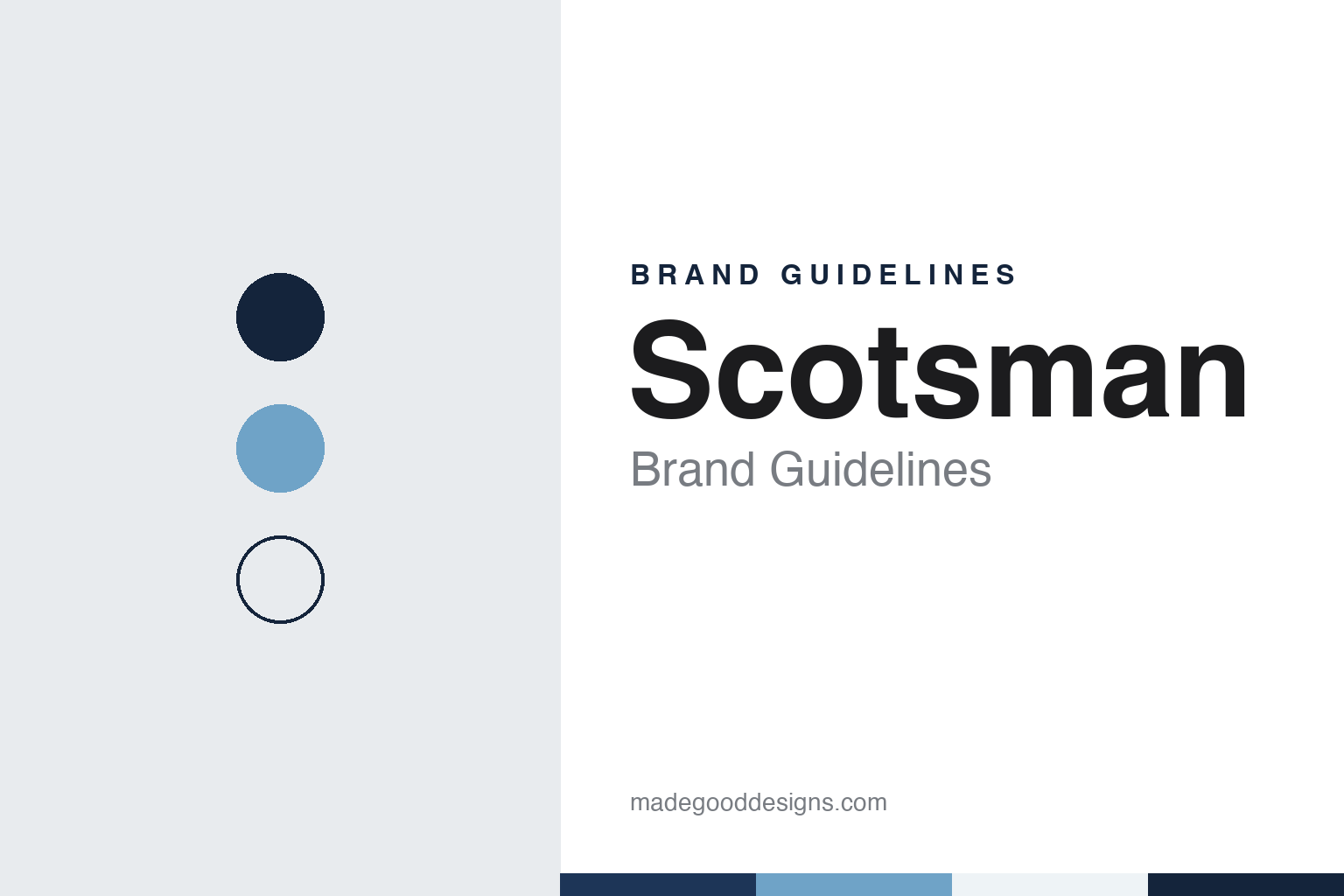
Scotsman Brand Guidelines
A stove maker’s ice-machine name that outlasted the stoves.
Aa
Two constants: a navy, ice blue and frost white palette and a condensed sans register. Abstract homage — not a Scotsman product or mark; no machine, logo or nameplate is reproduced.
Queen Stove Works
Camp stoves in Albert Lea, then ice.
Scotsman’s story starts with stoves, not ice. A company history in the International Directory of Company Histories, reproduced by Reference for Business, traces the business to 1921, when the Queen Stove Works was founded in Albert Lea, Minnesota. Queen first made camp stoves and later added oil space heaters and kitchen stoves.
The ice business arrived by acquisition. In 1950 Queen bought the American Gas Machine company, which made lanterns, ice chests, heaters and a single model of commercial ice machine, and from then on Queen sold its commercial ice machines under the name Scotsman, the same history says. The company says on its website that it “pioneered the development of affordable, reliable ice-making machines in the 1950s.”
Ownership changed several times. King-Seeley bought Queen in 1957 and merged with the American Thermos Products Company in 1960, after which Queen concentrated on ice machines. In 1967 King-Seeley Thermos bought Frimont, an Italian maker of commercial ice machines, and put the Scotsman name on its products too, which carried the brand into Europe, the Middle East and Asia, according to the history. Household Finance, later Household International, absorbed King-Seeley Thermos in 1968, and its manufacturing arm added a second Italian ice-machine maker, Castel MAC, in 1985.
In 1989 Household International spun off its refrigeration products group as a public company. Renamed Scotsman Industries and based in Vernon Hills, Illinois, it began trading on the New York Stock Exchange in April 1989. Through the 1990s it bought more businesses, among them the ice-machine makers Crystal Tips in 1992 and Simag in 1993, the food-preparation equipment maker Delfield in 1994 and the display-case maker Kysor in 1997, the history says.
Colour
Cubes, flakes and nuggets.
Scotsman makes ice machines, storage bins and dispensers for hotels, restaurants, bars, supermarkets and food processing, and it lists a wide spread of ice forms: cubes, flake and superflake, scale and nugget ice, plus a “gourmet” cube. It markets nugget ice as “The Original Chewable Ice,” and names ranges such as the Prodigy cubers, the Meridian series of ice and water dispensers and the Brilliance nugget machine. On its website it calls itself the largest manufacturer of ice machines in the world, with distributors and service agents in more than 100 countries and more than 300 models of machines, bins and dispensers.
The company also says it was the first ice-machine maker to receive ISO 9001:2000 certification. The 1990s company history credits it with being the first maker to bring out a CFC-free ice machine, ahead of the United States ban on CFC refrigerants from 1996; the design work began in early 1991 and brought parts suppliers into the process, the history says.
For the United States, Scotsman machines come from Fairfax, South Carolina. IndustryWeek named the Fairfax plant one of its Best Plants in September 2006, describing a site that started up in 1980, employed 290 people and built more than 300 models of commercial ice machines, using methods drawn from the Toyota Production System since the late 1980s. Its core work, the magazine said, was sheet-metal fabrication, plastic moulding, assembly and shipping. The Ali Group’s page for the brand lists its European base at Pogliano Milanese, near Milan, and an office in Shanghai.
Its slogan is “Ice The World Demands,” and it says its machines range from units that make one cube at a time to systems producing 10 tons of ice a day. Service manuals, operating videos and service bulletins are published for anyone specifying or using its machines, the company says, and customer comments are handled across its European, American and Asian head offices.
Typography
Ice, steel and the trade floor.
Commercial refrigeration is a trade that sells itself through equipment people rarely notice. In restaurant kitchens it appears as rows of stainless steel reach-in refrigerators and freezers, undercounter units and prep tables, built to be cleaned, opened hundreds of times a day and serviced on site. Its makers present those cabinets plainly: model numbers, door counts, capacities and finishes, with the brand name on a small badge or kick plate.
In shops the same makers face the customer. Glass-door merchandisers, open-air cases and curved glass display counters hold drinks, dairy and prepared food at the point of sale, and many carry the colours of a bottler or a grocer rather than the maker’s own. Ice machines sit between the two worlds: a machine that turns water into cubes, flakes or nuggets, usually above a bin, in a bar, hotel corridor or hospital kitchen.
The industry meets at trade fairs. The NAFEM Show in the United States, organised by the North American Association of Food Equipment Manufacturers, HOST in Milan and HostelCo in Barcelona are among the places where makers show new cabinets and ice machines to dealers, consultants and chain buyers. Restaurant association shows have played the same role for decades: True Manufacturing, for one, first showed its foodservice line at the National Restaurant Association show in 1972, according to a 2017 profile in the FCSI magazine.
Ownership varies widely across the names in this guide: some remain family companies, some are listed groups such as Japan’s Hoshizaki, and others now sit inside larger equipment groups. This guide sets out what can be checked about each brand — who founded it, who owns it and where it says its products are made — and marks clearly what rests only on the company’s own word.
Aa
A condensed sans for an industrial ice-machine name. (Specimen set in Barlow Condensed, a sans STAND-IN; NOT the Scotsman logo.)
Scotsman
From Enodis to the Ali Group.
Scotsman Industries did not stay independent. English Wikipedia’s article on Enodis says the British group, then still called Berisford, bought the Scotsman Group in 1999, a year before it renamed itself Enodis. When the American crane and foodservice maker The Manitowoc Company bought Enodis in October 2008, it was required to sell the Enodis ice business, including Scotsman and Ice-O-Matic, to meet competition concerns, Wikipedia’s article on Manitowoc says.
The buyer was the private equity firm Warburg Pincus. CStore Decisions reported in May 2009 that Scotsman Industries, of Vernon Hills, would become the name of the holding company for the former Enodis global ice business, with six factories in the United States, Italy and China and brands including Scotsman, Ice-O-Matic, Simag and Barline. On 6 November 2012 Foodservice Equipment Reports reported that the Milan-based Ali Group had agreed to buy Scotsman and all its brands, describing a business with five manufacturing facilities, 10 major sales offices, more than 800 employees and sales in more than 100 countries; the Ali Group says it completed the purchase in December 2012. Scotsman remains part of the group, which lists it among its ice and beverage dispensing brands, with its American office still in Vernon Hills.
For a design guide, Scotsman shows how a brand name can outlast the stove company that coined it and travel through a long line of owners while staying on the machine. Compare Ice-O-Matic, which has shared its owners since the Enodis years, and Manitowoc Ice, a Wisconsin ice-machine maker that went a different way. For this guide we use a deep navy, an ice blue and a frost white with a condensed sans, an unofficial interpretation; no product or logo is reproduced.
Explore & save
Keep Scotsman’s identity on hand — save it to a board in the Made Good inspiration library.
Scotsman identity set
Pin the Scotsman navy, ice blue and frost white palette and the condensed sans register to your own board.