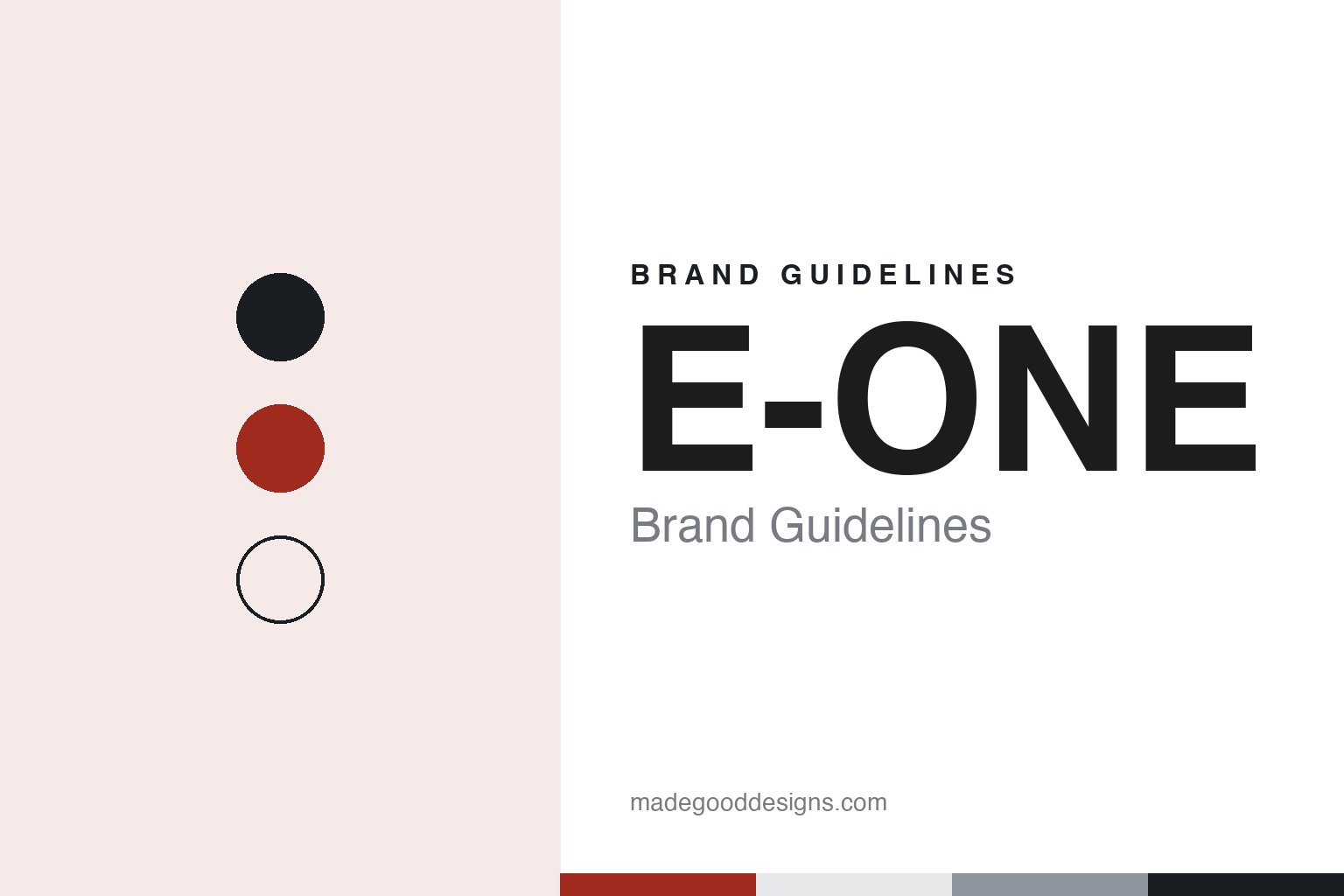
E-ONE Brand Guidelines
The Ocala fire truck maker built on extruded aluminium.
Aa
Two constants: a red, charcoal and aluminium grey palette and an industrial sans register. Abstract homage — not an E-ONE product or mark; no vehicle, logo or badge is reproduced.
Emergency One
An aluminium body built in a garage.
E-ONE began in 1974 as Emergency One, Inc. Its founder, Bob Wormser, built the company’s first fire apparatus body in his own garage, Firehouse reported in March 2024: a modular body of extruded aluminium, which, the company says, could be built separately from the chassis and loaded on later. E-ONE’s own history describes it as the first extruded aluminium fire truck cab and body.
In 1978 Wormser opened an 82,000-square-foot factory in Ocala, Florida, about 90 minutes north of Orlando, Firehouse reported; the company says the plant fronted Interstate 75, where passing fire department staff on holiday could see it. The firm, first called Emergency One, was later renamed E-ONE. It began with 25 employees.
According to E-ONE’s timeline, Federal Signal bought Emergency One in 1979, and under that ownership the company grew by acquisition: it says it bought American Eagle Fire Apparatus in Gainesville, Florida, in 1989; Superior Emergency Vehicles of Red Deer, Alberta, and the ambulance builder Frontline in 1991; the aerial platform maker Bronto of Tampere, Finland, in 1995; and Saulsbury Fire Apparatus of Tully, New York, in 1998. In 2008, the company says, E-ONE was sold to the investment firm American Industrial Partners.
Colour
Cyclone, Typhoon, Titan.
E-ONE’s product history, as the company tells it, is a run of chassis, aerials and airport trucks. Its first aerial, in 1981, was a 110-foot welded, extruded aluminium ladder on a torque-box chassis, Firehouse reported. The company dates its first aircraft rescue and fire fighting truck to 1982 and the Titan ARFF chassis to 1983, followed by the Hurricane chassis in 1984, the engine-forward Cyclone in 1986 and the Typhoon in 2001. It says it designed and built air-transportable ARFF units for the Australian Air Force in 1996, and in 1988, as a subcontractor to Teledyne, won a US Air Force contract for large eight-wheel-drive crash trucks.
E-ONE’s timeline also records a 1985 campaign, “We don’t follow tradition, we create it,” a 1987 line, “There’s no alternative to innovation,” and in 1988 the theme “America’s Fire Truck.” In 1990 it opened a Welcome Center in Ocala with a retail shop, the Fire Locker, which the company says it modelled on the Harley-Davidson stores; the shop still sells E-ONE merchandise, including a limited 50th-anniversary range announced in 2024. Its current tagline is “Delivering Strength Through Excellence.”
Aerials became a second strand. The company’s timeline describes its early ladders as a modular system, with five basic ladder sections sharing chassis and jack designs; the 95-foot platform and the 135-foot ladder joined it in 1983. Later came the HP 75 ladder in 1994, which E-ONE says was designed entirely in solid-modelling software; the HP 95 mid-mount platform in 2001, introduced in the same year as the Bronto F100RLP aerial platform from the Finnish maker it had bought in 1995; the HP 100 platform in 2007; and the Metro 100 Quint in 2017. In 1990 the company also started E-One University, a training programme for its dealers and customers; today it describes its dealer network as “highly engaged.”
The modern range covers custom and commercial pumpers, tankers, rescues, aerial ladders and platforms, industrial apparatus and ARFF trucks. The eMAX pumper was introduced in 2011, and the all-electric Vector was produced in 2022, with the first customer unit in 2023, by the company’s account; English Wikipedia, citing NGT News, calls the Vector the first full-electric North American fire truck, with orders from cities including Mesa, Arizona, and Varennes, Quebec.
Typography
Fire apparatus makers.
Fire apparatus makers sell to a small and particular set of customers: city fire departments, volunteer brigades, airports and industrial plants. Their pictures of themselves tend to look alike. Finished vehicles stand in rows outside the works in red, in lime-yellow or in white, depending on what each fire service orders, with roller doors open to show how the equipment is stowed.
The turntable ladder is the set piece. At demonstrations and open days, a ladder or an aerial platform is raised high beside a building or over an empty yard, often with a crew in the basket. Cabs carry chrome, reflective striping and the customer’s own crest and lettering, so a maker’s name can be small on the vehicle itself and much larger on its brochures, websites and service vans.
Handovers are a genre of their own. A new engine is driven out and photographed with its crew and local officials. At the FLORIAN 2026 fair in Dresden, Magirus handed three new engines to the city’s volunteer fire brigades and ran live demonstrations of turntable-ladder work, according to its own news page.
Trade fairs set the calendar. One of them is Interschutz in Hanover, and Magirus invited visitors to its stand there from 1 to 6 June 2026. Some of the makers go back to the age of horse-drawn ladders and hand pumps; others began in the late twentieth century as equipment dealers and repair shops before building vehicles of their own. This guide looks at each maker in turn: who founded it, who owns it now, where it says its vehicles are built, and which claims rest only on the company’s own word.
Aa
An industrial sans for a maker that styles its name in capitals. (Specimen set in Archivo, a sans STAND-IN; NOT the E-ONE logo.)
E-ONE
From private equity to REV Group to Terex.
The 2008 sale led to a new group. In 2010, according to English Wikipedia citing BUSRide, four companies owned by American Industrial Partners — Collins Industries, E-ONE, Halcore Group and Fleetwood Enterprises — were merged as Allied Specialty Vehicles, which was renamed REV Group in November 2015 and went public in January 2017. REV later added other fire apparatus makers, including KME in 2016. On 2 February 2026, Terex Corporation announced that it had completed its merger with REV Group, whose shares ceased trading; E-ONE’s website now carries Terex’s legal notices.
E-ONE is still made in Ocala. In March 2024, Firehouse reported, the company marked its 50th anniversary at its campus off Interstate 75, where Marion County and the City of Ocala issued proclamations; REV Group said both had named 6 March E-ONE Fire Truck Day. By then E-ONE had more than 1,000 employees between Ocala and a smaller plant in Hamburg, New York, opened in 2010 to build stainless steel apparatus for customers in harsher winter climates, the magazine reported. A 1984 E-ONE pumper, in service for 25 years with the Petal, Mississippi, fire department, was shown at the anniversary.
For a design guide, E-ONE shows how one material — extruded aluminium — can become the core of a brand story told across five decades of owners. Compare Bronto Skylift, the Finnish aerial maker E-ONE bought in 1995, and KME, its stablemate under REV Group. For this guide we use a strong red, charcoal and aluminium grey with a sans, an unofficial interpretation; no product or logo is reproduced.
Explore & save
Keep E-ONE’s identity on hand — save it to a board in the Made Good inspiration library.
E-ONE identity set
Pin the E-ONE red, charcoal and aluminium grey palette and the industrial sans register to your own board.