GSI Brand Guidelines
An Illinois garage workshop that became a global bin and dryer maker.
Aa
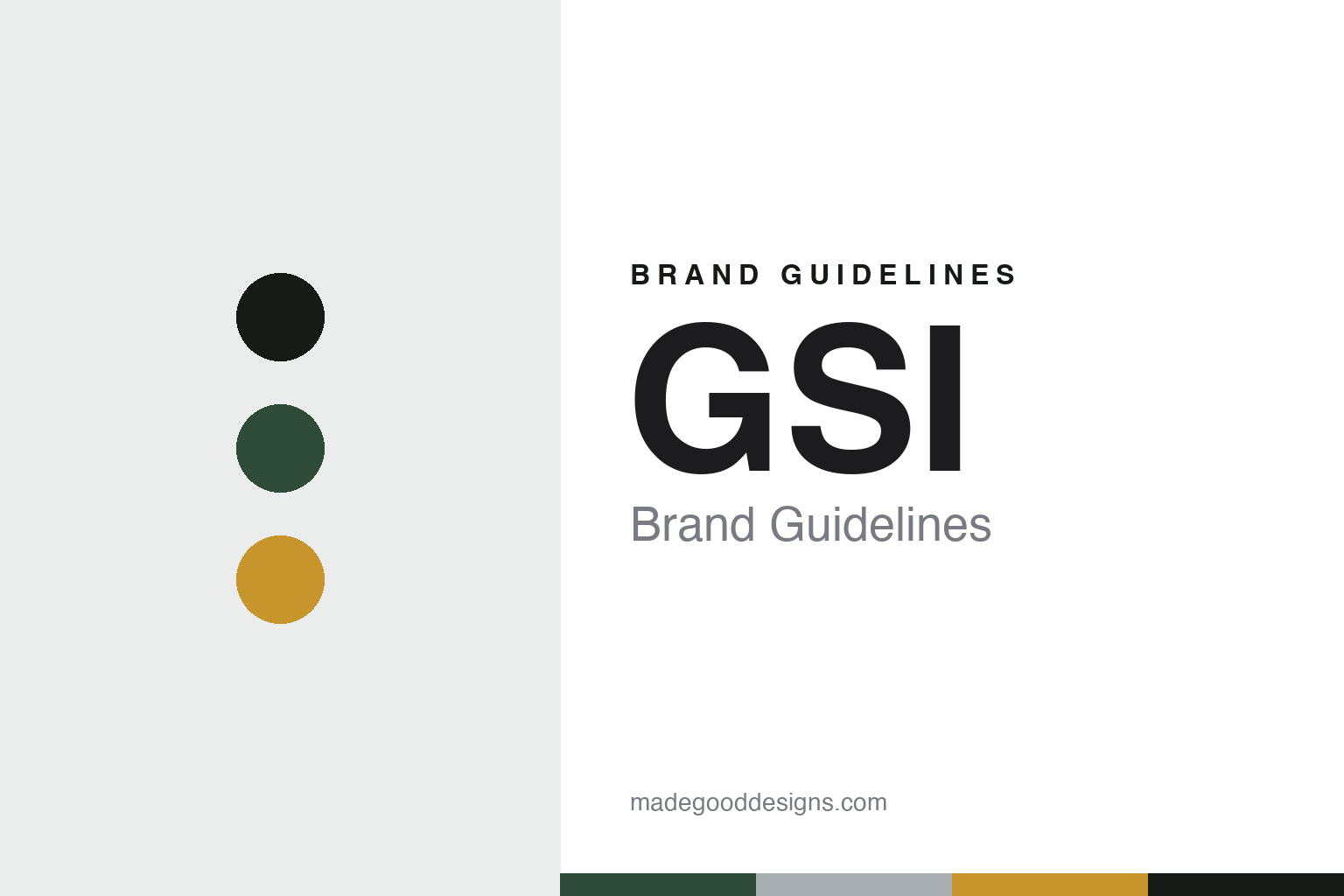
Two constants: a field green, zinc and corn gold palette and a condensed industrial sans register. Abstract homage — not a GSI product or mark; no bin, dryer, logo or decal is reproduced.
Grain Systems
A garage, three workers and corrugated steel.
GSI stands for Grain Systems. Its own history page says that Craig Sloan helped establish the company in 1972, in a 5,000-square-foot garage with only three workers, and that it began by making a wide range of corrugated steel storage bins. The business grew up in Assumption, Illinois; English Wikipedia’s article on AGCO and the investment page of Charlesbank Capital Partners both place GSI there.
The company tells its early story as a climb from the bottom of the trade. It says it started out as one of the smallest steel-bin makers and that by 1988 it had become one of the largest in the world. Today it calls itself the world’s largest manufacturer of steel farm bins, commercial grain bins and grain silos, and says it supplies more than 70 countries; those are the company’s own descriptions.
GSI has changed hands several times since the founding era. Charlesbank Capital Partners, the Boston private-equity firm, lists GSI among its past investments, with a year of investment of 2005. Its page describes GSI as a supplier of agricultural equipment to the grain, swine and poultry industries — a reminder that the group then also made livestock equipment — and says Charlesbank sold GSI to a financial buyer in 2007.
In October 2011 the American machinery group AGCO, owner of tractor brands such as Fendt and Valtra, bought GSI, English Wikipedia says. Under AGCO, according to the same article, GSI bought Johnson System of Marshall, Michigan, a maker of catwalks and towers, in 2013. For the next decade GSI was AGCO’s grain brand, grouped with livestock and seed-processing names in a division AGCO called Grain & Protein.
Colour
Bins, dryers, elevators and monitoring.
GSI’s product range follows grain from the harvest to the bin and out again. Storage is the core. Its website lists grain bins for farms and commercial sites, including the EVO and EVO 2X commercial bins, which the company says need fewer bolts and less steel to build; hopper tanks for wet grain, load-out or feed; floor systems such as Dura-Lok and Cut-Lok; and sweeps, unloads and spreaders. The company stresses its dealer and contractor network, which it says follows a project from site analysis to completion.
Drying is the second pillar. GSI sells portable dryers, its Quiet Dryer, mixed-flow dryers, T-Series tower dryers and commercial tower dryers, and it carries the Zimmerman name on a line of high-capacity commercial tower dryers. Its modular tower dryers, the company says, are assembled and pretested at GSI’s manufacturing facility before they are shipped for installation.
Around the bins and dryers sit the handling and access products that give a grain site its silhouette: commercial bucket elevators, chain and belt conveyors, automatic samplers and a bulk weigher, along with towers, tower stairs and catwalks sold under the QuickBolt name. The newest layer is digital. GrainVue, GSI’s monitoring system, tracks temperature, moisture and inventory inside a bin, can run fans automatically, and sends alerts when carbon dioxide levels rise, the company says; GSI Connect is a second management product in the same family.
The company’s own copy sums up the offer in four verbs: GSI “dries, moves, stores and monitors grain,” its About page says, closing with the lines “Putting them in control. Powering their profit.”
Typography
The trade and its catalogues.
Grain storage and handling is a trade whose products are buildings as much as machines. Its makers sell corrugated steel bins that stand in rows on prairie farms, hopper tanks for wet grain and load-out, tall bucket elevators and the towers and catwalks that link them, and dryers that run through the weeks of harvest. Further along the chain sit seed-cleaning plants, conveyors for fertiliser and pulse crops, and, in Asia, rice mills.
That shapes how the makers present themselves. Catalogue covers and websites lean on photographs of finished sites rather than single products: a cluster of galvanised bins against a wide sky, an elevator leg rising above a farmyard, a dryer tower lit up at dusk. Galvanised steel is the shared material, so a maker’s colour usually lives in its logo, its decals and its painted parts rather than in the structures themselves.
The business is also one of brands inside groups. Many of the names a farmer sees on an auger or a bin began as family workshops and were later bought by larger companies, which often keep the old name next to a group prefix. Ownership can change several times, through private-equity funds, listed companies and machinery groups, while the product names carry on.
This guide sets out what can be checked about each maker — when and where it began, who owns it now, where it says its products are made and which ranges it is known for — and marks clearly what rests only on the company’s own word.
Aa
A tall, condensed sans in the spirit of a bin decal or a catalogue cover. (Specimen set in Barlow Condensed, a sans STAND-IN; NOT the GSI logo.)
GSI
From AGCO to Grain & Protein Technologies.
GSI is no longer part of AGCO. In July 2024, English Wikipedia says, AGCO announced an agreement to sell its Grain & Protein division, including GSI, to the private-equity firm American Industrial Partners. On November 1, 2024 American Industrial Partners announced that it had completed the purchase, and that the business would operate as a new standalone, privately held company called Grain & Protein Technologies, with Jacob Thomas as chief executive. The announcement, datelined New York and Duluth, Georgia, said the company would keep its portfolio of five brands — GSI, Cumberland, AP, Tecno and Cimbria — and that at the time it employed more than 3,200 people across 14 manufacturing facilities in North America, Brazil, Europe and Malaysia.
The new owner has grown since. Grain & Protein Technologies’ own website now says it employs more than 3,600 people, manufactures in 19 locations across 10 countries and serves customers in more than 100 countries, with regional hubs in North America, South America, Europe, the Middle East and Africa, and Asia Pacific. Its stated purpose is “feeding the world better.” On GSI’s website the brands page now carries the heading “Grain & Protein Technologies’ Brands,” setting GSI beside the poultry and pig brands Cumberland, Tecno and AP and the seed and grain processor Cimbria.
Through every change of owner the three letters have stayed the same, and the company still tells its story from the 1972 garage in Assumption.
For a design guide, GSI shows how a short, plain name can carry a business through four owners while the bins and dryers on farms keep advertising it. Compare Cimbria, its sister brand under the same owner, and AGI, the Canadian group built from many grain-equipment makers. For this guide we use a field green, zinc and a corn gold with a condensed sans, an unofficial interpretation; no product or logo is reproduced.
Explore & save
Keep GSI’s identity on hand — save it to a board in the Made Good inspiration library.
GSI identity set
Pin the GSI field green, zinc and corn gold palette and the condensed industrial sans register to your own board.


