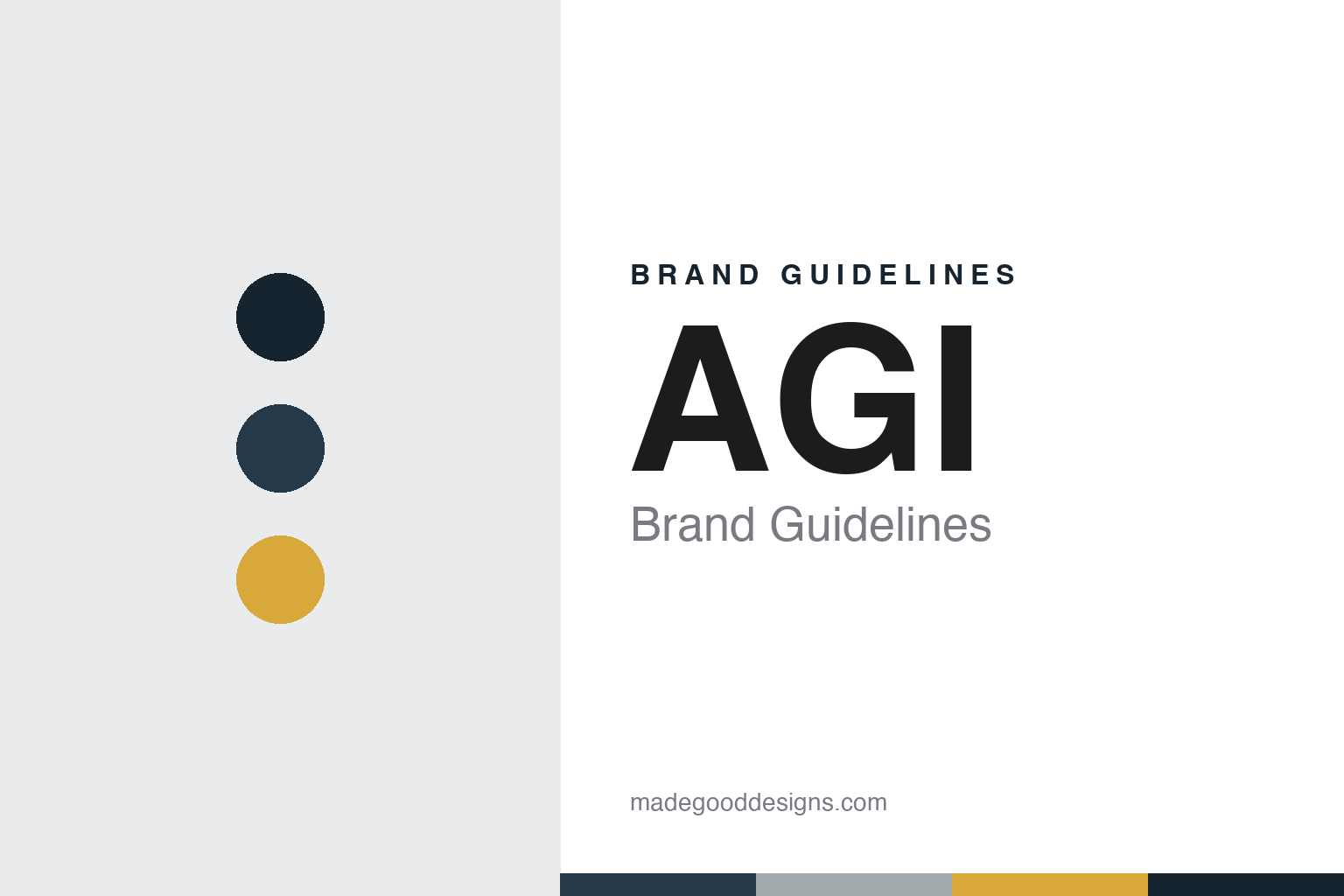
AGI Brand Guidelines
A Manitoba holding company that collected the prairie’s grain-equipment names.
Aa
Two constants: a dusk blue, galvanised grey and canola gold palette and a prairie grotesque register. Abstract homage — not an AGI product or mark; no bin, auger, logo or decal is reproduced.
A holding company
Three founders, two Manitoba makers and a Toronto listing.
AGI is the short name of Ag Growth International Inc., a Canadian maker of grain handling and storage equipment that issues its corporate news from Winnipeg, Manitoba. It did not begin as a factory. In an April 2026 release marking its 30th year, the company says it was formed initially as a holding company in 1996, and its history page names three founders: Rob Stenson, Art Stenson and Gary Anderson. In the same release Anderson, quoted as one of the three original co-founders, says the aim was “building practical, reliable solutions for farmers and agricultural businesses.”
The founders grew the business by buying established makers rather than starting new ones. Between 1996 and 2004, the company says, it acquired Wheatheart Manufacturing, a Manitoba maker of specialty farm equipment, and Westfield Industries, a grain-auger maker. Westfield’s own AGI page says it has been developing portable augers since 1951, and the company still features its plant at Rosenort, Manitoba, on that page.
The next step was the stock market. AGI completed its initial public offering on the Toronto Stock Exchange in 2004; its history page gives May and its anniversary release gives November. The listed vehicle at first was an income trust, Ag Growth Income Fund. A decision of the Ontario Securities Commission dated July 7, 2009 records that the fund’s securities were no longer traded on a marketplace and that it ceased to be a reporting issuer; the listed company since then has been Ag Growth International Inc., whose common shares the Manitoba Securities Commission described in November 2025 as listed on the Toronto Stock Exchange.
Acquisitions continued after the listing. Between 2004 and 2014, the company says, it added names including Grain Guard, Keho, Hi Roller and Union Iron. In 2015 it bought Westeel, which it calls the largest acquisition in its history; that deal brought PTM Technology and Frame with it and took AGI further into international markets. Between 2016 and 2018 it added VIS, Mitchell Mill Systems and Yargus Manufacturing, and then its second-largest purchase, Global Industries, whose brands included MFS, Stormor, Brownie and Hutchinson.
Colour
Augers, bins, belt conveyors and sensors.
AGI’s products cover the path grain takes from the field to storage and on to processing. On the farm side, Westfield makes portable grain augers and belt conveyors. Westeel makes galvanised storage: flat-bottom bins of corrugated steel, smoothwall bins built as one piece with a hopper bottom for grain and other materials, and aeration fans and heaters. Batco makes portable belt conveyors and field loaders for pulse crops, corn, soybeans, seed and fertiliser, and the company says they are designed for gentle handling. BinManager is AGI’s bin-monitoring system, which reads moisture and temperature inside a bin and in the outside air and can switch fans and heaters automatically, the company says.
The commercial side sells larger equipment and complete systems under names such as Hi Roller, Tramco, Mitchell Mill Systems and Westeel’s commercial range, along with fertiliser blending systems and feed-handling equipment. In its April 2026 release the company describes a portfolio “spanning grain handling and storage, fertilizer, feed, food, and digital technologies” and says it serves customers in more than 100 countries. It also says its Westfield, Batco, Westeel and Hi Roller products typically rank as the first or second brand in their sectors in many of the categories and regions where it operates; that is the company’s own assessment.
Where things are made is set out in the company’s releases. In June 2026 AGI said it had manufacturing facilities in Canada, the United States, Brazil, India, France and Italy. The same release announced an investment at its plant in Clay Center, Kansas — founded in 1958 as Hutchinson Manufacturing and part of AGI since 2017 — to add production of 4-inch corrugated farm grain bins there, with bin production expected to begin in mid-2027. The Kansas plant already makes augers, bin unloads, bucket elevators, towers, catwalks and drag and En Masse conveyors, the company says, and the new bin line will work alongside AGI’s bin plant at St. Boniface, Manitoba.
Typography
The trade and its catalogues.
Grain storage and handling is a trade whose products are buildings as much as machines. Its makers sell corrugated steel bins that stand in rows on prairie farms, hopper tanks for wet grain and load-out, tall bucket elevators and the towers and catwalks that link them, and dryers that run through the weeks of harvest. Further along the chain sit seed-cleaning plants, conveyors for fertiliser and pulse crops, and, in Asia, rice mills.
That shapes how the makers present themselves. Catalogue covers and websites lean on photographs of finished sites rather than single products: a cluster of galvanised bins against a wide sky, an elevator leg rising above a farmyard, a dryer tower lit up at dusk. Galvanised steel is the shared material, so a maker’s colour usually lives in its logo, its decals and its painted parts rather than in the structures themselves.
The business is also one of brands inside groups. Many of the names a farmer sees on an auger or a bin began as family workshops and were later bought by larger companies, which often keep the old name next to a group prefix. Ownership can change several times, through private-equity funds, listed companies and machinery groups, while the product names carry on.
This guide sets out what can be checked about each maker — when and where it began, who owns it now, where it says its products are made and which ranges it is known for — and marks clearly what rests only on the company’s own word.
Aa
A sturdy prairie grotesque for a company that grew by acquisition. (Specimen set in Archivo, a sans STAND-IN; NOT the AGI logo.)
AGI
One prefix over many inherited names.
AGI’s most visible brand decision is how it handles the companies it has bought. On its websites the acquired names keep their identity but sit under the group: product pages are headed AGI Westfield, AGI Westeel and AGI Batco, so a farmer sees a familiar auger or bin name together with the group prefix. For 2026, the company said in April, it would mark its 30th year with a specially designed 30th-anniversary logo, along with employee recognition and events through the summer and autumn.
The company has also been through a period of regulatory attention. On November 14, 2025 the Manitoba Securities Commission issued a management cease trade order that stopped two AGI insiders from trading in the company’s securities, because AGI had not filed its interim financial statements, management’s discussion and analysis and officer certificates for the quarter ended September 30, 2025. The order records that the company’s audit committee was overseeing the work to fix the default with outside counsel and forensic accountants. On January 9, 2026 the commission revoked the order, stating that the required filings had been made. The order applied to those two insiders only. By April 2026 Paul Brisebois was AGI’s interim president and chief executive, and the company’s June 2026 release named him president and chief executive.
For a design guide, AGI shows how a group built from many family firms can keep each name working while adding one shared prefix. Compare GSI, the Illinois bin maker that has passed through several owners, and Sukup, another North American bin and dryer maker. For this guide we use a dusk blue, galvanised grey and a canola gold with a sans, an unofficial interpretation; no product or logo is reproduced.
Explore & save
Keep AGI’s identity on hand — save it to a board in the Made Good inspiration library.
AGI identity set
Pin the AGI dusk blue, galvanised grey and canola gold palette and the prairie grotesque register to your own board.