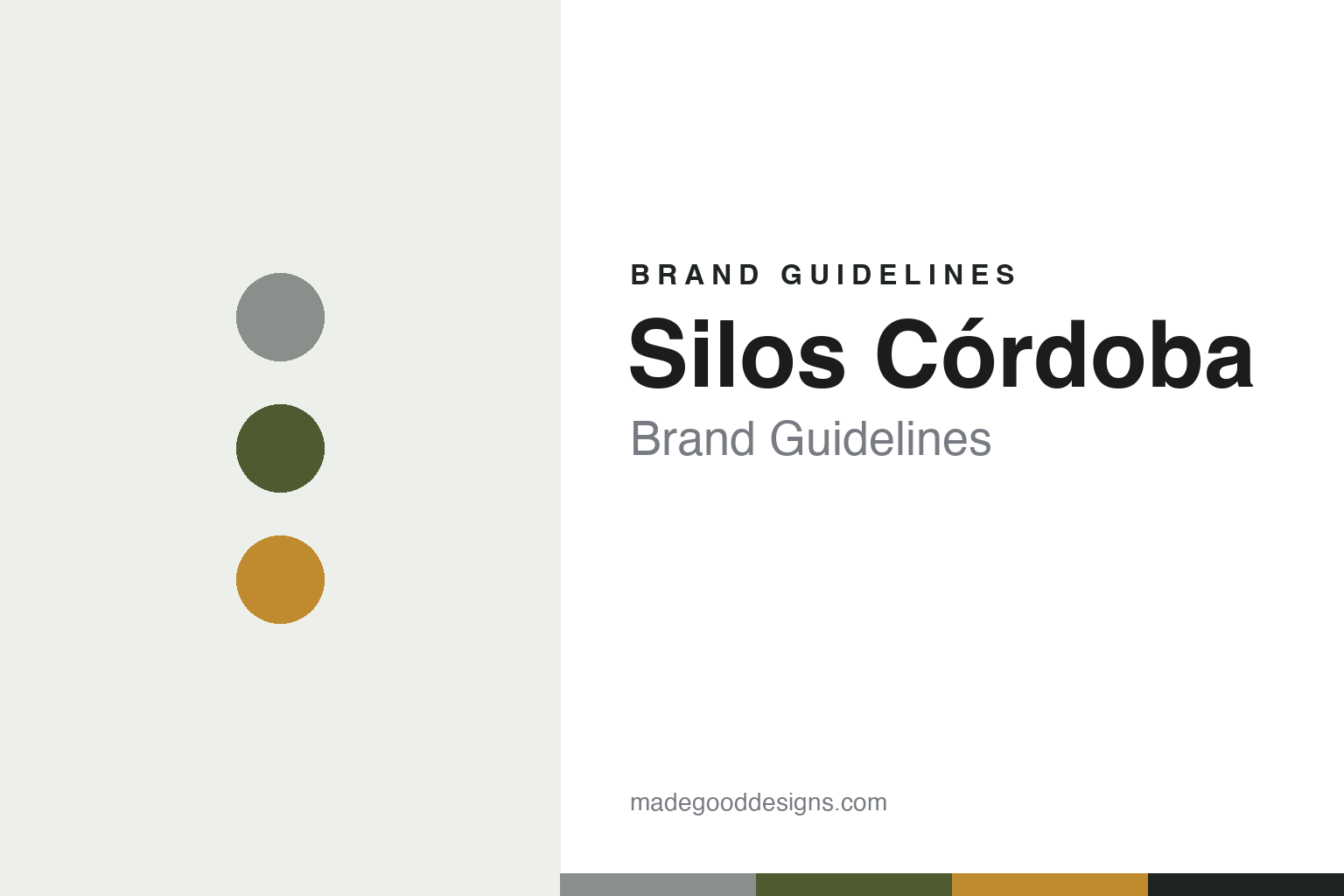
Silos Córdoba Brand Guidelines
The 1975 Andalusian silo maker revived by SCG Silos Grupo.
Aa
Two constants: a zinc grey, olive and ochre palette and an engineered sans register. Abstract homage — not a Silos Córdoba product or mark; no silo, logo or nameplate is reproduced.
From Córdoba
A livestock man’s storage business in Andalusia.
Silos Córdoba began in the Andalusian city of Córdoba in 1975. Its founder, Juan López Liétor, came from the livestock trade before setting up his own business, and the firm was started to meet the storage needs of Spain’s livestock sector, eldiario.es reported in a 2014 profile. By then the founder’s youngest son, Juan López Regalón, was running the company as general manager, the same profile said.
The business stayed local and regional for its first two decades. From the mid-1990s it began to sell abroad and opened sales offices in several countries, eldiario.es reported; in 2014 it listed delegations in Argentina, Turkey, Kazakhstan and Romania, and the paper wrote that the company had been the leading silo maker in the European market from 2005 to 2011, with 1.2 million tonnes of storage installed in that period. The same article noted two awards for the firm’s record: “Cordobeses del Año,” a local honour for its business career, and the Premio Alas from Extenda, the Andalusian government’s export promotion agency, for its international growth.
By 2017 the network had grown further. The Global Miller, the news blog of Milling and Grain magazine, reported in March that year that the Silos Córdoba Group exported to more than 45 countries on four continents, had offices in Argentina, Turkey, Kazakhstan, Mozambique, Romania, Uruguay, India and Nigeria, and worked with distributors in 37 countries. It had also merged its global operations into a single entity and centralised its human resources, finance and marketing.
The company described itself as an all-in-one supplier: it handled the design, manufacture and assembly of a silo plant if a client wanted that, and promoted steel silos as an alternative to flat storage sheds for grain, according to eldiario.es.
Colour
A silo-shaped headquarters and a 2017 redesign.
Silos Córdoba put its product into its architecture. Its headquarters in the Rabanales 21 science and technology park, on the edge of Córdoba, was designed by the architects Lola Moral Mata and Miguel Velasco Serrano, according to the architecture magazine Metalocus. It is made of two volumes: a manufacturing and logistics hall of about 10,000 square metres, and a cylindrical office block that, Metalocus wrote, plainly recalls a grain silo from outside and is organised inside around a void lit from above. eldiario.es made the same point in 2014, describing the building as carrying the company’s identity in the shape of its main product.
The graphic identity was reworked a few years later. In March 2017 The Global Miller reported that the Silos Córdoba Group had unveiled a new corporate image, begun the year before, to be rolled out across everything from the new website to the branding on its silos and industrial plants. The logos were redesigned by Juan Clemente Design. The aim, the report said, was to update the old image while keeping as much as possible of an established mark, by fixing one colour element and one typographic element as the drivers of the new line and building everything else from them.
The products themselves are galvanised steel. The current company lists flat-bottom silos, hopper silos, bulk loading silos and farm silos, along with complete storage plants supplied as turnkey projects, and Milling Middle East & Africa gave the same ranges in 2024. The company says it was the first silo maker to adopt Z-600 galvanised steel, a coating of 600 grams of zinc per square metre, as its manufacturing standard; that it designs its silos to the European Eurocode; and that it offers a zinc, aluminium and magnesium alloy coating it calls ProMag. Those are its own descriptions.
On its website the company also describes its corrugated wall sheets as having a gentle wave radius, which it says makes the silo walls easier to clean out when grain is unloaded.
Typography
The category.
Grain storage and handling is a trade whose products are buildings as much as machines. Its makers sell corrugated steel bins that stand in rows on prairie farms, hopper tanks for wet grain and load-out, tall bucket elevators and the towers and catwalks that link them, and dryers that run through the weeks of harvest. Further along the chain sit seed-cleaning plants, conveyors for fertiliser and pulse crops, and, in Asia, rice mills.
That shapes how the makers present themselves. Catalogue covers and websites lean on photographs of finished sites rather than single products: a cluster of galvanised bins against a wide sky, an elevator leg rising above a farmyard, a dryer tower lit up at dusk. Galvanised steel is the shared material, so a maker’s colour usually lives in its logo, its decals and its painted parts rather than in the structures themselves.
The business is also one of brands inside groups. Many of the names a farmer sees on an auger or a bin began as family workshops and were later bought by larger companies, which often keep the old name next to a group prefix. Ownership can change several times, through private-equity funds, listed companies and machinery groups, while the product names carry on.
This guide sets out what can be checked about each maker — when and where it began, who owns it now, where it says its products are made and which ranges it is known for — and marks clearly what rests only on the company’s own word.
Aa
An engineered sans for a steel-silo maker. (Specimen set in Archivo, a sans STAND-IN; NOT the Silos Córdoba logo.)
Silos Córdoba
Insolvency, closure and a new owner.
The original company ran into financial difficulty in the late 2010s. In March 2019 the commercial court in Córdoba approved a refinancing agreement between Silos Córdoba, S.L. and its financial creditors, according to a notice in the Boletín Oficial del Estado, Spain’s official gazette, in April 2019. On 1 December 2020 the same court declared Silos Córdoba, S.L.U. in voluntary insolvency proceedings (a concurso de acreedores), the gazette reported in January 2021; under that order the company kept the management of its assets, subject to the oversight of a court-appointed administrator.
Silos Córdoba, S.L. ceased operations in February 2023, according to a company statement quoted by Milling Middle East & Africa in September 2024. The same report said the brand had returned to the market after SCG Silos Grupo took over the whole of the former company’s intellectual property, including its engineering designs, registered trademarks and other assets, and that part of the original team had moved to the new business. SCG says on the Silos Córdoba website that it bought the brand to revive it, that its staff include former Silos Córdoba employees, and that it belongs to a group based in Dubai. Its headquarters are in the Córdoba technology park, so the name still comes from the same city.
The new company presents itself through the old one’s record: “over 45 years of experience,” storage plants in more than 45 countries and an offer that runs from single farm silos to complete storage terminals. Milling Middle East & Africa reported that it planned to concentrate on Europe, Africa and Latin America, where the earlier company had been strongest, and to add monitoring systems for grain moisture and temperature to its range.
That makes Silos Córdoba two things for a reader: a family firm founded in 1975 that went through insolvency and closed in 2023, and a brand that a new owner has carried on since 2024 with the same designs and part of the same people.
For a design guide, Silos Córdoba shows a brand that wrote its product into its own headquarters and kept its name through a change of company. Compare Symaga, another Spanish silo maker, and AGI. For this guide we use zinc grey, olive and a warm ochre with a sans, an unofficial interpretation; no product or logo is reproduced.
Explore & save
Keep Silos Córdoba’s identity on hand — save it to a board in the Made Good inspiration library.
Silos Córdoba identity set
Pin the Silos Córdoba zinc grey, olive and ochre palette and the engineered sans register to your own board.