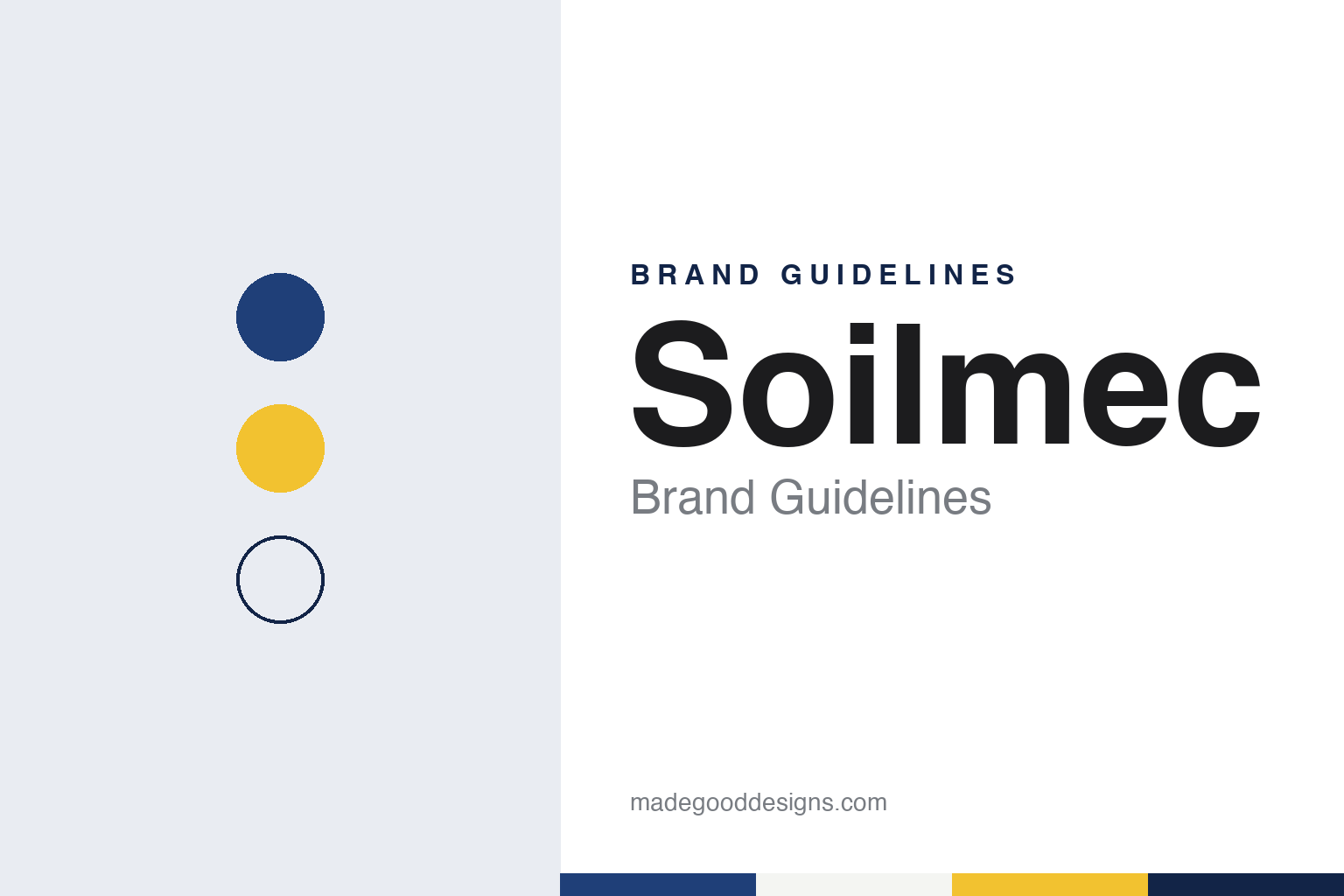
Soilmec Brand Guidelines
The Trevi Group’s Cesena rig maker, from the RT3 to the SR series.
Aa
Two constants: a blue, white and yellow palette and a condensed sans register. Abstract homage — not a Soilmec product or mark; no machine, logo or nameplate is reproduced.
Pali Trevisani
A piling contractor in Cesena that began building its own rigs.
Soilmec comes out of a piling contractor in Cesena, in Romagna. In 1957 Davide Trevisani founded the Impresa Palificazioni Trevisani in the town, a firm making bored piles, Italian Wikipedia says; his brother Gianluigi joined in 1962 to develop its work abroad. The contractor began designing its own equipment early. Italian Wikipedia dates a first patented self-propelled rig for driven piles to 1962 and a three-roller rotary head for large-diameter bored piles to 1967; Piling Canada, in a 2019 profile of the company, says the first RT3 rotary was designed and built in the Pali Trevisani maintenance workshop in 1965.
To make machines a business of its own, the group founded Soilmec S.p.A. in 1969. Its first production site, Italian Wikipedia says, was two sheds on six hectares at Pievesestina, outside Cesena: one for Pali Trevisani and one for Soilmec. The Trevi Group dates the start to 8 March 1969, when Davide Trevisani opened the Pievesestina factory fourteen months after building began. Pali Trevisani itself took the name Trevi S.p.A. in 1983, and the parent company, Trevi – Finanziaria Industriale, has been listed on the Milan stock exchange since July 1999, the group says.
The two businesses grew side by side. Trevi carried out foundation work in Italy and abroad, including the consolidation of the Leaning Tower of Pisa from 1995, Italian Wikipedia says, while Soilmec designed, built and sold the rigs. Soilmec today describes itself as a designer, manufacturer and distributor of equipment for the ground engineering industry, with its headquarters in Cesena and more than 90 design engineers.
Colour
From the RT3 to the SR series.
Soilmec’s history is usually told through its machines. Piling Canada’s 2019 profile, written by Deb Draper for the company’s fiftieth year, traces a line from the RT3 to the RTA, a truck-mounted rig whose mast could be lowered for transport, and the RH-2, a multi-purpose mast it says was used to build the first continuous flight auger piles. In the 1980s came the BH-12 hydraulic grab and the SM-305 micropile rig. The same article dates a parallelogram system to 1982, which allowed the mast to travel lying flat on the turret, and names the R-12 as the first completely hydraulic Soilmec drilling rig and the forerunner of its piling-rig range. It dates the company’s first patent to 1983.
Later decades added electronics and depth. The Drilling Mate System, or DMS, introduced in 2005 according to Piling Canada, records and manages data from the rigs on site. In 2007 Soilmec developed its first Tiger hydromill, a cutter for deep diaphragm walls, and the magazine reports that an improved model later reached 250 metres on the company’s test field. Soilmec also took in the small-diameter drilling team that became PSM in 2003 and acquired IPC in 2011, the article says.
The current range on the company’s website is grouped into piling rigs, hydromills and cranes, micropile and tunnel rigs, digital systems and ancillary plant. It includes the SR series of rotary piling rigs, the SC hydromills sold under names such as Tiger, Cougar and Urban Tiger, and the SM micropile rigs, among them the electric SM-13e. Piling Canada reported in 2019 that the original Pievesestina factory still assembled piling rigs, cranes and hydromills, that plants at Asolo and Parma built drilling and grouting rigs, and that facilities in Brazil, India and China looked after maintenance and refurbishment.
English Wikipedia describes Soilmec machines as typically white with blue trim, with the name in yellow letters outlined in black.
Typography
How the category presents itself.
Piling and foundation rig makers sell machines that do most of their work out of sight, below ground, so their pictures tend to show what stands above it. The common image is a tall mast rising over a building site, often framed against a city skyline or a half-finished bridge, with the rig itself on crawler tracks in mud, gravel or sand. The height of the mast gives the photograph its shape, and the model code painted on it is often the largest lettering in the frame.
A second set of images is about tools. Augers, drilling buckets, casings, grabs and cutter wheels are laid out in rows or shown close up, clean and freshly painted, so that the parts that will disappear into the ground can be seen at all. Vibratory hammers, clamps and power packs are photographed the same way, as objects on their own, before they are lifted by a crane.
Trade fairs matter in this category. The bauma show in Munich is where makers stage large stands, with rigs raised to full height under the hall roof or on the open-air grounds, and where new models, electric versions and anniversaries are announced. Stand design, banners and the colour of the machines themselves are part of how a maker is recognised there.
Many of these companies also carry a family or founder’s name, or grew out of a contractor’s own workshop, and their histories are told through dates, places and model numbers rather than slogans. For this series we look at how each maker presents that history, using an unofficial palette and a stand-in typeface, and reproducing no machine, logo or nameplate.
Aa
A condensed sans for model codes and mast lettering. (Specimen set in Barlow Condensed, a sans STAND-IN; NOT the Soilmec logo.)
Soilmec
A rig maker inside a foundation group.
Soilmec’s ownership follows the Trevi Group’s. At the end of 2014 CDP Equity, through the Fondo Strategico Italiano, took 16.8 percent of the group, Italian Wikipedia says. After a crisis that began around 2015, Trevi went through capital increases and a debt restructuring agreement, which the Bologna Court of Appeal approved in January 2020. In October 2019, Il Resto del Carlino reported, a new board moved control of the group from the Trevisani family to managers named by investment funds and the creditor banks; the family, which then held 32 percent through Trevi Holding, was expected to see that stake diluted. In December 2019 Soilmec sold its majority holding in the American company Watson, Italian Wikipedia says.
In April 2026 Trevi – Finanziaria Industriale named CDP Equity as the holder of about 21 percent of its shares, and in March 2026 CDP Equity committed to take up its share of a new rights issue, according to the company’s filings. The group describes itself as two divisions working together: Trevi, which carries out special foundation and soil consolidation work, and Soilmec, which designs, manufactures and markets machinery, plant and services for foundation engineering. In 2019 the Trevi Group said Soilmec had 12 subsidiary companies and more than 1,300 people.
For a design guide, Soilmec shows a machine maker that grew out of a contractor’s workshop, with a history told through model names from the RT3 to the SR series. Compare it with Casagrande and MAIT. For this guide we use a deep blue, an off-white and a signal yellow with a condensed sans, an unofficial interpretation; no product or logo is reproduced.
Explore & save
Keep Soilmec’s identity on hand — save it to a board in the Made Good inspiration library.
Soilmec identity set
Pin the Soilmec blue, white and yellow palette and the condensed sans register to your own board.