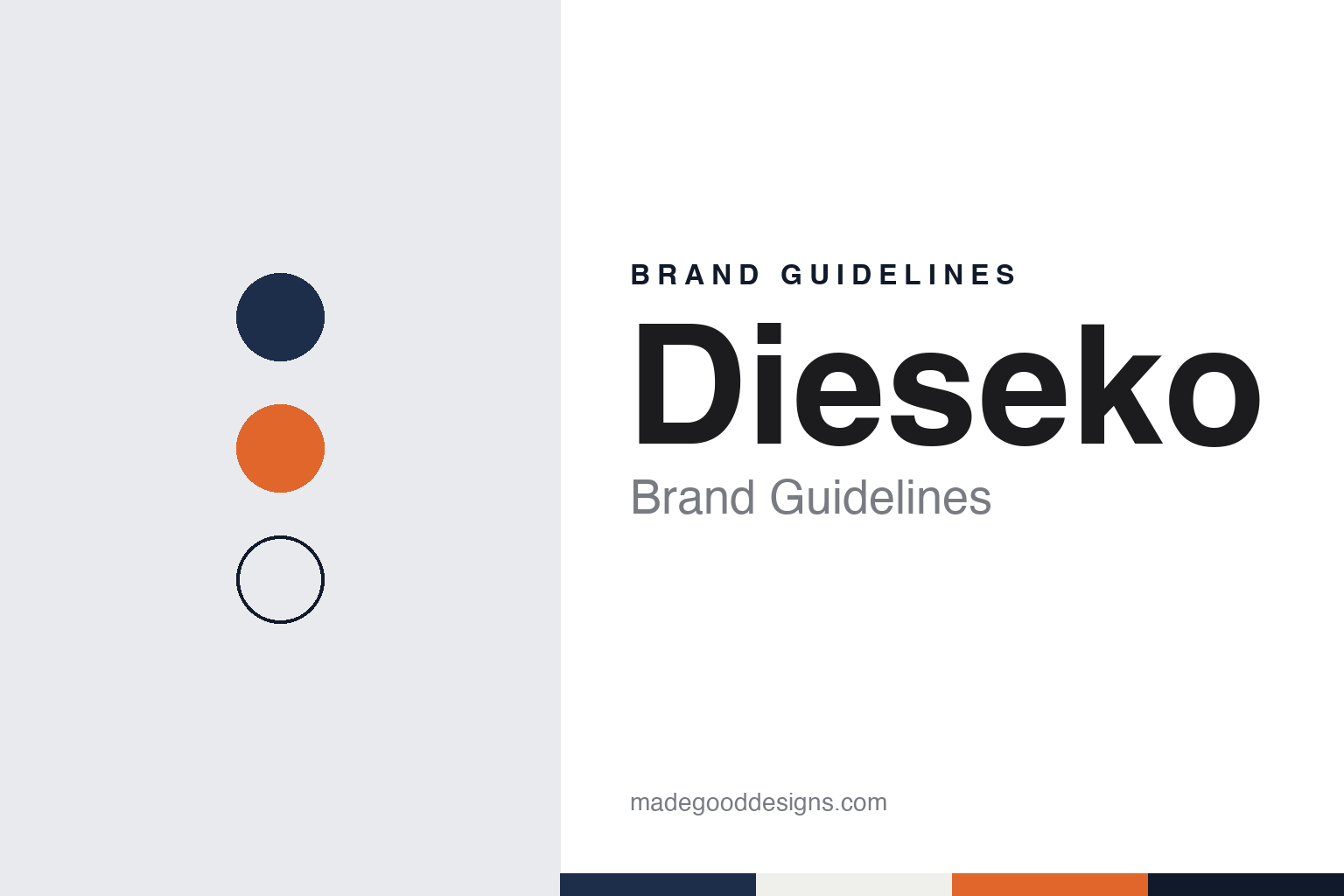
Dieseko Brand Guidelines
Sliedrecht’s vibratory hammers, from a rental fleet to offshore wind.
Aa
Two constants: a navy, concrete and orange palette and a narrow sans register. Abstract homage — not a Dieseko product or mark; no machine, logo or nameplate is reproduced.
Two Dutch roots
A rental fleet and an importer of hammers.
Dieseko began as a rental business. The company says it was founded in 1974 in Bolnes, renting vibratory hammers to foundation contractors; it moved to Papendrecht in 1978, when it became a dealer of foreign hammers, and settled in Sliedrecht in 1983, where it is still based. In 1985 it turned to production of its own through a plant called VIP, Versluis Industrial Products, and in 1989 it launched the PVE brand, short for Piling & Vibro Equipment.
The second root is ICE, International Construction Equipment. The group says ICE was founded in Amsterdam in 1977 as an importer of American vibratory hammers, built its first hammer of its own in 1979, and supplied equipment for the Delta Works in 1983. ICE became part of Geveke in 1990 and was taken over by Active Share in 2004, according to the group’s timeline.
The two came together in 2008 as Dieseko Group BV. NPM Capital, announcing its investment in November 2013, described the group as the result of a 2008 merger of Dieseko Verhuur BV of Sliedrecht and International Construction Equipment of Almere, with roots in the 1970s and almost 30 years’ experience in making hydraulic vibratory equipment for driving and extracting sheet piles, piles and other foundation elements. Its customers, NPM said, used the machines for canal bank protection, port quays and road viaducts, and for foundation piles for offshore oil platforms and wind farms.
Colour
Vibration, then rigs.
Dieseko’s product story is about vibration. Its current range covers vibratory hammers, hydraulic power packs, hydraulic clamps, pressing machines, resonators, impact hammers and crane shock absorbers, with rental alongside sales. The group calls its 1992 PVE 2320VM the first variable-moment vibratory hammer and dates a ring vibrator to 1996. It says the PVE 200M went to work on the Betuwelijn railway in 2001, that the PVE 300M of 2010 was the largest vibratory hammer in the world at its launch, and that the PVE 500M of 2014 was the largest monobloc vibratory hammer; those are the company’s own descriptions. In 2015, it says, it developed a new driving method, the Resonator, in cooperation with RTI.
Offshore wind has become a large part of the story. The group lists a PVE 200M on the Bard 1 offshore project in 2009, two upending vibratory hammers for the Global Tech wind farm in Germany in 2012, and a modular offshore hammer called the Giant in 2013. In 2021, it says, Dieseko Offshore secured a contract with Saipem to supply a 2000MU vibratory hammer for installing the monopiles of the Calvados offshore wind farm, and a 500MU upending and lifting hammer passed testing for DNV certification.
Rigs came later. Dieseko bought PVE Piling & Drilling Rigs in 2015 and Woltman Piling Equipment in 2016, forming Woltman Piling & Drilling Rigs, and took a majority interest in Pilequip in Australia in 2018, the group says. Its electric work includes the Woltman 90DRe drilling rig of 2022 and the PVE 700e electric hydraulic power unit of 2023, gathered under a programme it calls “Founding the Future.” The group says it has about 200 employees, with branches in the Netherlands, the USA, Australia and Poland, and serves other markets through dealers.
The timeline also shows how the business spread. Dieseko opened a branch in the USA in 1995; ICE set up a fully owned rental fleet in Shanghai in 2010, and a rental fleet followed in Brazil in 2011. From 2017 the group became a worldwide supplier of Bell dredging pumps and amphibious dredgers. More recent additions it lists include a side gripper and a noise mitigation screen in 2019, a vibrating plate for ground improvement called the Frog in 2020, and a training programme, the Dieseko Academy, the same year.
Typography
How the category presents itself.
Piling and foundation rig makers sell machines that do most of their work out of sight, below ground, so their pictures tend to show what stands above it. The common image is a tall mast rising over a building site, often framed against a city skyline or a half-finished bridge, with the rig itself on crawler tracks in mud, gravel or sand. The height of the mast gives the photograph its shape, and the model code painted on it is often the largest lettering in the frame.
A second set of images is about tools. Augers, drilling buckets, casings, grabs and cutter wheels are laid out in rows or shown close up, clean and freshly painted, so that the parts that will disappear into the ground can be seen at all. Vibratory hammers, clamps and power packs are photographed the same way, as objects on their own, before they are lifted by a crane.
Trade fairs matter in this category. The bauma show in Munich is where makers stage large stands, with rigs raised to full height under the hall roof or on the open-air grounds, and where new models, electric versions and anniversaries are announced. Stand design, banners and the colour of the machines themselves are part of how a maker is recognised there.
Many of these companies also carry a family or founder’s name, or grew out of a contractor’s own workshop, and their histories are told through dates, places and model numbers rather than slogans. For this series we look at how each maker presents that history, using an unofficial palette and a stand-in typeface, and reproducing no machine, logo or nameplate.
Aa
A narrow sans for model codes on hammer housings and power packs. (Specimen set in Archivo Narrow, a sans STAND-IN; NOT the Dieseko logo.)
Dieseko
From private equity to a new piling platform.
Ownership has changed several times. In November 2013 the private equity firm NPM Capital, which Dieseko describes as a subsidiary of SHV, took a majority interest in Dieseko Group and bought out the previous investor, Greenfield Capital Partners, as NPM and the trade site Offshore Wind reported. At the time the group had 120 staff at its Sliedrecht head office and branches in Singapore, Brazil and China, and its directors kept a stake. In July 2026 Container News reported that NPM had sold its stake in Dieseko to DevCo, an investment and development firm based in Helsinki, after twelve years of ownership.
DevCo has since grouped Dieseko with other equipment makers. On 6 July 2026 Dieseko, Movax and Watson & Hillhouse announced a new platform under DevCo ownership, with the stated ambition of building a leading global piling and foundation equipment platform. Dieseko says its management is also a shareholder alongside DevCo, and names Raymonde Wagemaker as chief executive. The group still sells under its two brands, PVE and ICE, and says each keeps its own heritage.
For a design guide, Dieseko shows a foundation-equipment group built from a rental fleet and an importer, which kept both brand names after the merger. Compare it with Movax, now under the same owner, and ABI. For this guide we use a harbour navy, a concrete grey and a signal orange with a narrow sans, an unofficial interpretation; no product or logo is reproduced.
Explore & save
Keep Dieseko’s identity on hand — save it to a board in the Made Good inspiration library.
Dieseko identity set
Pin the Dieseko navy, concrete and orange palette and the narrow sans register to your own board.