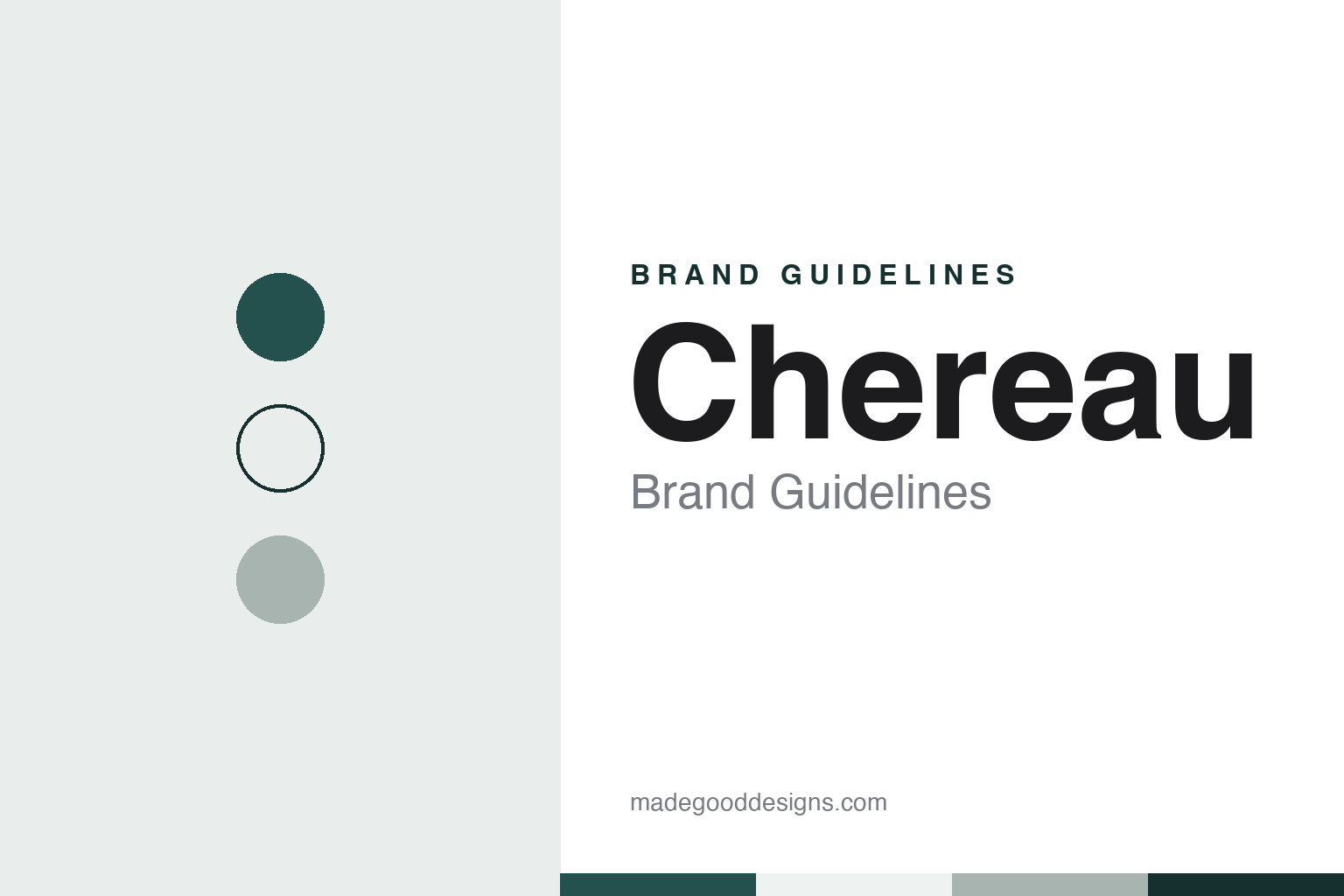
Chereau Brand Guidelines
A coachbuilder’s son, a new food-transport rule and a cold chain from the bay of Mont-Saint-Michel.
Aa
Two constants: a bay teal, frost white and sea mist palette and a condensed sans register. Abstract homage — not a Chereau product or mark; no vehicle, logo or nameplate is reproduced.
From showmen’s wagons to cold bodies
A coachbuilding family and a new rule on food transport.
Chereau grew out of a family of coachbuilders. French Wikipedia says Jean Chéreau came from a coachbuilding family established in Rouen, and that in 1950, with Simone Chéreau, he founded Établissements Jean Chéreau in Avranches, in the Manche department of Normandy, to build vans and truck bodies. L’Argus, reporting in January 2016, gave the founding as 1953 in Avranches. The first factory, at Le Val-Saint-Père near Avranches, covered 650 square metres, French Wikipedia says.
The early business was known for eye-catching advertising vehicles. In 1954, according to French Wikipedia, Chéreau won a grand prize in a contest for advertising vehicles with a semi-trailer built in 1953 for the wine brand Vins du Postillon: a Berliet tractor topped with two sheet-metal horses, pulling a converted Fruehauf trailer fitted out as a bistro in the style of a horse-drawn mail coach.
Refrigeration became the specialty. French Wikipedia says new rules on the transport of foodstuffs adopted by the French agriculture ministry in 1952 led Jean Chéreau to see an opening; the first insulated truck bodies left the Avranches works in 1953, and in 1955 the company moved into refrigerated bodies. Its website says that in the 1950s Jean Chéreau developed the company’s first refrigerated bodies for perishable goods. By the end of the 1960s Chéreau was making its own semi-trailer chassis, and in 1976 it became a public limited company, Établissements Jean Chéreau SA.
Growth followed in the region. French Wikipedia says Chéreau began exporting after 1976 and opened a new factory at Ducey in 1981, which was extended several times in the 1990s; by 2000 the company had 60,000 square metres of industrial buildings. In February 2004 Trailer/Body Builders reported that Chéreau made more than 40 percent of its sales in Great Britain, Belgium, the Netherlands, Ireland, Spain, Italy and Greece.
Colour
Receivership, Kögel and a management buyout.
The family era ended in 2003. French Wikipedia says the company entered receivership in February 2003. On 30 September 2003, Trailer/Body Builders reported, the German trailer maker Kögel, then Kögel Fahrzeugwerke AG of Ulm, received approval from the Commercial Court of Coutances to buy Chéreau, through an investment group formed with the Munich investor SMB; Kögel was to take over operational management.
The German link did not last. The German trade magazine eurotransport reported that Kögel itself ran into payment difficulties at the start of 2004, after which SMB founded Trailer Holding and took over both manufacturers, with Chéreau belonging to Trailer Holding from 2005. The plan for Kögel to supply chassis for Chéreau’s refrigerated bodies in Germany did not work out, the magazine said, and the two companies operated increasingly independently.
In December 2009, French Wikipedia says, the shareholders sold the company to its senior managers, led by its president Alain Guermeur, through a new holding company, Chéreau Holding SAS. The change came with job cuts after the downturn of 2008 and 2009, French Wikipedia says.
Products are the other half of the story. Chereau builds refrigerated semi-trailers and rigid truck bodies, and its website lists versions for long-distance haulage, distribution, meat, seafood, flowers, fresh produce, frozen goods and health products, as well as trailers and swap bodies. At the Solutrans show in Lyon in November 2017, La Manche Libre reported, Chéreau showed the Chéreau Next, a connected refrigerated semi-trailer that passed information to the tractor’s dashboard; it won the silver medal of that year’s industrial-bodywork innovation prize, after gold medals in 2013 and 2015. French Wikipedia also describes a hydrogen-powered refrigerated semi-trailer prototype finished in July 2019 and an all-electric prototype shown in September 2021.
Typography
How trailer makers present themselves.
Truck trailer makers sell a product that spends its working life on the road, and much of their imagery starts there: a long semi-trailer seen side-on on a motorway, a curtainsider rounding a bend, a tipper on a building site. The trailer is often the largest flat surface in a fleet, so the maker’s own name tends to sit small, on a plate, a mudguard or the front wall, while the customer’s livery fills the sides.
Bodies set the look of each category. Refrigerated box trailers are usually shown in plain white, with a cooling unit on the front wall, because the panels are built to be clean and easy to brand. Curtainsiders carry printed fleet colours on their sliding sides. Tippers are shown with their steel or aluminium bodies raised, and low-loaders with a heavy load chained down.
Factory photography is the second register. Makers show lines of bare chassis waiting for axles, paint and coating halls, sandwich panels being bonded and finished trailers parked in rows outside the plant. Product names tend to be short codes or coined words that sort ranges by body type, which helps fleets order the same specification year after year.
The third register is the trade fair and the dealer yard. IAA Transportation in Hanover and similar shows give makers a stand where new chassis, lighter bodies and telematics are lined up for fleets and the trade press. Dealers, rental firms and used-trailer centres then carry the brand into regional markets, where the customer is usually a haulier, a fleet manager or a logistics buyer rather than a member of the public.
Aa
A condensed sans for long panel sides. (Specimen set in Barlow Semi Condensed, a sans STAND-IN; NOT the Chereau logo.)
Chereau
The Reefer Group and a Normandy base.
In January 2016 L’Argus reported that the Barcelona private-equity firm Miura Private Equity had reached an agreement in principle to buy Chéreau, two months after buying the Spanish refrigerated-trailer maker SOR Iberica, and planned to combine the two in a new group called The Reefer Group. The same article placed the deal in a wider change in French bodybuilding, noting that Lamberet had been sold the year before to a subsidiary of a Chinese group.
Ownership changed again in 2021. France’s competition authority, the Autorité de la concurrence, authorised the acquisition of exclusive control of The Reefer Group by Amundi Private Equity Funds in a decision dated 17 May 2021, following a share sale agreement of 12 April 2021. In December 2025 Le Journal des Entreprises reported a further reorganisation of the group’s capital, with funds still in the majority: a new consortium built around Arkéa Capital, Epopée Gestion and Crédit Agricole took over from the pool assembled around Amundi, while 63 managers held 19 percent of the capital.
The group has grown beyond its two founding companies. Le Journal des Entreprises reported that The Reefer Group, run by chief executive Damien Destremau from its headquarters at Ducey-Les Chéris, added Aubineau Constructeur of the Deux-Sèvres in 2024 and took 70 percent of the British maker Paneltex, giving it four brands. Chereau says on its website that its four production sites are at Avranches and Ducey, near the bay of Mont-Saint-Michel, with more than 60,000 square metres of industrial buildings.
For a design guide, Chereau shows how a regional bodybuilder can keep its name and its home town through several changes of owner. Compare Kögel, its owner in the early 2000s, and Lamberet, another French refrigerated-body maker. For this guide we use a bay teal, a frost white and a sea mist with a condensed sans, an unofficial interpretation; no product or logo is reproduced.
Explore & save
Keep Chereau’s identity on hand — save it to a board in the Made Good inspiration library.
Chereau identity set
Pin the Chereau bay teal, frost white and sea mist palette and the condensed sans register to your own board.