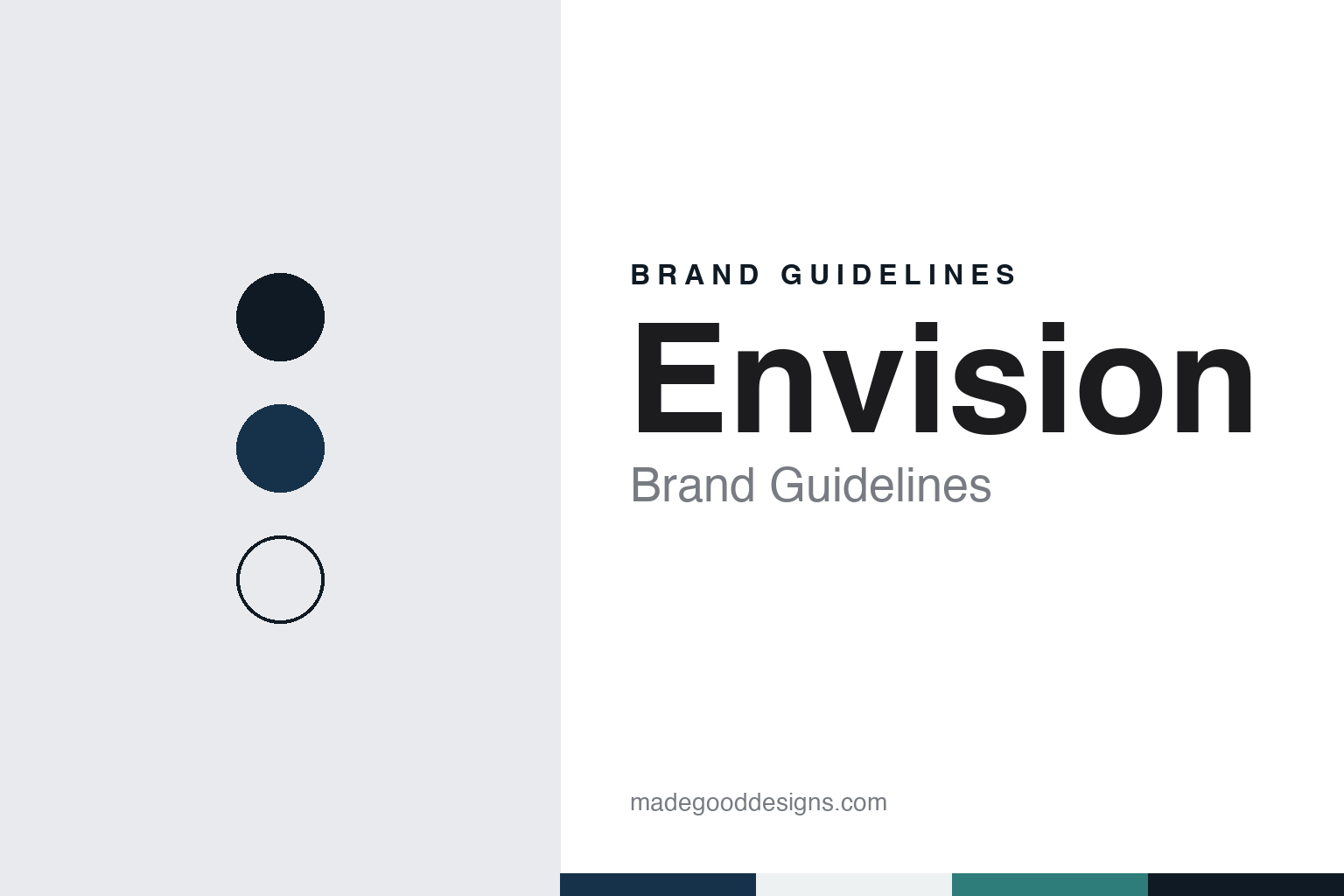
Envision Brand Guidelines
A Shanghai wind maker that started in Jiangyin in 2007.
Aa
Two constants: an offshore navy, teal and white palette and a geometric sans register. Abstract homage — not an Envision product or mark; no turbine, logo or nameplate is reproduced.
Jiangyin
A finance background and a factory town on the Yangtze.
Envision began in 2007 in Jiangyin, an industrial city in Jiangsu province in eastern China. English and Chinese Wikipedia both name its founder as Zhang Lei, and Chinese Wikipedia adds that he came from a finance background; China Daily named him among its top ten Chinese innovators in 2014, according to English Wikipedia. The company, known in Chinese as 远景能源, began full operations in 2009.
Today the company is headquartered in Shanghai and is privately held. English Wikipedia describes it as a maker of wind turbines and energy management software, with wind research and development split between the Shanghai headquarters, a factory complex in Jiangyin and an innovation centre in Silkeborg, Denmark. Envision also lists a battery-storage research centre in Osaka, a cloud service centre in Houston and a digital innovation centre in Silicon Valley, Wikipedia says, and in 2022 it opened a green hydrogen research centre in Boston.
The business looked abroad early. In 2013 Envision installed five turbines of 2.1 megawatts with a 110-metre rotor at the Ucuquer wind farm in central Chile, English Wikipedia reports, citing Windpower Monthly, and in the same year it signed software contracts with wind farm owners in the United States. It opened a London office in 2015 to handle Europe, the Middle East and Africa, bought a 25-megawatt onshore project near Eskilstuna in Sweden as its first European project, and in the same year acquired ViveEnergia’s 600 megawatts of wind projects in Mexico. In early 2016 it opened an operational office in Hamburg to serve European clients and a global blade innovation centre in Boulder, Colorado, to lead blade research in the United States, according to English Wikipedia.
Colour
A two-bladed prototype on the Danish coast.
Envision’s most fully documented engineering story is its experiment with two blades instead of three. In November 2012 the Danish engineering weekly Ingeniøren reported that a two-bladed prototype turbine from the company had been collecting test data at Thyborøn, on Denmark’s west coast, since that September. The machine was called PP2B, short for partial pitch, two blades: only the outer two-thirds of each blade could be turned, or pitched, against the wind, which the magazine described as unusual. The development team behind it worked out of Envision’s centre in Silkeborg.
The idea did not end with the prototype. In August 2025 Down To Earth, the Indian environmental magazine, reported that Envision said its next-generation two-blade onshore turbine, built on its Model X onshore platform, had run for 500 days. The company traced that work back to its Global Innovation Center in Denmark, where in 2012 it developed a 3.6-megawatt offshore two-blade turbine it calls the “Game Changer,” with a prototype from 2013, the magazine reported.
Scale came from the home market. Chinese Wikipedia, citing the Chinese Wind Energy Association, says Envision was the second-largest turbine maker in mainland China by new installations in 2018, and, citing BloombergNEF, ranks it fourth among global suppliers in 2020. The consultancy Wood Mackenzie went further in a press release dated 1 May 2024: it placed Envision second in the world for 2023 with 14.1 gigawatts of grid-connected capacity, which Wood Mackenzie called the company’s best year yet, behind Goldwind and ahead of Vestas. Wood Mackenzie noted that four Chinese makers were in the global top five that year, which it called a first for the sector.
Typography
How wind makers present themselves.
Wind turbine makers sell machines that few people ever see up close, so the pictures they publish do much of the work of a brand. The most familiar image is the finished turbine: a white tower and three blades on a ridge, across farmland or in a line out at sea, often shot at dawn or against a clear sky. Onshore and offshore are presented as two different worlds, one of fields and hills, the other of open water and service vessels.
The second set of images is about scale and movement. Makers like to show a single blade strapped to a long trailer on a country road, or rows of blades, towers and nacelles waiting on the quay of a port before being loaded onto ships. Port hubs and installation vessels have become a picture in their own right as offshore wind has grown.
Inside the factory, the pictures turn to process: nacelles lined up in high, bright halls, generators and hubs on assembly stands, and blade moulds the length of the building, with workers in overalls and helmets for scale. Service teams make up the last familiar scene, technicians clipped on at the top of a nacelle with the landscape far below, or descending a blade on ropes.
Behind the images is a heavy industry with a small number of large makers. BloombergNEF reported that 169 gigawatts of wind capacity were added worldwide in 2025, about 95 per cent of it onshore, and that Chinese makers took the top six places in its supplier ranking for the first time. This guide sets out what can be checked about each brand — who founded it, who owns it and where it says its turbines, blades and towers are made — and marks clearly what rests only on the company’s own word.
Aa
A geometric sans for a company that sells software alongside steel. (Specimen set in Sora, a sans STAND-IN; NOT the Envision logo.)
Envision
Batteries, a racing team and green ammonia.
The Envision name now covers more than turbines. In August 2018 Nissan announced that it would sell its electric battery business to Envision Group, and on 29 March 2019 Nissan said it had completed the sale of its battery operations and production facilities, with the new battery company due to start work on 1 April 2019. English Wikipedia says the deal, which also involved NEC, created Envision AESC, with battery plants in Smyrna, Tennessee, and Sunderland in England among the operations involved.
The group also put its name on motorsport. English Wikipedia says the Formula E team founded as Virgin Racing in 2014 has been majority-owned by Envision since 2022, races as Envision Racing from Silverstone Park, and won the teams’ championship in the 2022–23 season. Chinese Wikipedia instead dates the start of Envision’s involvement with the team to 2018 and its announcement of a full takeover to November 2021.
Its newest showcase is chemical rather than mechanical. In July 2025 the business magazine Caixin Global reported that Envision Group, which it described as a wind turbine maker, had officially put into operation a project in Chifeng, in China’s Inner Mongolia region, that makes ammonia using electricity from its own standalone renewable power grid. English Wikipedia also records Envision projects in Spain announced in 2022, including a planned battery plant and a wind park with a turbine assembly plant.
For a design guide, Envision shows how a turbine maker can present itself as a technology group, with wind, batteries, software and hydrogen under one name. Compare Goldwind, another Chinese maker at the top of the global rankings and Vestas, which Wood Mackenzie placed third that year. For this guide we use an offshore navy, a teal and a tower white with a sans, an unofficial interpretation; no product or logo is reproduced.
Explore & save
Keep Envision’s identity on hand — save it to a board in the Made Good inspiration library.
Envision identity set
Pin the Envision navy, teal and white palette and the geometric sans register to your own board.