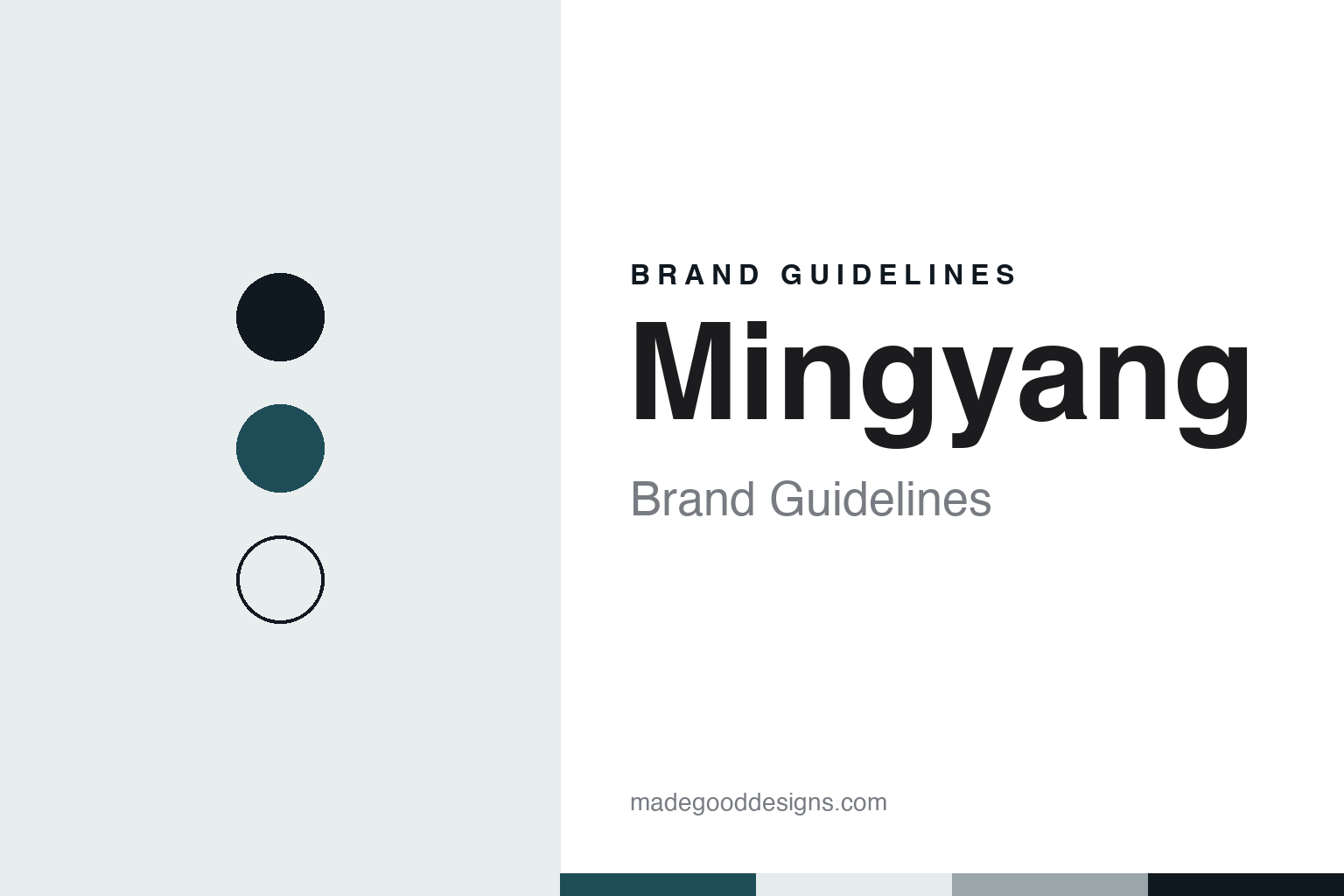
Mingyang Brand Guidelines
The Zhongshan turbine maker that went offshore.
Aa
Two constants: a Mingyang estuary teal and rotor silver palette and an Engineering sans register. Abstract homage — not a Mingyang product or mark; no turbine, logo or nameplate is reproduced.
Zhongshan
An electrical firm that turned to wind.
Mingyang’s story starts in Zhongshan, in China’s Guangdong province. The Danish encyclopedia Lex says the group was founded by Zhang Chuanwei and traces its roots to 1993, when he set up Zhongshan Mingyang Electric, a maker of electrical equipment. The company itself says it was “founded in 1993” and still has its headquarters in Zhongshan. In English it now writes its name as two words, Ming Yang, and its turbines carry the MySE prefix.
The wind business came later. English Wikipedia gives 2 June 2006 as the date Guangdong Mingyang Wind Power Technology was established, and Lex also dates the present wind company to 2006, calling it the forerunner of today’s Mingyang Smart Energy. Production began in 2007 with a 1.5-megawatt prototype designed with Aerodyn, the German engineering firm, both sources say. Around 2010 the company added two-bladed turbines, again developed with Aerodyn; English Wikipedia calls them the SCD, for Super Compact Drive, and says an offshore SCD of 6.5 megawatts was presented in 2013 and first connected to the grid in 2015. Lex sets the company’s growth in a period when China’s wind industry expanded quickly, often working with foreign firms and engineers, and moved step by step from onshore wind towards offshore.
Mingyang has been listed on three exchanges. It floated on the New York Stock Exchange in October 2010 and left it in June 2016, a move Lex places within a wider return of Chinese companies to their home markets. It listed on the Shanghai Stock Exchange in January 2019, and in July 2022 added a secondary listing in London through global depositary receipts, the company says. Lex notes that control remains with the founder and with people and investment companies close to him, and the company describes itself as privately owned and not controlled by the state.
Colour
MySE turbines, fixed and floating.
Offshore wind is where Mingyang has made its name. In August 2021 it announced the MySE 16.0-242, which Lex and English Wikipedia describe as the largest offshore turbine under development at the time. In January 2023 it announced an 18-megawatt platform with blades 140 metres long, English Wikipedia says. Its current flagship in Europe, the company says, is the MySE 18.5-260, a fixed-bottom offshore turbine with a 260-metre rotor and blades 127.5 metres long, made from a glass and carbon fibre epoxy composite. The company describes its drivetrain technology as a “hybrid drive” and says the platform is offered for both fixed-bottom and floating use.
Floating wind is the other strand. Lex describes the Mingyang Tiancheng floating platform, put into operation off Yangjiang in Guangdong with two 8.3-megawatt turbines on one structure, 16.6 megawatts in all; the company calls its floating design OceanX.
The figures that place Mingyang in the industry come from trade bodies. According to Lex, the Chinese Wind Energy Association counted 12.29 gigawatts of new Mingyang installations in 2024, third among suppliers in China, and 31.3 per cent of the country’s newly installed offshore capacity; the Global Wind Energy Council ranked it third worldwide by new installations that year. The company says it has more than 2,000 research and development staff across ten research centres.
Outside China, the company has spent recent years building a European presence. In September 2025 it signed a partnership with Octopus Energy, the British energy supplier, under which Octopus Energy Generation planned to deploy Mingyang onshore turbines, the two companies announced. Ming Yang Europe joined Germany’s offshore wind industry association, BWO, in March 2026 and the industry group Norwegian Offshore Wind in May 2026, by its own account.
Typography
Design and documentation.
Wind turbine makers sell machines that few people ever see up close, so the pictures they publish do much of the work of a brand. The most familiar image is the finished turbine: a white tower and three blades on a ridge, across farmland or in a line out at sea, often shot at dawn or against a clear sky. Onshore and offshore are presented as two different worlds, one of fields and hills, the other of open water and service vessels.
The second set of images is about scale and movement. Makers like to show a single blade strapped to a long trailer on a country road, or rows of blades, towers and nacelles waiting on the quay of a port before being loaded onto ships. Port hubs and installation vessels have become a picture in their own right as offshore wind has grown.
Inside the factory, the pictures turn to process: nacelles lined up in high, bright halls, generators and hubs on assembly stands, and blade moulds the length of the building, with workers in overalls and helmets for scale. Service teams make up the last familiar scene, technicians clipped on at the top of a nacelle with the landscape far below, or descending a blade on ropes.
Behind the images is a heavy industry with a small number of large makers. BloombergNEF reported that 169 gigawatts of wind capacity were added worldwide in 2025, about 95 per cent of it onshore, and that Chinese makers took the top six places in its supplier ranking for the first time. This guide sets out what can be checked about each brand — who founded it, who owns it and where it says its turbines, blades and towers are made — and marks clearly what rests only on the company’s own word.
Aa
An engineering sans — MySE model codes. (Specimen set in Inter Tight, a sans STAND-IN; NOT the Mingyang logo.)
Mingyang
“Innovating Clean Energy for All.”
Britain became the test of that strategy. In October 2025, Lex says, Mingyang announced plans for an offshore turbine factory in Scotland with up to 1,500 jobs, on a site at Ardersier near Inverness. On 25 March 2026 the UK Government said it could not support the use of the company’s turbines in UK offshore wind projects, citing national security, and the factory plan was blocked, STV News and the Scottish Financial Review reported. The decision followed a long deliberation; in January the trade minister Sir Chris Bryant had said the UK needed to be “clear eyed” in its relationship with China, STV News reported. Scotland’s First Minister, John Swinney, said he was “deeply disappointed.” Mingyang said it too was disappointed and would “continue to engage constructively” with the government; in a statement dated 27 March 2026 it said it had proposed keeping all operational and project data in the UK, under UK jurisdiction and control.
The identity the company presents in Europe is plain: the two-word Ming Yang name, the MySE model codes and the line “Innovating Clean Energy for All,” which it gives as its mission. Its English website describes a business that has widened from wind turbines into solar power, energy storage and hydrogen. Mingyang Electric, a maker of switchgear and transformers listed in Shenzhen, is a separate company, part of Mingyang New Energy Investment Holding Group, Chinese Wikipedia says.
For a design guide, Mingyang shows an industrial identity built on model codes and the scale of its machines. Compare Goldwind, another Chinese turbine maker, and Envision Energy, which also builds turbines in China. For this guide we use an estuary teal and a rotor silver with a sans, an unofficial interpretation; no product or logo is reproduced.
Explore & save
Keep Mingyang’s identity on hand — save it to a board in the Made Good inspiration library.
Mingyang identity set
Pin the Mingyang estuary teal and rotor silver palette and the Engineering sans register to your own board.