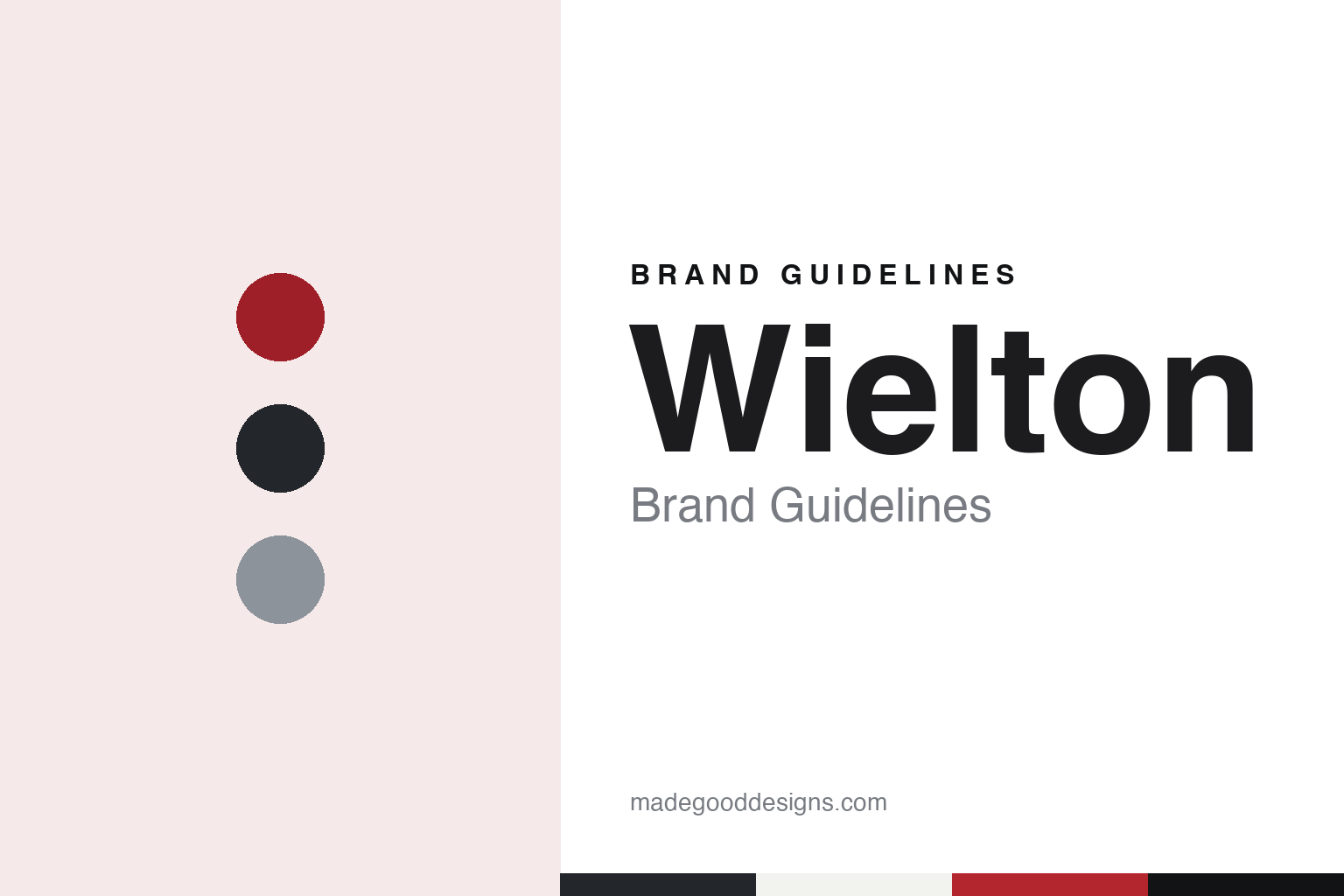
Wielton Brand Guidelines
The Wieluń trailer maker that grew into a European group.
Aa
Two constants: a Wielton graphite, red and steel palette and an Engineered sans register. Abstract homage — not a Wielton product or mark; no trailer, logo or nameplate is reproduced.
From a workshop in Wieluń
A car workshop, nails and rebuilt trailers.
Wielton was founded in January 1996 in Wieluń, a town in central Poland, and the company still has its head office there. Polish Wikipedia names its founders as Ryszard Prozner and Krzysztof Tylkowski, who had earlier run a car repair workshop, made nails and converted imported semi-trailers for tractor units. The company tells the same story on its own website: a workshop first, then years of modernising semi-trailers, and only then semi-trailers of its own design.
Production grew in steps. Polish Wikipedia records a new assembly hall in 1999 and larger warehouses in 2004; the company says the hall of 1998–1999 brought its first lasers, plasma cutting and an automatic welder for beams, and the start of its first production line. In 2002, it says, a company called Wielton Trading was set up and sales of trailers under the Wielton name began, with its own manufacturing following the next year; in 2004 that business became a joint-stock company, Wielton S.A.
The founders then ran short of capital, the company says. In 2006 control passed to the brothers Paweł and Mariusz Szataniak, who had also worked on rebuilding semi-trailers and, according to Polish Wikipedia, had earlier taken the company Pamapol to the stock exchange. Sales companies in Ukraine and Russia followed. Wielton made its debut on the Warsaw Stock Exchange on 28 November 2007, according to the listings calendar of the Polish investor site Strefa Inwestorów, and in the same year joined the Łódź Special Economic Zone, the company says. In 2009 it added a farm brand, Wielton Agro, for agricultural trailers.
Colour
Curtain Master, Weight Master, Container Master.
Wielton describes its customers as transport, construction, manufacturing, distribution and agricultural companies, and its range follows those trades. Its website groups the products into curtain semi-trailers, tipper semi-trailers, closed box semi-trailers, high-volume combinations, rigid bodies and tipper trailers, container semi-trailers, scrap trailers and farm trailers.
The model names follow one pattern, and it is the clearest piece of verbal identity the brand has. Almost every family ends in “Master”: Curtain Master and Mega Curtain Master for curtainsiders, Weight Master and Strong Master for tippers, Container Master for container chassis and Dolly Master for the converter dolly used in longer combinations. The pattern reaches the volume trailers too, with Curtain Volume Master and Side Volume Master. The company also offers a line it calls EVO that can be bought online from its website.
Its brand line in Polish is “Ekspert na drodze” — “expert on the road.” The company says more than 75,000 semi-trailers and trailers carrying the Wielton logo are on the roads, that its products are sold in 35 countries in Europe, Asia and Africa, and that the group employs more than 3,000 people, including about 300 engineers and designers. It describes itself as one of the three largest makers of semi-trailers, trailers and truck bodies in Europe.
Engineering is part of the story it tells. Polish Wikipedia says the Ministry of Economy granted Wielton the status of a research and development centre in 2015, and that in February 2016 the company opened an R&D centre in Wieluń with a station for testing complete trailers, which the company describes as the only one in Poland and the second in Europe. In 2016 Wielton received the President of Poland’s Economic Award in the “National Success” category, according to both the Polish and English Wikipedia articles.
Typography
Trailers and their makers.
Truck trailer makers sell a product that spends its working life on the road, and much of their imagery starts there: a long semi-trailer seen side-on on a motorway, a curtainsider rounding a bend, a tipper on a building site. The trailer is often the largest flat surface in a fleet, so the maker’s own name tends to sit small, on a plate, a mudguard or the front wall, while the customer’s livery fills the sides.
Bodies set the look of each category. Refrigerated box trailers are usually shown in plain white, with a cooling unit on the front wall, because the panels are built to be clean and easy to brand. Curtainsiders carry printed fleet colours on their sliding sides. Tippers are shown with their steel or aluminium bodies raised, and low-loaders with a heavy load chained down.
Factory photography is the second register. Makers show lines of bare chassis waiting for axles, paint and coating halls, sandwich panels being bonded and finished trailers parked in rows outside the plant. Product names tend to be short codes or coined words that sort ranges by body type, which helps fleets order the same specification year after year.
The third register is the trade fair and the dealer yard. IAA Transportation in Hanover and similar shows give makers a stand where new chassis, lighter bodies and telematics are lined up for fleets and the trade press. Dealers, rental firms and used-trailer centres then carry the brand into regional markets, where the customer is usually a haulier, a fleet manager or a logistics buyer rather than a member of the public.
Aa
An engineered sans — the register of model plates and spec sheets. (Specimen set in Archivo, a sans STAND-IN; NOT the Wielton logo.)
Wielton Group
Strong local brands under one roof.
Wielton grew into a group by buying established names rather than replacing them. Polish Wikipedia records the purchase of Fruehauf in France in May 2015 and of the Italian company Viberti Rimorchi, owner of the Viberti and Cardi brands, in August 2015; the company says it took full ownership of Fruehauf SAS in 2017. In May 2017 it bought 80 percent of the German maker Langendorf, known for trailers that carry glass and precast concrete, and in 2018 it added the British body and trailer builder Lawrence David. In December 2021 the Spanish maker Guillén joined: the Spanish law firm Cuatrecasas, which advised the seller, said in January 2022 that the Valencian company had sold 80 percent of Guillén Desarrollos Industriales to Wielton. The group’s own site now lists Wielton, Langendorf, Lawrence David, Viberti, Cardi, Guillén, Fruehauf and Wielton Agro as its brands.
Its footprint followed. Polish Wikipedia lists production centres in Wieluń, at Auxerre in France and at Waltrop in Germany, with assembly in Pescara, Italy, and near Moscow, and a subsidiary set up in Abidjan, Côte d’Ivoire, at the end of 2016 to assemble trailers. English Wikipedia says that in March 2022, after Russia’s full-scale invasion of Ukraine, Wielton suspended its business in Russia and its deliveries there. Polish Wikipedia adds that a subsidiary, Wielton Defence, was set up in 2024 for transport equipment for the defence sector, and that in 2025 it signed a framework agreement to supply structural parts and assembly work to the Polish truck maker Jelcz. Paweł Szataniak has been the company’s president since 2020, Polish Wikipedia says.
For a design guide, Wielton shows how a young maker can build one family of names — the “Master” ranges — while keeping older national brands alive beside its own. Compare Schmitz Cargobull, a German family-owned trailer maker, and Kögel, another European semi-trailer brand. For this guide we use graphite, a tarpaulin red and a steel grey with a sans, an unofficial interpretation; no product or logo is reproduced.
Explore & save
Keep Wielton’s identity on hand — save it to a board in the Made Good inspiration library.
Wielton identity set
Pin the Wielton graphite, red and steel palette and the Engineered sans register to your own board.