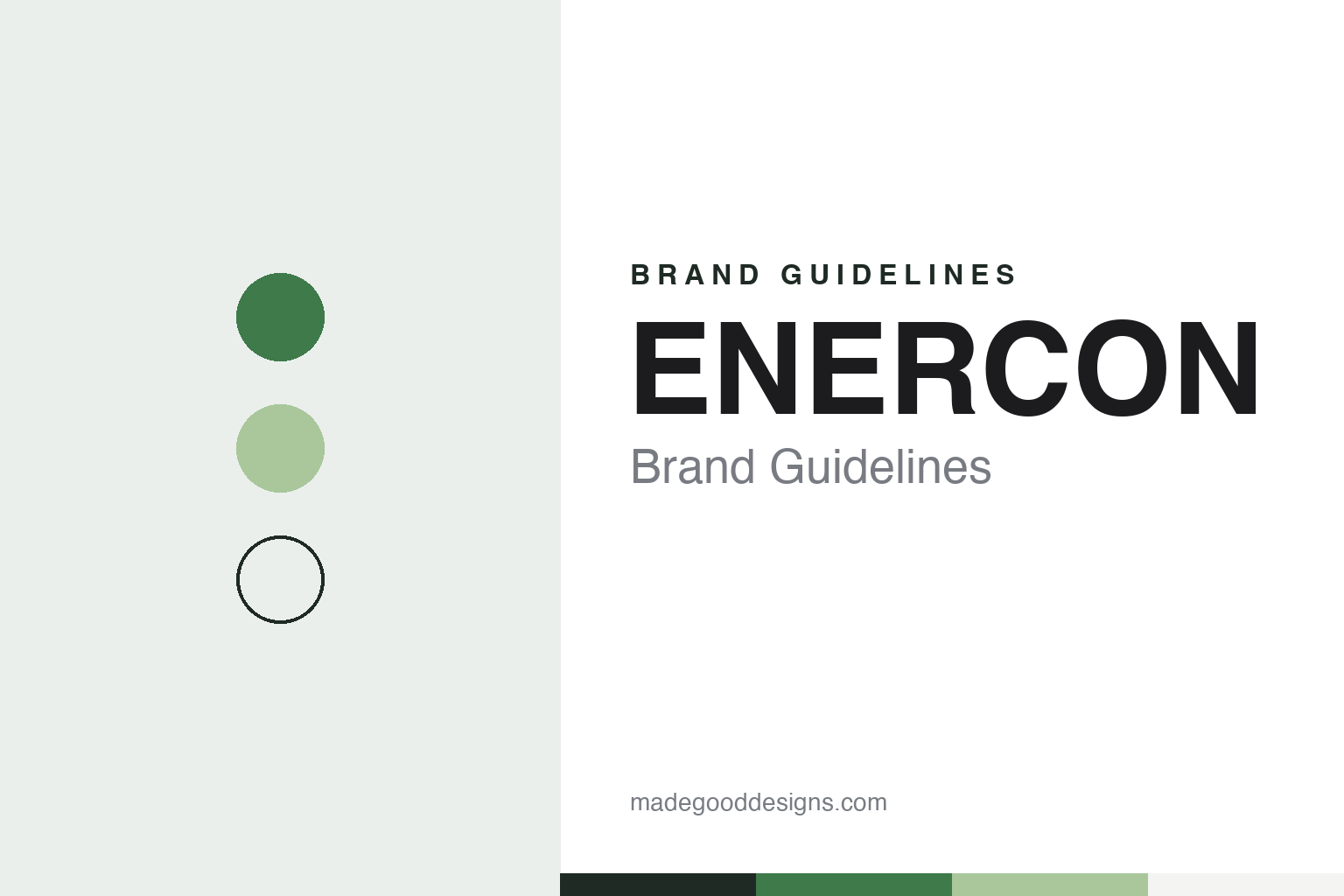
ENERCON Brand Guidelines
The Aurich maker that dropped the gearbox and painted its towers green.
Aa
Two constants: a white-and-graded-green palette and an engineering sans register. Abstract homage — not an ENERCON product or mark; no turbine, logo or nameplate is reproduced.
Aurich, 1984
An electrical engineer, a few staff and a small turbine.
ENERCON was founded in 1984 in Aurich, in East Frisia in the north-west of Germany, by the electrical engineer Aloys Wobben. The company says he developed his first wind turbines in-house “with just a handful of employees,” and that his main research interest as a student had been converting electrical energy with power electronics. German Wikipedia says the first product was the E-15/16, followed four years later by the E-17 and the E-32, and that it took seven years before the small firm could build its own production hall in the Aurich district of Extum, where the head office has been since the start.
The turning point came in 1993 with the E-40. German Wikipedia describes it as the first gearless wind turbine and says more than 4,400 were built worldwide; English Wikipedia calls it the model that pioneered the gearless design. Instead of a gearbox, the hub and blades drive the rotor of a large ring generator directly, a concept ENERCON has kept across later ranges. Production moved to an industrial estate in Sandhorst, on the edge of Aurich, and German Wikipedia notes that ever-larger rotor blades then had to cross the town by truck, which led the company to push for a disused rail line to be reopened.
The name is written in capitals. German Wikipedia says the group’s parent company is UEE Holding SE & Co. KG, its initials standing for “Unendlich Erneuerbare Energien” (endlessly renewable energies), but that only the ENERCON brand is used in public. The company’s own line is “Energy for the World,” which it says has guided it “for more than 40 years.”
The founder collected public honours along the way. ENERCON says he received the Order of Merit of the Federal Republic of Germany in 1997, the German Environment Prize in 2000 and an honorary doctorate from the University of Kassel in 2006.
Colour
A Foster nacelle and towers that fade into the sky.
ENERCON is unusual among turbine makers for having a recognisable look. From 1995 and 1996, German Wikipedia says, its nacelles took on an egg or teardrop shape designed by the British architect Norman Foster, whose office also designed the dome of the Reichstag in Berlin. The company says the teardrop was meant to shelter the machinery from the weather and help the aerodynamics “while also making the turbine look good,” and that it became one of its global trademarks.
The second trademark sits at the bottom of the tower. In Germany and many other countries, ENERCON towers carry bands of green above the foundation that grow lighter from bottom to top; German Wikipedia says the grading follows the Natural Color System and is intended to blend the towers into the horizon, and that on islands and exposed sites, such as Borkum in the North Sea, the bands are blue instead. The company names the green rings alongside the teardrop as its signature features. Its rotor blades were also long distinguished by tips shaped like aircraft winglets.
The look has changed. ENERCON’s own history page now calls the teardrop a “former trademark.” With the EP3 platform, shown at HUSUM Wind in 2017, and the EP5 platform, German Wikipedia says, the egg shape was dropped from 2020 and the ring generator again stands proud of a more compact nacelle clad in glass-fibre composite, closer in spirit to the E-40. EP5 is based on the LP4 design of the Dutch maker Lagerwey, which ENERCON took over in 2018, and its permanent-magnet generators mark a departure from the company’s long use of electrically excited ones. The E-175 EP5, shown at WindEnergy Hamburg in 2022, is the current top model.
ENERCON builds only for land. German Wikipedia says it makes onshore turbines exclusively, and English Wikipedia records that it has at times expressed scepticism about offshore wind parks. Today the company says its plants in Germany, Portugal and Turkey make nacelle, generator, hub and rotor-blade components, with partners in China, India and Turkey producing blades and generators; it names its Aurich and Magdeburg production companies as the main plants for the nacelle and generator.
Typography
Towers, blades and nacelles.
Wind turbine makers sell machines that few people ever see up close, so the pictures they publish do much of the work of a brand. The most familiar image is the finished turbine: a white tower and three blades on a ridge, across farmland or in a line out at sea, often shot at dawn or against a clear sky. Onshore and offshore are presented as two different worlds, one of fields and hills, the other of open water and service vessels.
The second set of images is about scale and movement. Makers like to show a single blade strapped to a long trailer on a country road, or rows of blades, towers and nacelles waiting on the quay of a port before being loaded onto ships. Port hubs and installation vessels have become a picture in their own right as offshore wind has grown.
Inside the factory, the pictures turn to process: nacelles lined up in high, bright halls, generators and hubs on assembly stands, and blade moulds the length of the building, with workers in overalls and helmets for scale. Service teams make up the last familiar scene, technicians clipped on at the top of a nacelle with the landscape far below, or descending a blade on ropes.
Behind the images is a heavy industry with a small number of large makers. BloombergNEF reported that 169 gigawatts of wind capacity were added worldwide in 2025, about 95 per cent of it onshore, and that Chinese makers took the top six places in its supplier ranking for the first time. This guide sets out what can be checked about each brand — who founded it, who owns it and where it says its turbines, blades and towers are made — and marks clearly what rests only on the company’s own word.
Aa
An engineering sans for a maker that writes its name in capitals. (Specimen set in Archivo, a sans STAND-IN; NOT the ENERCON logo.)
A foundation-owned maker
Ownership, disputes and a harder market.
ENERCON is not listed on any stock exchange. In 2012 Aloys Wobben transferred all his shares to the Aloys Wobben Stiftung, a foundation that the company says is the sole owner of the holding company UEE Holding, with effect from 1 October 2012 according to German Wikipedia. ENERCON says the structure is meant to keep the business independent, and that more than 13,000 people work across its administration, sales, production and service sites.
The wider group has drawn scrutiny. In August 2018 ENERCON announced that more than 800 jobs would go, citing a lack of orders in its home market, taz reported; the cuts fell on companies such as tower makers in Emden and Magdeburg and the blade maker Aero Ems, which ENERCON described as independent suppliers. In October 2018 the public broadcaster NDR’s Panorama 3 reported that several of those suppliers belonged, through companies in the Netherlands and the British Virgin Islands, to a Liechtenstein trust bearing the founder’s name; ENERCON had told reporters in 2016 that the structure was legally proper and set up as part of succession planning. In November 2019 further cuts of about 3,000 jobs were announced, German Wikipedia says.
There were disputes abroad too. German Wikipedia records that the United States International Trade Commission barred imports of ENERCON turbines from 1996 to 2010 over a patent held by Kenetech, later owned by GE Wind Energy, with which ENERCON settled in 2004; and that a long dispute with its former Indian subsidiary ended with ENERCON leaving India, before preparing a return from 2017. On 24 February 2022, a cyber-attack on the Viasat satellite network affected the remote-maintenance units of about 5,800 ENERCON turbines, which had to be replaced, the Süddeutsche Zeitung reported, as cited by Wikipedia.
For a design guide, ENERCON shows how a machine can carry an identity in its shape and paint rather than in a logo: a nacelle drawn by an architect and towers graded to fade into the landscape. Compare Nordex, another German turbine maker, and Siemens Gamesa. For this guide we use white and graded greens with a sans, an unofficial interpretation; no product or logo is reproduced.
Explore & save
Keep ENERCON’s identity on hand — save it to a board in the Made Good inspiration library.
ENERCON identity set
Pin the ENERCON white and graded green palette and the engineering sans register to your own board.