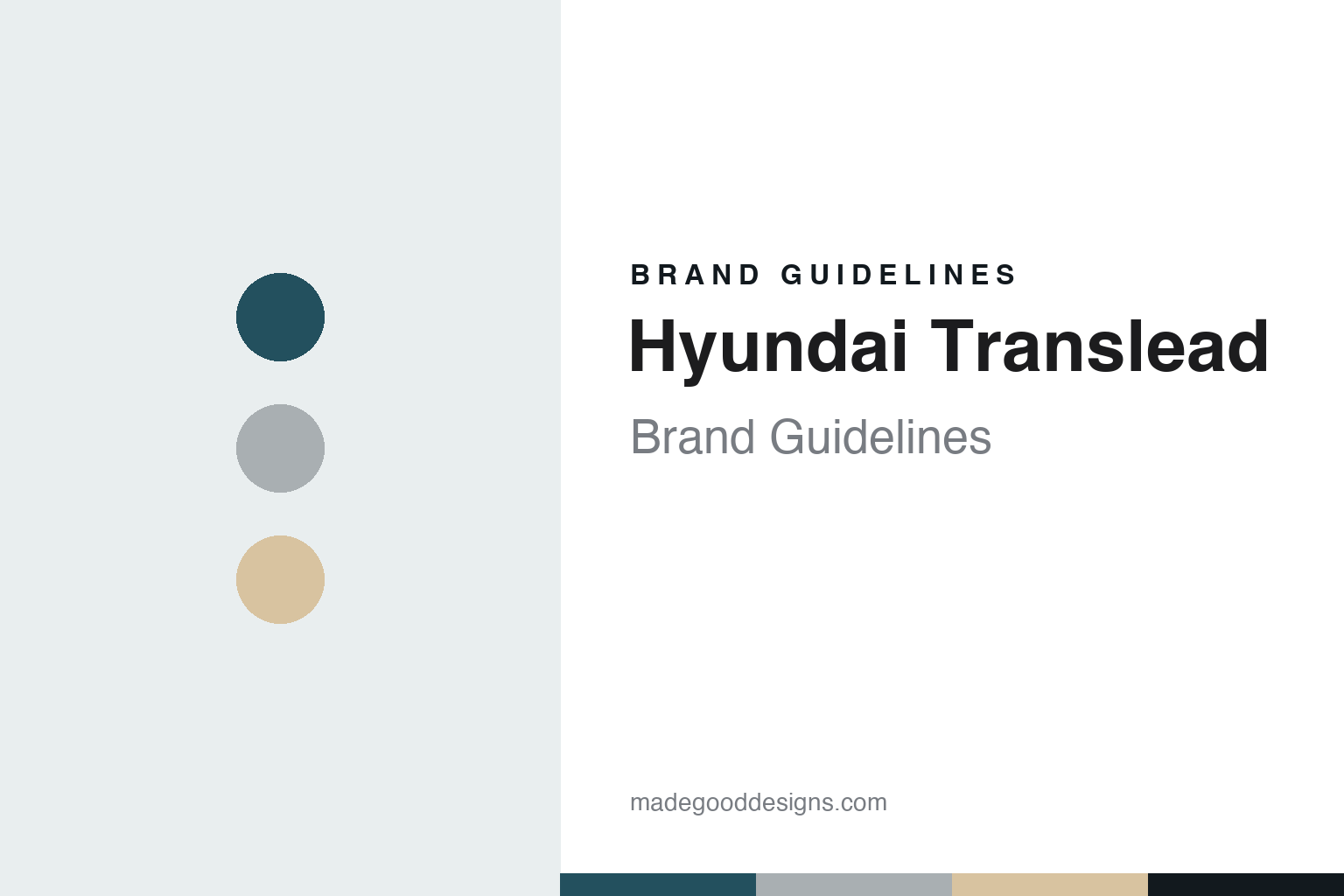
Hyundai Translead Brand Guidelines
A Korean carmaker’s San Diego subsidiary that builds North American vans in Baja California.
Aa
Two constants: a harbour teal, galvanized grey and Baja sand palette and a grotesque sans register. Abstract homage — not a Hyundai Translead product or mark; no trailer, logo or nameplate is reproduced.
A San Diego subsidiary
Containers, chassis and a border-straddling plant.
Hyundai Translead began in 1989, when Hyundai Motor Company of South Korea moved into transportation equipment by setting up a subsidiary in San Diego, California, called Hyundai Precision America Incorporated, the company says. Its first products, which the company dates to 1991, were steel containers and container chassis. From the start the business straddled the border: Trailer/Body Builders described it in 2001 as a company with its headquarters in San Diego and its plant in Tijuana, Mexico, owned by a Korean corporation and supplied by Americans.
Van trailers followed. The company says it introduced dry van trailers in 1994 and became the first North American trailer maker to earn ISO 9001 certification; Trailer/Body Builders wrote in 2007 that the firm had held ISO 9001 since 1996. Refrigerated vans came next, with the ThermoTech range, which the company dates to 1999. By 2001 the Tijuana plant built refrigerated and dry-freight containers, container chassis, and refrigerated and dry-freight van trailers, including a thin-wall sheet-and-post van and a new plate trailer, Trailer/Body Builders reported. It added that the plant had produced 25,000 containers in 2000 and was making between 80 and 90 container chassis a day.
The magazine also caught the business in an expansive mood. In 2001, while much of the trailer industry was going through a difficult period, Hyundai bought two of its outside suppliers, adding 500 people and bringing employment to 2,400, and set up its own fabrication shop so that it could make about 90 percent of the fabricated parts it needed. Its production managers told the magazine that an assembly line could be converted from containers to van trailers in about an hour, by swapping the first assembly jig much as a die is changed in a press.
Colour
A new name and an automotive way of building.
The present name arrived in 2001. Trailer/Body Builders reported that year that the change from Hyundai Precision America followed changes in the parent company, and that Hyundai Translead is a blend of the words “transportation” and “leadership.” It described the firm as a wholly owned subsidiary of Hyundai Motor Company, the maker of Hyundai cars, and English Wikipedia’s article on Hyundai Motor Company still lists Hyundai Translead as the group business that makes semi-trailers for the North American market.
The parent’s car plants shaped the way the trailers are built. In 2007 Trailer/Body Builders visited a new 154,000-square-foot building, the H line, on the Tijuana complex, which by then covered just over 200 acres. Designed to produce 50 dry vans and domestic containers a day, it drew its tooling, jigs and fixtures from Hyundai and its suppliers in Korea. The magazine noted what the line left out: no robots, no conveyor and no forklifts, with carts moving each trailer from station to station and subassemblies such as walls and floors built beside the line. Because the workforce spoke English, Spanish, Korean and, in some cases, indigenous languages from southern Mexico, training relied on graphics, icons and pictures.
A second plant followed in Rosarito, about 40 minutes south-west of the Tijuana plant. Trailer/Body Builders reported in 2017 that ground was broken in November 2015 on a 350-acre site, that the 548,000-square-foot plant was in pre-production by August 2016, and that it was producing 120 composite and sheet-and-post trailers a day with 2,400 employees. Hyundai’s automotive engineers worked with Translead’s engineers on the layout, and tooling came from machine builders in Korea, China and Spain; welding and painting stayed at the Tijuana plant. By the magazine’s own annual survey, the company had risen from 13th place among North American trailer makers in 1997 to second in 2016.
Typography
Trailers on the road.
Truck trailer makers sell a product that spends its working life on the road, and much of their imagery starts there: a long semi-trailer seen side-on on a motorway, a curtainsider rounding a bend, a tipper on a building site. The trailer is often the largest flat surface in a fleet, so the maker’s own name tends to sit small, on a plate, a mudguard or the front wall, while the customer’s livery fills the sides.
Bodies set the look of each category. Refrigerated box trailers are usually shown in plain white, with a cooling unit on the front wall, because the panels are built to be clean and easy to brand. Curtainsiders carry printed fleet colours on their sliding sides. Tippers are shown with their steel or aluminium bodies raised, and low-loaders with a heavy load chained down.
Factory photography is the second register. Makers show lines of bare chassis waiting for axles, paint and coating halls, sandwich panels being bonded and finished trailers parked in rows outside the plant. Product names tend to be short codes or coined words that sort ranges by body type, which helps fleets order the same specification year after year.
The third register is the trade fair and the dealer yard. IAA Transportation in Hanover and similar shows give makers a stand where new chassis, lighter bodies and telematics are lined up for fleets and the trade press. Dealers, rental firms and used-trailer centres then carry the brand into regional markets, where the customer is usually a haulier, a fleet manager or a logistics buyer rather than a member of the public.
Aa
A grotesque sans for a coined compound name. (Specimen set in Archivo, a sans STAND-IN; NOT the Hyundai Translead logo.)
Hyundai Translead
Composite vans, galvanized steel and a hydrogen truck.
Hyundai Translead tells its recent story through range names and firsts it claims for itself. The company says it introduced the HT Composite and HT Composite XT dry vans in 2007, became the first North American manufacturer to offer hot-dipped galvanization as a standard feature in 2013, and became the number one trailer manufacturer in North America in 2017. Its current dry van range runs from the Original and HY-Cube to the Composite models and the HT-X, which it introduced in 2026 with a ten-year warranty, alongside the ThermoTech reefer, the Latitude flatbed and converter dollies. It says it opened an innovation lab, the iLab, in 2022, and in a March 2024 release marking 35 years, chief executive Sean Kenney credited the firm’s dealers with building the brand.
The brand has since stretched beyond trailers. The company says it launched the Anza truck body in 2025 and the Juneau refrigerated truck body in 2026. In October 2025 Hyundai Motor Company appointed Hyundai Translead as the official distributor of its XCIENT Fuel Cell heavy-duty trucks in North America, Trailer/Body Builders reported. Transport Topics wrote in November 2025 that the company, “broadly known as a trailer manufacturer,” expected to ship between 50 and 100 of the hydrogen tractors to the United States in 2026, through its dealer network from early that year, and that the trucks would continue to be built at Hyundai’s Jeonju plant in South Korea. Its trailer plants are in Tijuana and Rosarito, in Baja California, and its head office is in San Diego.
For a design guide, Hyundai Translead shows how a carmaker’s subsidiary can carry the parent’s name while coining its own second word, and how plain range names such as Composite, ThermoTech and Latitude describe what each trailer does. Compare Wabash, the Indiana van maker, and Great Dane, another North American builder of dry vans and reefers. For this guide we use a harbour teal, galvanized grey and Baja sand with a grotesque sans, an unofficial interpretation; no product or logo is reproduced.
Explore & save
Keep Hyundai Translead’s identity on hand — save it to a board in the Made Good inspiration library.
Hyundai Translead identity set
Pin the harbour teal, galvanized grey and Baja sand palette and the grotesque sans register to your own board.