Utility Trailer Brand Guidelines
A Phoenix lumber business, a trailer from Los Angeles and a century of Bennetts.
Aa
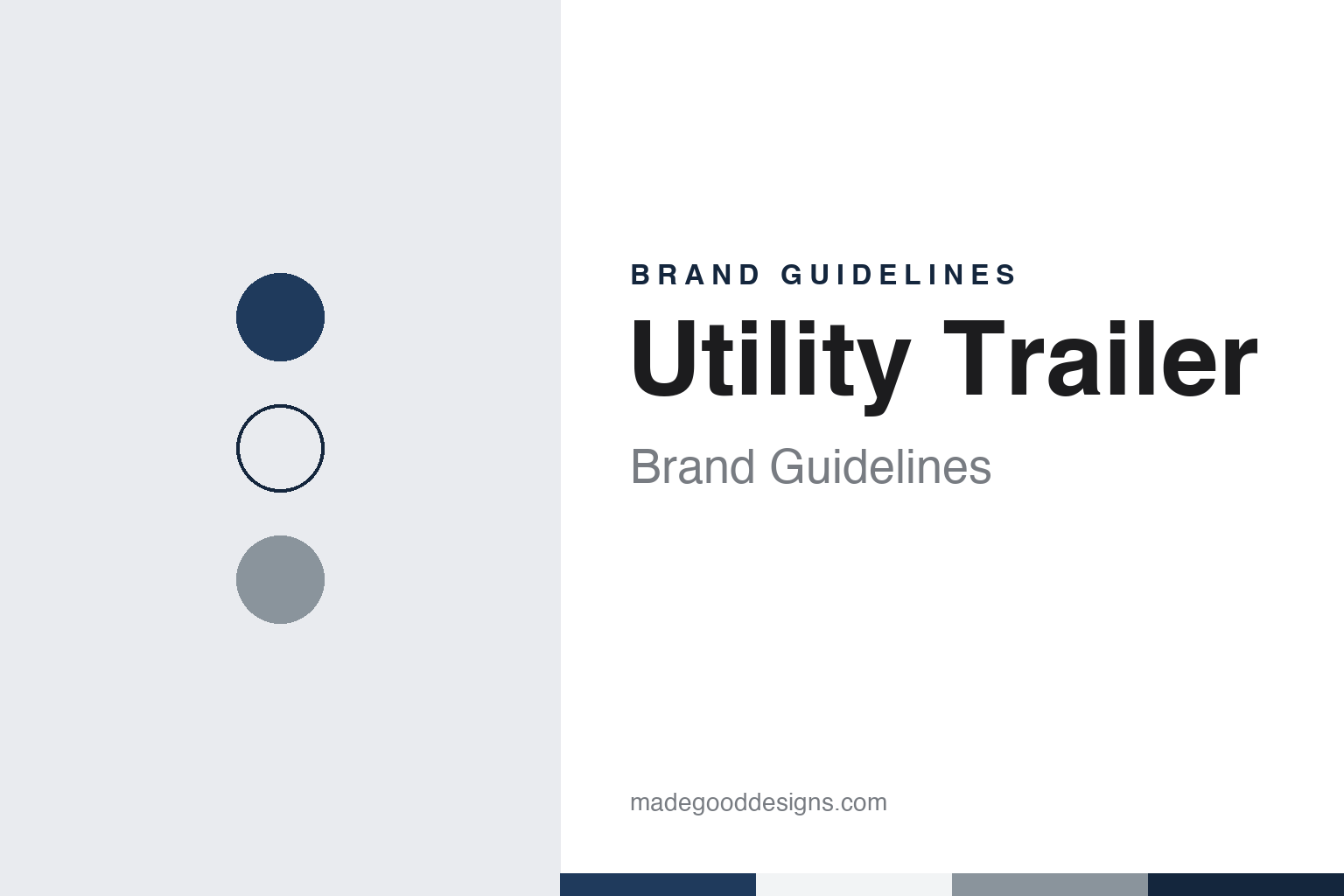
Two constants: a highway blue, reefer white and steel grey palette and an industrial sans register. Abstract homage — not a Utility Trailer product or mark; no trailer, logo or nameplate is reproduced.
From lumber to trailers
Two brothers, a load of lumber and a move to Los Angeles.
Utility Trailer Manufacturing Company was founded in 1914 by the brothers H. C. and E. W. Bennett, English Wikipedia says. The family’s own telling of the story was given by Craig Bennett, then senior vice president of sales and marketing, in a 2014 interview with Heavy Duty Trucking. His grandfather and great-uncle ran a retail lumber business in Phoenix, Arizona, when a man arrived from Los Angeles hauling lumber on a trailer behind his vehicle; seeing that he carried twice as much, the brothers asked where the trailer came from, bought the company and moved to Los Angeles. English Wikipedia describes the purchase as the assets of a Los Angeles wagon company.
The name came from the customers. According to English Wikipedia, the company adopted “Utility” because most of its early clients were California’s original utility companies. In its first decades it built to order: in the same interview Craig Bennett recalled cattle trailers, lowbeds, tank trailers and even a trailer built to carry a frozen sperm whale that toured as a travelling show from the late 1960s. Utility now calls itself “The First Name in Trailers” on its website.
Refrigeration became the core of the business. The first Utility reefers, Craig Bennett told Heavy Duty Trucking, were insulated with spun glass and cooled by a bunker of ice at the front; mechanical refrigeration units followed, and in the 1970s the company learned to apply polyurethane foam, a material then used in the aircraft industry, to truck trailers. English Wikipedia says the company stayed in the western United States until the 1960s, when it began to expand east of the Rocky Mountains, and that by the mid-1990s most of its business was on the East Coast.
Ownership has stayed with the founders’ descendants. English Wikipedia says the company has remained in the Bennett family since 1914; in June 2014 Refrigerated Transporter, writing on the centenary, described Craig Bennett as part of the third generation to run the family-owned business.
Colour
Reefers, dry vans and flatbeds.
Utility’s signature product is the 3000R refrigerated trailer. In 2014 Craig Bennett told Heavy Duty Trucking that it had been the best-selling refrigerated trailer in North America for 20 years, and that the company had built a new factory in Virginia in the late 1990s and redesigned the trailer from a clean sheet, replacing the earlier 2000R. In February 2020 FleetOwner described Utility as the top-selling reefer manufacturer since 1994; English Wikipedia calls it the largest maker of refrigerated van trailers in the United States.
The rest of the range covers dry freight and open loads. FleetOwner listed the 4000D-X Composite and 4000D dry vans, the 4000AE, 4000S and 4000AE Drop Deck flatbeds, and a curtainsided trailer sold as the Tautliner. On its website the company also offers trailer telematics under the name UTILITY TrailerConnect, and aerodynamic devices for its trailers.
Production is spread across North America. In February 2020 FleetOwner reported six trailer plants: reefers at Marion, Virginia, Clearfield, Utah and Piedras Negras, Mexico; dry vans at Glade Spring, Virginia and Paragould, Arkansas; and flatbeds and curtainsiders at Enterprise, Alabama. English Wikipedia names the Virginia reefer plant as Atkins, near Marion, and dates the Clearfield plant to 1993, Atkins to 1994 and Glade Spring to 1999, citing local newspapers of those years.
Testing is part of the story the company tells. Craig Bennett told Heavy Duty Trucking in 2014 that Utility ran its own test track, first a dirt track at the City of Industry factory and later a concrete one at Rancho Cucamonga, where trailers were twisted, struck with forklifts and thermally tested. For its centenary the company built a museum trailer with photographs and a documentary film, shown at the Mid-America Trucking Show in 2014 before a national tour, Refrigerated Transporter reported.
Typography
How trailer makers present themselves.
Truck trailer makers sell a product that spends its working life on the road, and much of their imagery starts there: a long semi-trailer seen side-on on a motorway, a curtainsider rounding a bend, a tipper on a building site. The trailer is often the largest flat surface in a fleet, so the maker’s own name tends to sit small, on a plate, a mudguard or the front wall, while the customer’s livery fills the sides.
Bodies set the look of each category. Refrigerated box trailers are usually shown in plain white, with a cooling unit on the front wall, because the panels are built to be clean and easy to brand. Curtainsiders carry printed fleet colours on their sliding sides. Tippers are shown with their steel or aluminium bodies raised, and low-loaders with a heavy load chained down.
Factory photography is the second register. Makers show lines of bare chassis waiting for axles, paint and coating halls, sandwich panels being bonded and finished trailers parked in rows outside the plant. Product names tend to be short codes or coined words that sort ranges by body type, which helps fleets order the same specification year after year.
The third register is the trade fair and the dealer yard. IAA Transportation in Hanover and similar shows give makers a stand where new chassis, lighter bodies and telematics are lined up for fleets and the trade press. Dealers, rental firms and used-trailer centres then carry the brand into regional markets, where the customer is usually a haulier, a fleet manager or a logistics buyer rather than a member of the public.
Aa
An industrial sans for a working fleet. (Specimen set in Archivo, a sans STAND-IN; NOT the Utility Trailer logo.)
Utility Trailer
A family business with a German partner.
Utility’s headquarters are in the City of Industry, in Los Angeles County, with a sales office in Alpharetta, Georgia and a parts distribution centre in Batavia, Ohio, according to English Wikipedia. The company sells through independent dealers; English Wikipedia counts more than 100 locations in the United States, Canada, Mexico and South America.
In September 2023 Utility formed a joint venture with the German trailer maker Schmitz Cargobull, called Cargobull North America. Schmitz Cargobull’s press release said the partners had developed two transport refrigeration units, the 625 Hybrid and the 655 MT, based on its S.CU unit and fitted with its TrailerConnect telematics, and that both would debut at the IFDA Distribution Solutions conference in Fort Worth, Texas, that month, with the grocer Kroger as the first customer on Utility’s 3000R trailers. In the same release Utility’s president and chief executive Jeff Bennett said the company wanted to be “the best, holistic destination for everything reefer customers need.” Truck & Bus Builder reported in October 2023 that the venture covered hybrid and fully electric refrigerated trailers for North America. Utility’s website now offers Cargobull 625+ and 655MT+ hybrid units alongside its own trailers.
The partnership links two family-owned trailer makers from opposite sides of the Atlantic. Schmitz Cargobull’s release said both companies rely on a family-company culture, and in 2020 Craig Bennett described Utility to FleetOwner as a family company producing trailers since 1914.
For a design guide, Utility Trailer shows how a long family history and a single signature product can carry a brand in a market of fleets and dealers. Compare Schmitz Cargobull, its joint-venture partner, and Great Dane, another American trailer maker. For this guide we use a highway blue, a reefer white and a steel grey with a sans, an unofficial interpretation; no product or logo is reproduced.
Explore & save
Keep Utility Trailer’s identity on hand — save it to a board in the Made Good inspiration library.
Utility Trailer identity set
Pin the Utility Trailer highway blue, reefer white and steel grey palette and the industrial sans register to your own board.