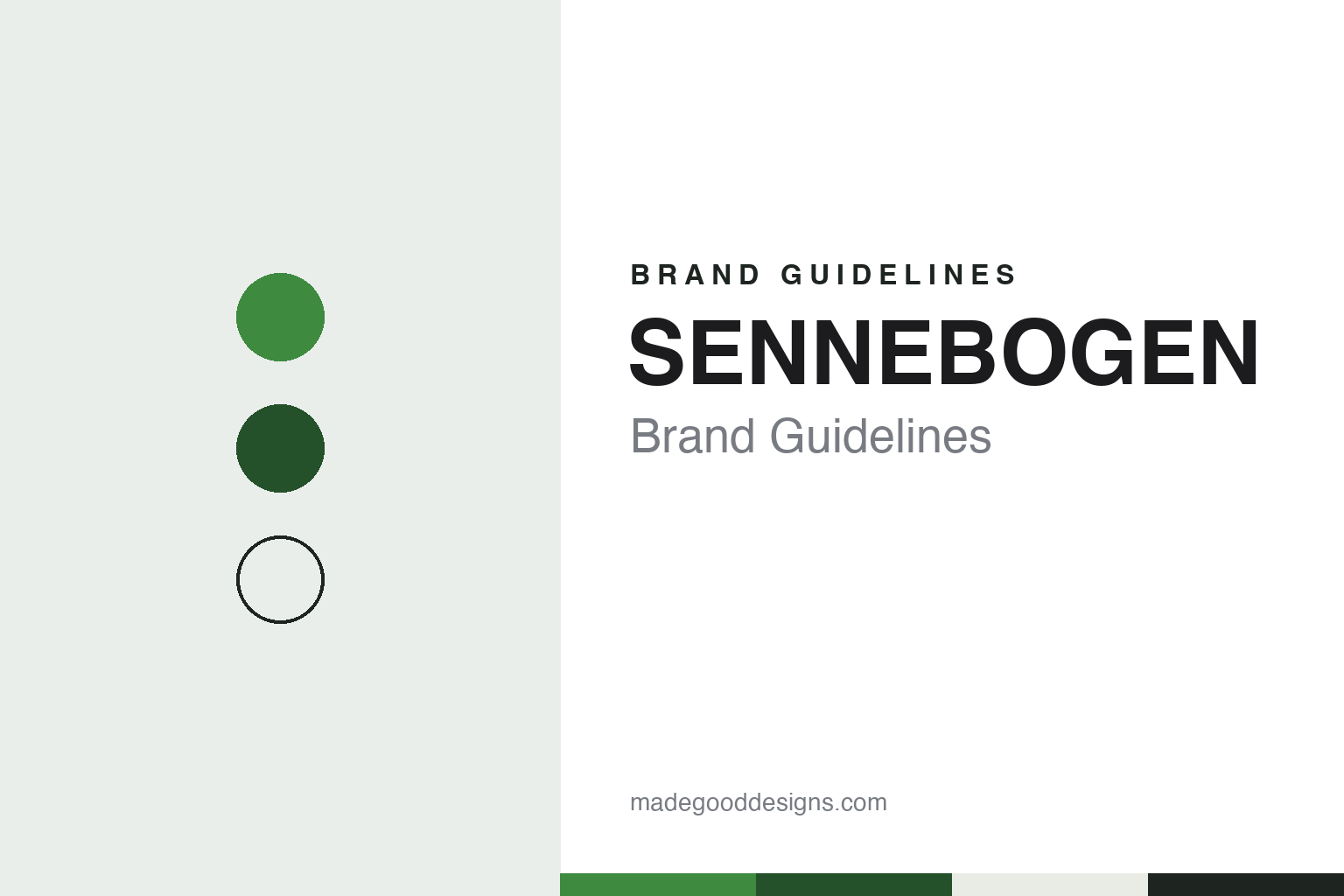
SENNEBOGEN Brand Guidelines
Straubing’s green family crane and material handler maker.
Aa
Two constants: a SENNEBOGEN green palette and a condensed capitals register. Abstract homage — not a SENNEBOGEN product or mark; no machine, logo or nameplate is reproduced.
From farm machines to cable excavators
A 21-year-old, a manure loader and a plant by the station.
SENNEBOGEN began in 1952, when Erich Sennebogen, then 21, set up a business at Pilling, near Straubing in Lower Bavaria, to make agricultural machinery. Both the company and German Wikipedia give that year and that age, and the recycling trade magazine recovery, writing for the company’s 65th anniversary in 2017, noted that the original Pilling site lies only a few kilometres from today’s Straubing plants.
The first mobile machine was the S 500, which German Wikipedia describes as an early cable excavator used mainly to load manure on farms and to dig wells, built from 1954 to 1959. The company says its first mechanical cable excavators for the construction trade followed in 1957, and that fast growth led it to build a new plant beside the station in Straubing in 1959. By 1960, it says, the thousandth SENNEBOGEN excavator had left the works.
Hydraulics came next. The company says it developed its first hydraulic excavators from 1962 and put them into production in 1964. In 1969, according to both the company and German Wikipedia, it built the world’s first fully hydraulic cable excavator. Its hydraulically adjustable articulated boom, known as GAUH, is dated 1980 by the company and 1984 by German Wikipedia.
The firm also worked with larger partners. German Wikipedia records a sales cooperation with Weserhütte on cable excavators and cranes from 1977 to 1987, and a joint venture of SENNEBOGEN, Zeppelin, Caterpillar and Eder, the European Excavator Design Center, which built about 20,000 mobile hydraulic excavators at Wackersdorf between 1991 and 2005. A Wackersdorf plant of its own followed around the same time: the company dates it to 1990, German Wikipedia to 1991.
Colour
Material handlers, cranes and the quayside.
Today SENNEBOGEN calls itself a full-liner in cranes and material handling. Its catalogue runs from telehandlers and telescopic cranes to crawler cranes, duty-cycle cable excavators and port cranes, with material handlers from 17 to 420 tonnes operating weight, the company says. In 1996 it grouped its material handlers into the green line series, and in 2012 it introduced an E-series with Electric Drive technology.
The port is one of its markets. The company says it entered the port mobile crane business in May 2017 with the SENNEBOGEN 9300, a mobile harbour crane for bulk and general cargo, and it now lists the 9300 E and the smaller 2200 under port cranes, with high-rise cabs for a view into a ship’s hold. At bauma 2019 it showed the 895 E, which it calls the largest material handler ever built.
Electric machines run through the range. In a 2022 interview with recovery, managing director Erich Sennebogen said the company had built mains-powered electric machines for more than 30 years, and described two battery-powered material handlers: the 19-tonne 817, first shown at IFAT 2022, and the 30-tonne 825, which made its battery debut at bauma that year after testing with the metals recycler CRONIMET.
Some partners sell or carry its work. German Wikipedia says SENNEBOGEN has supplied carrier machines to ABI since 1984, has worked with Manitowoc Grove on selling its crawler telescopic cranes in the American market since 2015, and since the end of 2019 has built the Fendt Cargo T955 telehandler for the farm machinery maker Fendt, a return of sorts to agriculture.
Recognition is mostly the company’s own account. SENNEBOGEN says its SR 28 crawler excavator received the Stuttgarter Designpreis at bauma 1986, and both the company and German Wikipedia say it received the Blauer Engel environmental label at bauma 1989 for a low-noise mobile material handler.
Typography
Design and documentation.
Port and terminal equipment is sold to a small, specialist audience: port authorities, terminal operators, shipping lines and the logistics firms that move containers inland. The makers’ own websites and brochures tend to show the machines at work rather than on their own, because scale is the point. A ship-to-shore crane is pictured with its boom reaching out over the stacked deck of a container ship; a gantry is shown against the quay it serves.
The smaller machines are presented in the same working settings. Straddle carriers appear in long rows between container stacks, reachstackers lift boxes at the edge of a yard, and terminal tractors pull trailers and chassis between the quay and the gate. Forklift trucks and empty-container handlers are photographed in timber yards, steel mills and inland depots as well as in ports, since the same makers sell to heavy industry and distribution.
Automation has added a second kind of picture. Alongside the machines, the pictures now include control rooms and screens, and a maker such as Kalmar lists automation systems and charging solutions as products in their own right. Kalmar says the first fully automated straddle-carrier terminal opened in Brisbane in 2005, and ZPMC lists automated terminals in Xiamen and Shanghai among its projects.
Delivery is part of the story too. Large cranes are often moved fully assembled by sea: ZPMC says its own fleet carries large products whole, and English Wikipedia says it ships cranes in a fully erected state, so a crane standing upright on a heavy-lift vessel is a familiar image in the trade. The guides in this group follow makers across Finland, Sweden, the Netherlands, Germany, France, the United States and China, and set out what each company says about itself alongside what independent sources record.
Aa
Condensed capitals — a long family name set in upper case. (Specimen set in Barlow Condensed, a sans STAND-IN; NOT the SENNEBOGEN logo.)
SENNEBOGEN
The green family company.
SENNEBOGEN has stayed in the family. recovery wrote in 2017 that it “is and remains a family company,” run by Erich and Walter Sennebogen, the second generation of the founding family, and the company names the two brothers as its owners today. Its history page says the third generation began joining the business from 2017, and German Wikipedia counts at least four family members among seven managing directors as of August 2026. The parent company is Erich Sennebogen Holding GmbH & Co. KG in Straubing, according to German Wikipedia.
The machines are made in Bavaria and Hungary. The company says it develops and builds them at five Bavarian sites and two plants in Hungary; German Wikipedia lists plants I and II in Straubing, plants III and IV in Wackersdorf and a customer service centre at Steinach, with steel and welding work at Balatonfüred, which SENNEBOGEN took over and modernised in 1996, and at Litér. Sales subsidiaries followed in Stanley, North Carolina, in 2000 and Singapore in 2009, the company says. Its own line for this is “Quality made in Germany”.
Colour is the clearest part of the identity. The company calls itself “the green family company from Straubing,” recovery described its products in 2017 as “the green cranes and material handlers,” and the company’s history marks a “Go for Green” motto launched at bauma 2010 and a stand at bauma 2013 that it called the “green heart” of the fair. It also keeps a founder’s motto from 1963, “Geht nicht, gibt’s nicht” (“there’s no such thing as can’t”), and since 2019 the claim MOVE BIG THINGS. For its 60th anniversary in 2012 it used a special logo in which, it says, stones stood for dealers and service partners and gems for its plants and subsidiaries. The name itself is written in capitals, SENNEBOGEN, across its materials.
For a design guide, SENNEBOGEN shows how one colour, held across machines, fairs and slogans, can carry a family name through seven decades. Compare Liebherr, a family-owned crane maker founded in Germany, and MAFI, a German port vehicle maker. For this guide we use a mid green, a forest green and steel greys with a condensed sans, an unofficial interpretation; no product or logo is reproduced.
Explore & save
Keep SENNEBOGEN’s identity on hand — save it to a board in the Made Good inspiration library.
SENNEBOGEN identity set
Pin the SENNEBOGEN green palette and the condensed capitals register to your own board.